Hot Water On-Demand Timer Calculator
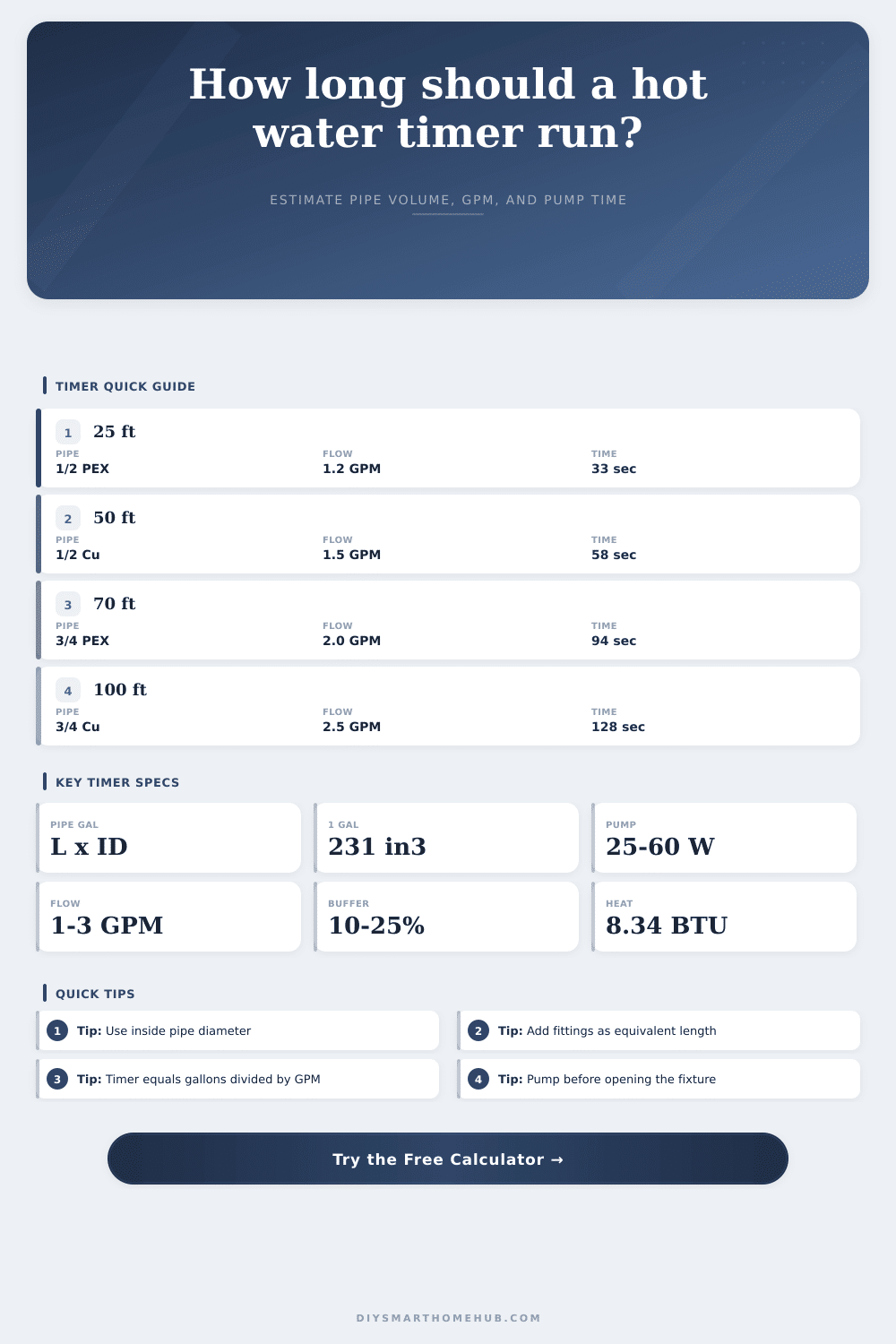
Estimate how long an on-demand recirculation pump should run from fixture distance, pipe inside diameter, flow rate, purge volume, pump watts, timer buffer, and daily water and heat volume.
Hot water timer formula breakdown
| Pipe type | Approx inside diameter | Gallons per 100 ft | Timer note |
|---|---|---|---|
| 3/8 in PEX branch | 0.350 in / 8.9 mm | 0.50 gal | Small lavatory branches purge quickly |
| 1/2 in PEX branch | 0.475 in / 12.1 mm | 0.92 gal | Common modern fixture branch size |
| 1/2 in copper branch | 0.545 in / 13.8 mm | 1.21 gal | Slightly more volume than 1/2 in PEX |
| 1/2 in CPVC branch | 0.485 in / 12.3 mm | 0.96 gal | Close to 1/2 in PEX volume |
| 3/4 in PEX trunk | 0.671 in / 17.0 mm | 1.84 gal | Long trunks often control timer length |
| 3/4 in copper trunk | 0.785 in / 19.9 mm | 2.40 gal | Large volume needs more run time |
| Pump path | Typical flow | Typical watts | Timer behavior |
|---|---|---|---|
| Under-sink cold-line return | 0.8 to 1.6 GPM | 25 to 40 W | Allow extra seconds for crossover valve response |
| Dedicated return loop | 1.0 to 3.0 GPM | 25 to 60 W | Use the full loop volume when heating both legs |
| Tankless demand pump | 0.6 to 1.5 GPM | 35 to 70 W | Keep above the heater activation flow if required |
| Small branch circulator | 0.5 to 1.2 GPM | 10 to 25 W | Best for short point-of-use branches |
| Whole-house demand button | 1.5 to 3.5 GPM | 45 to 90 W | Long trunks need equivalent length allowance |
| Fixture run | Distance | Likely pipe | Planning timer |
|---|---|---|---|
| Powder room near heater | 20 to 30 ft | 3/8 or 1/2 in branch | Often under 45 seconds |
| Kitchen at opposite wall | 45 to 70 ft | 1/2 in branch after trunk | Commonly 60 to 120 seconds |
| Second-floor shower | 60 to 90 ft | 1/2 in branch plus 3/4 in trunk | Equivalent length matters |
| Primary bath at far end | 80 to 120 ft | Long trunk and branch mix | Use buffer and measured arrival |
| Dedicated return loop | 100 to 180 ft loop | 3/4 trunk, 1/2 return | Loop volume controls cycle |
The kitchen faucet has been running cold for roughly forty seconds when it finally gets hot and you can stand there at the sink waiting for it. That’s not just random: physics explains why cooled water remains trapped in pipe between your heater and the faucet. Fixing this issue involves an on-demand timer system which pushes that cold water out first before you turn the handle.
How do we get this timing correct? Running the pump for too short a time mean lukewarm water; running it for too long wastes energy, since it’s circulated heated water back into the tank. Solving this requires measuring actual volume inside those pipes rather than trusting what is written on labels.
How to Fix Cold Water Waiting Time
What is the typical volume of water in a half-inch pipe? Most folks think it’s a half inch, right? But in fact CPVC, copper, and PEX pipes has very different inside diameters. A half-inch copper pipe carries significantly more water then an equal-length half-inch PEX pipe. That means a nearly thirty-percent change to the size of the purge volume.
Thankfully, the calculator does all that calculation for you when you enter the exact distance and pipe material, eliminating guesswork about coefficients or conversions (cubic inches to gallons). Since water does not follow a perfectly straight line, you must measure true path of the water flow. Water goes up walls, down into crawlspaces, around joists, etc. Each bend adds not only extra length but also additional resistance.
To account for that real-world factor, there’s a simple multiplier for fittings, but if you didn’t include one your timer could shut off before the hot water reaches the valve. Additionally, the system relies on flow rate because small recirculation pumps typically has difficulty maintaining pressure along longer runs. Adding a few seconds will not do anything if the pump can’t push enough water through the pipe in that time period. So, instead of setting the timer for the maximum flow listed on the box (rated peak flow), you must set it to match actual flow being delivered.
Finally, there is one more heat factor to consider. Every gallon of water you recirculate is a gallon of hot water that you paid for via your utility bill. The energy used to heat that water is lost when it returns to the heater or sits in the pipe cooling down again. In this way, it’s a tradeoff between electrical consumption versus water waste. It makes perfect sense if you really care about having instant hot water, but less so if you never use the far-flung bathroom.
To put this decision in context, consider that if you use a fixture eight times a day then its convenience value is pretty high; but perhaps it’s only used once a week, so a timer would of been overkill. Because sensors aren’t instantaneous, there will always be a delay from when the sensor registers temperature change until the pump responds. Add some buffer to your timer setting to accommodate this lag. A 10-25% buffer ensures that the pump will run long enough to compensate for the sensor lag time. Better to overshoot by two seconds than undershoot by five.
If you overshoot, you’ll have immediate access to hot water; if you undershoot, you’re still waiting. You’re making something reliable, not perfect. You want something to work when it’s needed, rather than frustrating the user just to save a tiny bit of energy. Take measurements of your pipes; make sure you measure inside diameter! Know how many bends there are, set the timer, and get back on with your day. The few seconds you’ve saved add up to a full year. Enjoy hot water without waiting, again.