Hose Bib Flow Watering Time Calculator
Estimate watering runtime from a real bucket-test GPM, the target gallons needed for area and depth, hose pressure loss, and the nozzle flow that actually reaches the bed or lawn.
Detailed watering breakdown
| Nozzle type | Rated flow | Rated pressure | Application efficiency |
|---|---|---|---|
| Watering wand shower head | 2.2 GPM | 30 psi | 90% on beds and planters |
| Fan spray nozzle | 3.0 GPM | 35 psi | 82% with careful overlap |
| Oscillating lawn sprinkler | 4.0 GPM | 35 psi | 70% with wind and edge loss |
| Rotary sprinkler | 3.5 GPM | 40 psi | 76% with matched arcs |
| Soaker hose loop | 1.2 GPM | 20 psi | 92% near root zone |
| Impact sprinkler head | 5.0 GPM | 45 psi | 68% with throw losses |
| Drip manifold from hose bib | 0.8 GPM | 25 psi | 95% at emitters |
| Open-end hose discharge | 9.0 GPM | 25 psi | 78% for basin filling |
| Watering depth | Gallons per 100 sq ft | Gallons per 500 sq ft | Typical use case |
|---|---|---|---|
| 0.25 in | 15.6 gal | 77.9 gal | Seedling mist, heat refresh, shallow containers |
| 0.50 in | 31.2 gal | 155.8 gal | Light turf watering or established shrubs |
| 0.75 in | 46.7 gal | 233.6 gal | Moderate garden bed irrigation |
| 1.00 in | 62.3 gal | 311.5 gal | Deep lawn or vegetable bed watering |
| 1.50 in | 93.5 gal | 467.3 gal | Dry soil recovery or new plant establishment |
| Hose setup | Flow checked | Estimated loss | Runtime impact |
|---|---|---|---|
| 50 ft of 5/8 in hose | 4 GPM | About 2 psi | Small change for most nozzles |
| 100 ft of 5/8 in hose | 6 GPM | About 14 psi | Noticeably lowers sprinkler throw |
| 100 ft of 1/2 in hose | 5 GPM | About 28 psi | Runtime may rise sharply |
| 100 ft of 3/4 in hose | 6 GPM | About 4 psi | Better for high-flow watering |
| Project | Area | Depth target | Target gallons |
|---|---|---|---|
| Patio herb containers | 24 sq ft | 0.5 in | About 7.5 gal |
| Two raised vegetable beds | 128 sq ft | 1 in | About 80 gal |
| Foundation shrub strip | 180 sq ft | 0.75 in | About 84 gal |
| New sod repair patch | 250 sq ft | 0.5 in | About 78 gal |
| Front lawn sprinkler zone | 450 sq ft | 1 in | About 280 gal |
If you have A HOSE, you are like most gardeners: You don’t really know when you’re making a mess of that sidewalk, or helping the plants, either, in the process. Are you watering long enough? Is an hour too much, or would ten minutes do? Guess what? Your guess is probably wrong when it comes to how long to water.
Human beings aren’t very good at measuring surface area versus volume; we can look at wet grass and think it must be soaked all the way down, yet what’s happening just beneath the surface may be nothing but a wet top inch with dry roots beneath. Calculating what to do instead of guessing will not only save money on your water bill, but improve plant health, too.
How to Water Your Garden Correctly
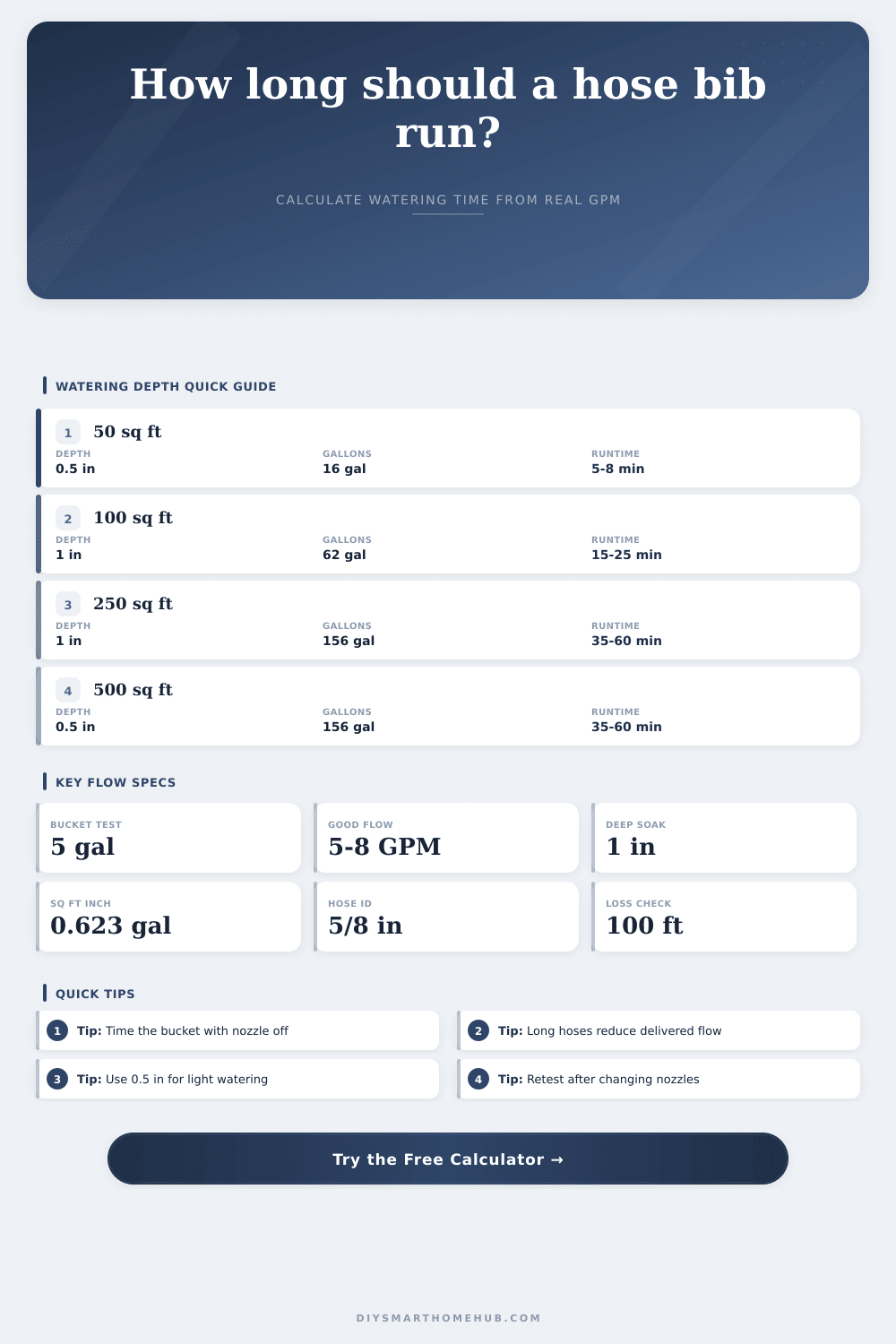
To do this, simply input your target area size and results from the bucket test into the calculator (above) and let it crunch numbers for you. No need to guess the flow rate visually. Measuring what spills out of your spigot should be done first. Time how long it takes to fill a known container (such as a five-gallon bucket). This gives you your true gallons per minute before any hose friction or nozzle restriction take their toll.
It’s common for most folks to think their house pressure is uniform throughout, but elevation changes, pipe diameter and length all affects the flow rate. Sometimes a tap on one side roars while another in the back trickle. Testing the actual source are required if you want an accurate estimate.
The other variable is what kind of hose you use. Again, physics is your enemy here. Pressure drop as water travels through a narrow hose, especially a long one. Fifty feet of a five-eighths-inch-diameter hose sounds reasonable enough; a hundred feels like too much stretch and result in substantial psi lost by the time it gets to the nozzle end. To make up for this, the tool will take into account known engineering calculations to reduce your calculated max flow to reality. And if you’re relying on a quarter-inch-thin soaker hose to feed vegetables, you’ll lose even more along the way compared than a heavy-duty irrigation line.
There’s also the issue of watering what ground really requires: How deep do you wish to wet things? In general, about an inch of water every week is what most garden bed and established lawn need during hot weather. For a 100-square-foot area, that would be about sixty-two gallons. That doesn’t sound like much, until you consider that if you use that amount by spraying it on quickly, not much will reach the root zone.
Different types of equipment work with different levels of efficiency. A wind-blown oscillating sprinkler will shoot thirty percent or more into air or onto your driveway. A handheld wand can be very efficient since you’re aiming it just where you want it. As the reference chart on the page indicates, different tools requires different amounts of runtime to soak the soil equally well. Now choose your run time accordingly. Keeping in mind that minutes can multiply if your area is really big, or your pressure not-so-high.
It is better to use a shorter run time more often, say twice or three times weekly, than to water everything at once and create runoff, which defeats the purpose of watering in the first place. The other factor is soil type. Clay retains moisture longer. Sandy soils drains rapidly and require repeated lighter applications. They also benefit from deep soaking once in a while instead of shallow watering multiple times a day.
Run your numbers through the calculator for the starting point, then eyeball and go with your trowel for the last check. Does it puddle on top? Turn it off and let it absorbs, then come back later. In truth, how much water you give matters far more different than when you give it. It’s a matter of volume, not timing. It comes back to the fact that you’re giving so many resources over so many square feet. A few minutes’ time spent figuring out your rate of flow could of help you stop guessing, then you’ll be able to garden precisely, rather than haphazardly, which benefits both your plants and your wallet.