Grow Light Photoperiod Calculator
Calculate grow-light hours from canopy PPFD, crop-stage DLI targets, dimming percentage, uniformity, canopy area, fixture power, and smart timer limits.
🌱Photoperiod presetsPick a crop-stage profile, then fine-tune the light.
⚙Calculator inputsEffective PPFD includes dimming and uniformity.
💡Current setup specsLive values from the calculator.
Photoperiod results
📊Crop-stage comparison gridUse as a sanity check for DLI and photoperiod.
Starts and clones
Typical DLI 4-8 with gentle PPFD. Longer days can work when the canopy reading is low and uniform.
Leafy greens
Typical DLI 10-17. Many indoor greens land well with 12-16 hours at moderate PPFD.
Herbs and vegetative
Typical DLI 12-22. Increase PPFD or hours gradually when growth is compact and healthy.
Flowering fruit crops
Typical DLI 20-35 or more. High DLI usually needs stronger PPFD, not only longer days.
📋Photoperiod reference tablesFormulas, targets, schedules, and canopy examples.
| Formula | Equation | Inputs | Use |
|---|---|---|---|
| DLI | DLI = PPFD x hours x 3600 / 1,000,000 | PPFD and photoperiod | Daily light delivered |
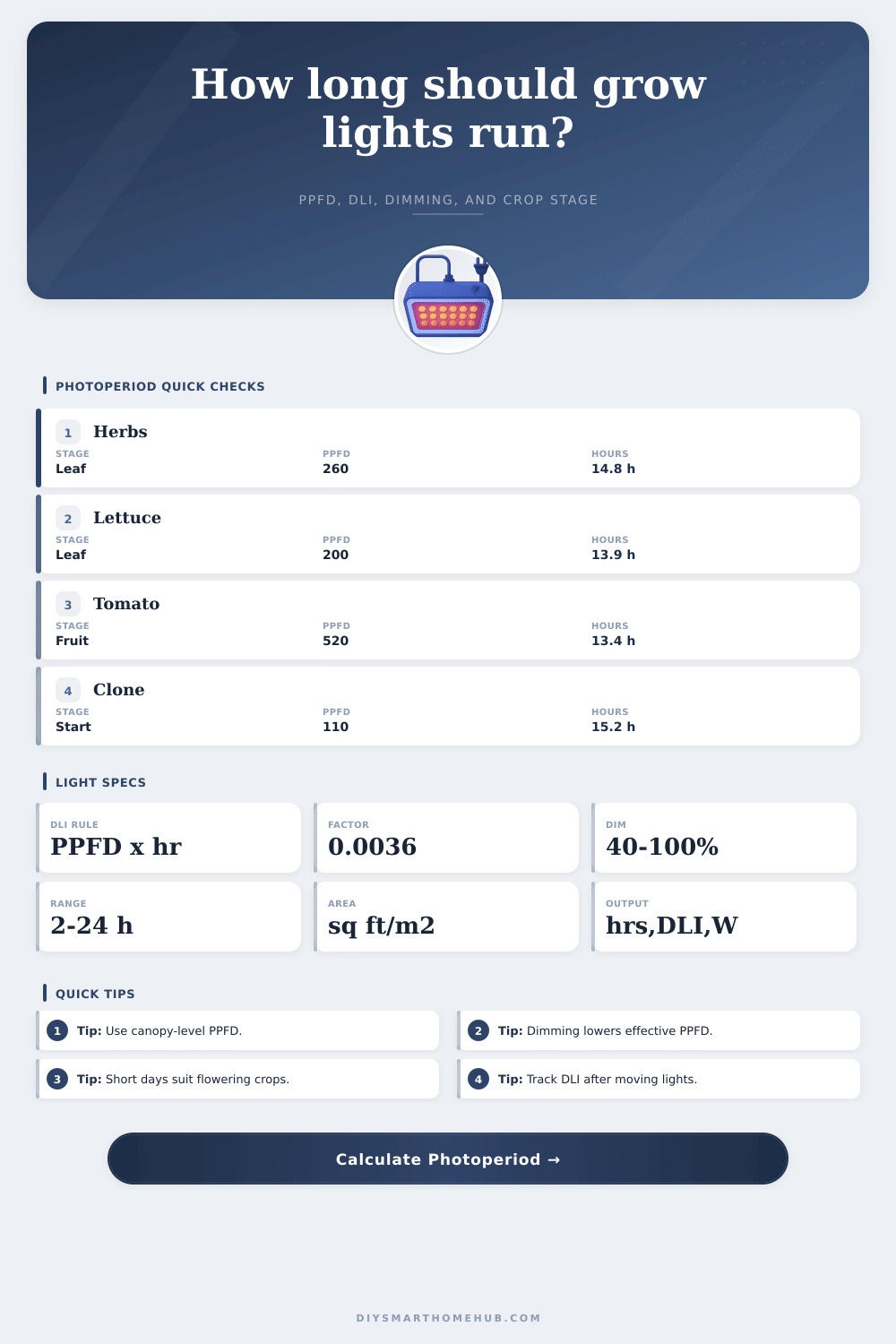
| DLI shortcut | DLI = PPFD x hours x 0.0036 | Same values | Fast calculator form |
| Photoperiod | hours = DLI / (PPFD x 0.0036) | Target DLI and PPFD | Timer hours needed |
| Dimming factor | effective PPFD = measured PPFD x dim x uniformity | Percent settings | Real canopy PPFD |
| Daily energy | kWh = watts x count x hours / 1000 | Fixture watts and count | Smart plug load estimate |
| Crop stage | DLI target | PPFD range | Common hours |
|---|---|---|---|
| Clone / germination | 4-8 mol/m²/day | 80-180 | 14-18 h |
| Seedling | 6-12 mol/m²/day | 120-250 | 12-18 h |
| Leafy greens | 10-17 mol/m²/day | 180-350 | 12-16 h |
| Herbs / veg | 12-22 mol/m²/day | 250-450 | 12-18 h |
| Fruit / flower | 20-35 mol/m²/day | 400-800 | 10-16 h |
| Schedule style | Best use | Watch item | Calculator cue |
|---|---|---|---|
| 10-12 hours | High PPFD fruiting or short-day crops | Strong light required | Higher PPFD per DLI |
| 12-14 hours | Balanced indoor shelves | Good daily rhythm | Usually efficient |
| 14-16 hours | Leaf crops, starts, herbs | Heat and dryback | Common grow rack window |
| 16-18 hours | Low PPFD fixtures | Limited dark period | Use for gentle lights |
| 18+ hours | Very low PPFD recovery | May be unrealistic | Raise PPFD if possible |
| Canopy example | Area | Target DLI | Planning note |
|---|---|---|---|
| Seed tray | 2 sq ft / 0.19 m² | 6 | Low PPFD is usually enough |
| Kitchen herbs | 4 sq ft / 0.37 m² | 14 | Moderate PPFD, longer timer |
| Lettuce rack | 8 sq ft / 0.74 m² | 10-14 | Uniformity matters across shelves |
| 2 x 4 tent | 8 sq ft / 0.74 m² | 14-25 | Dimming can tune each stage |
| 4 x 4 fruiting | 16 sq ft / 1.49 m² | 22-35 | Needs strong fixture output |
🧮Dimming and fixture checksHow PPFD changes when power changes.
| Dimmer setting | PPFD multiplier | Example from 400 PPFD | Photoperiod effect |
|---|---|---|---|
| 100% | 1.00 | 400 PPFD | Shortest hours for same DLI |
| 80% | 0.80 | 320 PPFD | Hours rise by about 25% |
| 60% | 0.60 | 240 PPFD | Hours rise by about 67% |
| 40% | 0.40 | 160 PPFD | May need a long timer window |
💡Photoperiod planning tips
This calculator estimates lighting schedules from PPFD and DLI. Plant response also depends on temperature, water, nutrients, spectrum, cultivar, and stress history.
Light’s treated by most indoor gardeners as an on/off switch, turn it on, water the plants, and hope for the best. It will work…until your tomatoes won’t set fruit or your lettuce goes pale. And while source of your light (brand, type of bulb, etc) may not be the issue, amount of light (length of time lit) almost always is.
You know plants need light. But how many? Few gardeners realize that plants requires a certain number of light particles during full day, not just a few hours. Enter: Daily Light Integral, or DLI. DLI is a measure of photosynthetically active radiation delivered to your plant canopy in a given 24 hour period. Think of it as their growth budget. It’s like feeding your plants, overfund it and they’ll burn; underfund them and they’ll starve.
What Is Daily Light Integral (DLI)?
Your lights’ specs is just numbers that don’t speak to biology until they’re plugged into something (like this) that turns that amount of light energy into usable time. The tool requires honest data. Most folks just plug their meters in the dead center of their grow tent and assume the entire canopy enjoys identical PPFD. It doesn’t. The sides is always darker. The calculator prompts you for a uniformity factor, that’s why. This is because it is true. Drop it from ninety to eighty percent (for example) if your light distribution isn’t even and watch: you’ll likely end up needing an extra hour or two of runtime. Does it sound slight? But it avoids the long stretch-out that kills compactness and therefore whole point of growing herbs.
The next topic is dimming. Moddern drivers allow you to dial back power, either to mitigate heat or to reduce stress on seedlings. Dimming a fixture by half doesn’t merely decrease its output; it doubles amount of time necessary to achieve the desired DLI level. It’s a time vs. It is an energy-cost equation. It is one or the other.
Not all plants need same budget (some are cheap feeders (lettuce), leafy greens) that do well on a relatively low DLI (ten to seventeenish), while some fruiting crops (peppers, tomatoes) is expensive feeders and may need up to thirty or more. Growing tomato seeds at the same settings as you have for growing basil? You’ll get leaves and not much more.
So what’s the number you’re aiming for? There’s a set of reference tables built into program that roughly guide you through those targets; however, your actual situation may be different than. Consistency is key. Pick a target for your crop stage, and stick to it. Enter your measured PPFD value, and let the math do the talking: How long should I keep my lights on?
The other limitation, which might be practical for some growers, is that running some fixtures at low intensity require running them sixteen or eighteen hours a day to reach desired DLI. But plants must have dark times, six hours in this case, to rest and respire and maintain their hormonal balance. If the calculator suggests a runtime that pushes against twenty-four hours, you’ve hit a wall. No time left in the day? To get better uniformity and higher PPFD, you must place your fixtures better or use stronger ones. Pushing beyond twenty-four isn’t an option if there’s not enough time left in the day. You can’t solve a low PPFD issue by simply giving it more time.
What else is not considered? Electricity bills. While we know that a plant’s DLI depends on its light intensity multiplied by hours of exposure, energy also matters. For example, running high-wattage lights for twelve hours consumes significantly less power than running medium fixtures for eighteen hours even if they deliver similar light totals. The calculator provides an estimate of how many kWh your set up will burn per day so you can see electricity bill before it arrives. This allows you to match good growing practices (DLI) with your budget. If the veggie phase is more accommodating, you may want to dial back a bit on light while saving on electric expenses.
Lighting isn’t about how bright things are, it’s about how well things integrate with each other. The sun doesn’t think “lumens”… It simply dishes out a steady daily dose of energy that life adapted to over millions of years. Inside, you have to do the same thing: Be consistently consistent. Adjust for uniformity and dimming. These factor quietly eat away at your light budget. Use the inputs to find your rhythm. Treat the darkness as sacred as the light. Realize that plants both grow in the dark and photosynthesize in the bright. Get this balance right. It turns hobbyist guesswork into a repeatable agricultural process. You no longer wonder why your crops fail; now you know precisely what they need to thrive.