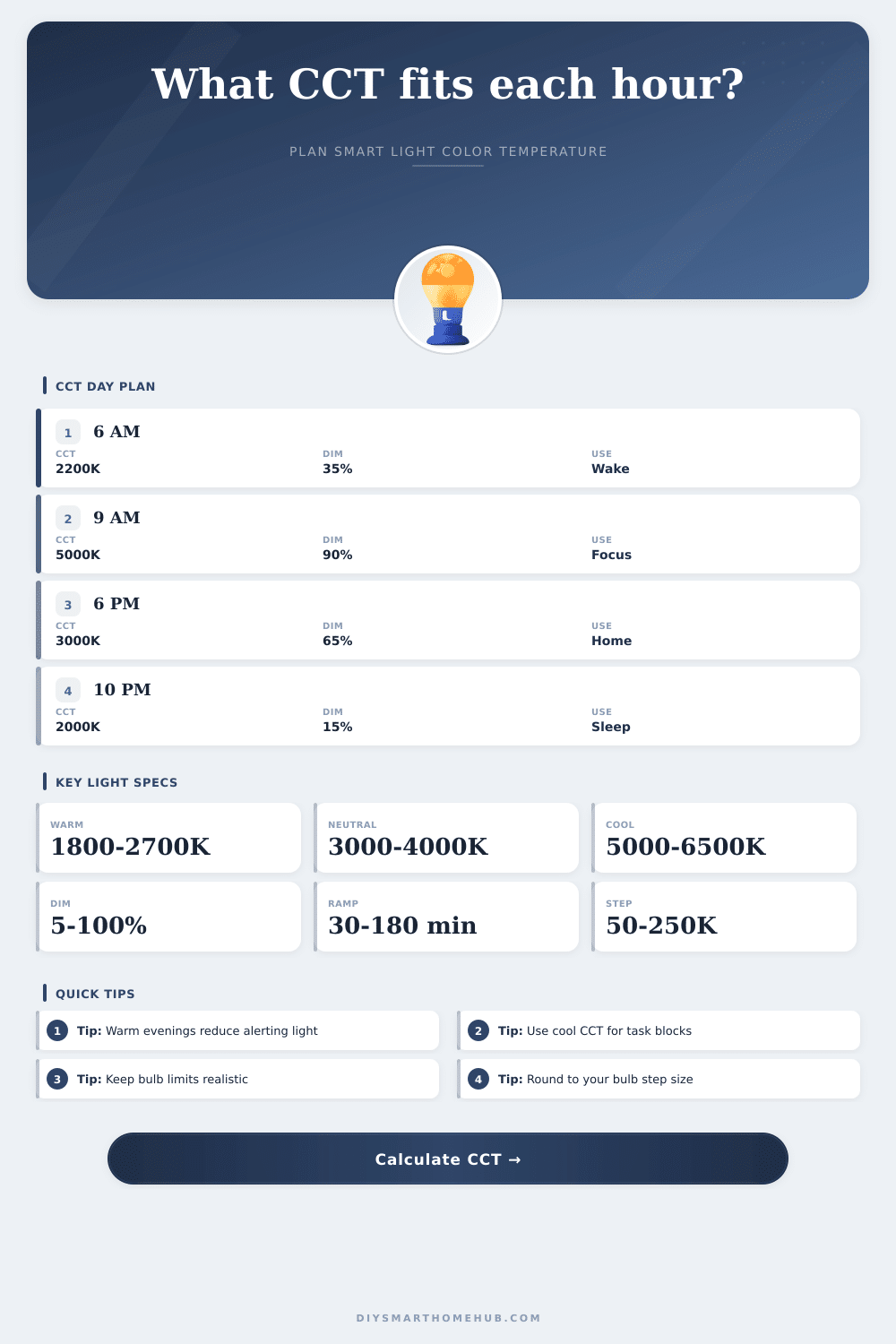
Color Temperature Time-of-Day Calculator
Calculate a smart light CCT target by time of day using wake time, bedtime, warm and cool Kelvin bounds, dimming percentage, bulb step size, and an evening melanopic-friendly reduction.
🎯Lighting schedule presetsPick a day rhythm, then adjust the bounds and dimming.
⚙Calculator inputsCCT interpolates across morning and evening blocks.
📊Schedule comparison gridHow the selected time compares with fixed scenes.
📌Schedule specsBounds used by the calculator.
Time-of-day result
📋CCT reference tablesTypical smart lighting ranges and formulas.
| Time block | CCT formula | Dim formula | Use |
|---|---|---|---|
| Night | Warm bound | Warm dim | Lowest-alerting navigation light |
| Morning ramp | Warm + progress x range | Warm dim + progress x dim range | Wake-up transition |
| Day plateau | Cool bound | Day dim | Focus, cleaning, task work |
| Evening ramp | Cool - progress x range | Day dim - progress x dim range | Wind-down transition |
| Melanopic proxy | CCT ratio x dim | Evening reduction applied | Relative alerting-light check |
| CCT range | Common name | Smart home use | Timing note |
|---|---|---|---|
| 1800K-2200K | Amber / candle | Night route, nursery, late media | Best near bedtime |
| 2200K-2700K | Warm white | Living rooms and relaxed evenings | Good after sunset |
| 3000K-3500K | Soft neutral | Kitchen, bath, general home | Useful transition range |
| 4000K-5000K | Neutral to cool | Office, workbench, cleaning | Good daytime task CCT |
| 5000K-6500K | Daylight | Morning boost and high focus | Avoid late evening if sleep-sensitive |
| Room profile | CCT bias | Dim bias | Planning behavior |
|---|---|---|---|
| Living room | 0 K | 0% | Balanced all-day scene |
| Office | +350 K | +5% | Keeps focus blocks cooler and brighter |
| Kitchen | +250 K | +8% | Raises task visibility |
| Bedroom | -250 K | -10% | Softer evening emphasis |
| Nursery | -450 K | -20% | Warmer, lower-output night behavior |
| Media room | -300 K | -15% | Reduces glare and alerting light |
| Automation idea | Start point | Target point | Scene note |
|---|---|---|---|
| Sunrise wake | Wake time | Warm to cool | Ramp over 30-120 minutes |
| Work block | Midmorning | 4000K-5500K | Pair with higher dim level |
| Dinner scene | Sunset | 2700K-3500K | Moderate brightness, less blue-rich light |
| Wind-down | Bed minus ramp | 1800K-2400K | Apply melanopic reduction and dimming |
| Night path | After bed | 1800K-2200K | Very low dim level |
💡Color temperature tips
This calculator is for smart home lighting scene planning. CCT, brightness, spectrum, fixture optics, room reflectance, age, and individual light sensitivity all affect real circadian response.
Most of us don’t think much about indoor lighting. Flip a switch, and the room works. It is done. But did you know light quality vary throughout the day? You may not see it right away, but your brain will register it anyway. Our brains reads certain wavelengths as cues for activity or sleep. Pile your bedroom full of bright blue light before going to bed, and you’ll tell your nervous system that it’s still early in the day.
The calculator above takes care of the math for you; all you need to do is input your wake time and target brightness. By doing so, you eliminate any guesswork when it comes to converting units and coefficients. It turns biology-based concepts (like circadian rhythm management) into something easy to use: Kelvin values and percentages.
How Smart Lighting Helps Your Body and Sleep
Instead, most people begin with an attempt to guess what their color temperature preference should of be: if it’s morning or evening, should they have warm light or cool light? We prefer warm light for evenings (cozy!), and we prefer cool light for mornings and afternoons (productive!). Great instincts! But unfortunatly executed wrong. Because while having warm versus cool light is fine, how you transition between them isn’t.
Jumping suddenly from bright daylight simulation to dimmer amber candlelight when the sun sets can feel jarring, very artificial. Biology likes smooth transitions. This means that in any serious lighting plan, ramping up and down matters. You want the light to match nature as the sun sets. It should slowly descend as twilight does. This allows our bodies to produce melatonin without being suddenly cut off from alerting blue light.
That’s where many people hit a snag: There’s a lot more range on today’s tunable bulbs than we’re able to tell apart with ease, even at lower intensities. So if you want to really crank it up when you’re working (say, in a study or office space), you may bump your cool end to sixty-five hundred Kelvin there. That seems like a good choice. But try to keep that warm end too far up and you’ll have undermined your after-dark relaxing time. Three grand Kelvin will be too bright to provide enough contrast for your eye to register “rest”, so you’re better off defining realistic parameters for yourself based off the lights you do have in your home.
It also takes into account how brightness plays into all this, since brightness and color temperature both works together to create a circadian response. If your brightest setting is still warm, it could still stimulate you. However, something slightly cooler but very dimmed down can feel much more gentle on your sleep cycle. Yet there’s an additional layer of complexity that generic presets lack; the role each room plays in your life.
For example, the kitchen needs greater brightness and color temperature while cooking or cleaning, for safe visibility. The nursery or even the media room is better served by warmer, more subdued colors that provide less glare and contribute to a relaxing environment. Without hard-coding you into preset templates, the calculator makes small adjustments across such rooms based on these real-world scenarios.
Of course, you may want to override them if, say, your home office also happens to be a place of relaxation. That way, it won’t commit the same error many fixtures do: thinking all rooms are interchangeable containers for lighting. They’re all meant for something else entirely; they need a different spectrum at different times of day.
Evening reduction is perhaps the most overlooked aspect of smart lighting design. People get so excited about dimming their lights and turning them off, they forget to consider how light shifts as it dims. Because reducing the melanopic load proxy also means warming the light temperature, you begin to peel away alertness from visibility. You’re still seeing well-enough to make your way around safely while avoiding firing up the alert pathways in your head. And this has implications for day-to-day energy regulation and long-term sleep quality.
The page has a table of references that explains how different physiological goals map to use cases at various times throughout the day. Lighting is also about rhythm. What I mean by that: Lighting isn’t just about lighting, it’s about leading your body through the day. Begin where nature intends you to begin (with your natural wake time); and build out from there. Your evening routine should support you (not fight against) your biology.
Do this starting with your natural wake time and working backward from your bedtime. Remember, a night owl’s numbers will vary from an early riser’s, and that’s the whole point. There is no right or wrong; there is simply the answer that works for your life. Simply take note: Light tells our brain something; so what are you telling yours? Feed it well. And if that means turning off a harsh buzz in the middle of the night, know it doesn’t have to be that way. The answer can be a few clicks away. You’re worth more than that.