Garden Bed Watering Volume Calculator
Estimate bed area, irrigation depth, gallons, liters, soil water storage, seasonal demand, and drip run time for raised beds, rows, circles, triangles, and custom planting zones.
Calculation breakdown
| Watering goal | Depth inches | Gallons per 32 sq ft | Liters per 3 m² |
|---|---|---|---|
| Seedling surface refresh | 0.35 in | 7.0 gal | 24.4 L |
| Light maintenance watering | 0.50 in | 10.0 gal | 34.9 L |
| Moderate soak | 0.75 in | 15.0 gal | 52.4 L |
| Standard weekly vegetable depth | 1.00 in | 19.9 gal | 69.8 L |
| Fruiting crop deep soak | 1.25 in | 24.9 gal | 87.3 L |
| Deep summer recharge | 1.50 in | 29.9 gal | 104.7 L |
| Soil profile | Available water per ft | Default root zone | Practical watering note |
|---|---|---|---|
| Sandy raised bed mix | 0.7 in/ft | 10 in | Stores less; water smaller volumes more often |
| Sandy loam vegetable soil | 1.0 in/ft | 12 in | Moderate storage with quick drainage |
| Balanced loam bed | 1.2 in/ft | 12 in | Good storage for weekly vegetable watering |
| Silt loam high-storage bed | 1.6 in/ft | 14 in | Holds more water but can crust at surface |
| Clay loam slow-drain bed | 1.4 in/ft | 12 in | Use split cycles to avoid runoff |
| Container potting mix | 0.8 in/ft | 8 in | Dries faster from sides and wind exposure |
| Compost-rich raised bed | 1.3 in/ft | 12 in | Good storage when evenly wetted |
| Total zone flow | 10 gal target | 25 gal target | 50 gal target |
|---|---|---|---|
| 0.25 gal/min micro drip | 40 min | 100 min | 200 min |
| 0.50 gal/min small drip zone | 20 min | 50 min | 100 min |
| 1.00 gal/min soaker bed | 10 min | 25 min | 50 min |
| 2.00 gal/min hose wand | 5 min | 12.5 min | 25 min |
| Seasonal condition | Multiplier | For a 20 gal base | When it fits |
|---|---|---|---|
| Cool spring or fall | 0.75x | 15 gal | Cloudier weeks, young crops, low wind |
| Normal growing week | 1.00x | 20 gal | Average vegetable bed demand |
| Warm sunny week | 1.15x | 23 gal | Higher transpiration without extreme heat |
| Hot dry week | 1.35x | 27 gal | Dry air, full sun, fruiting crops |
| Heatwave or windy exposure | 1.55x | 31 gal | Short-term high demand periods |
| Mulched bed with shade cloth | 0.85x | 17 gal | Reduced evaporation and cooler surface soil |
Seedlings
Use shallow depths and short cycles because small roots cannot access stored moisture deep in the bed.
Leafy greens
Moderate, steady moisture keeps lettuce, spinach, and chard from cycling between wilt and saturation.
Fruiting crops
Tomatoes, peppers, squash, and cucumbers usually need deeper watering during bloom and fruit fill.
Herbs
Many herbs prefer smaller watering targets, especially in loam beds with mulch and good drainage.
Containers
Plan by volume and flow, then check often because exposed potting mix dries faster than in-ground beds.
Don’t panic if tomato foliage wilts on a hot, humid afternoon; too much water can be as bad as none. Remember: It’s not about intuition, it’s about measurement. To succeed at watering, you must remember rather than guess how much water you are using. Run the hose for so many minutes? No, that doesn’t work. Pressure varies, and your nozzle isn’t necessarily efficient.
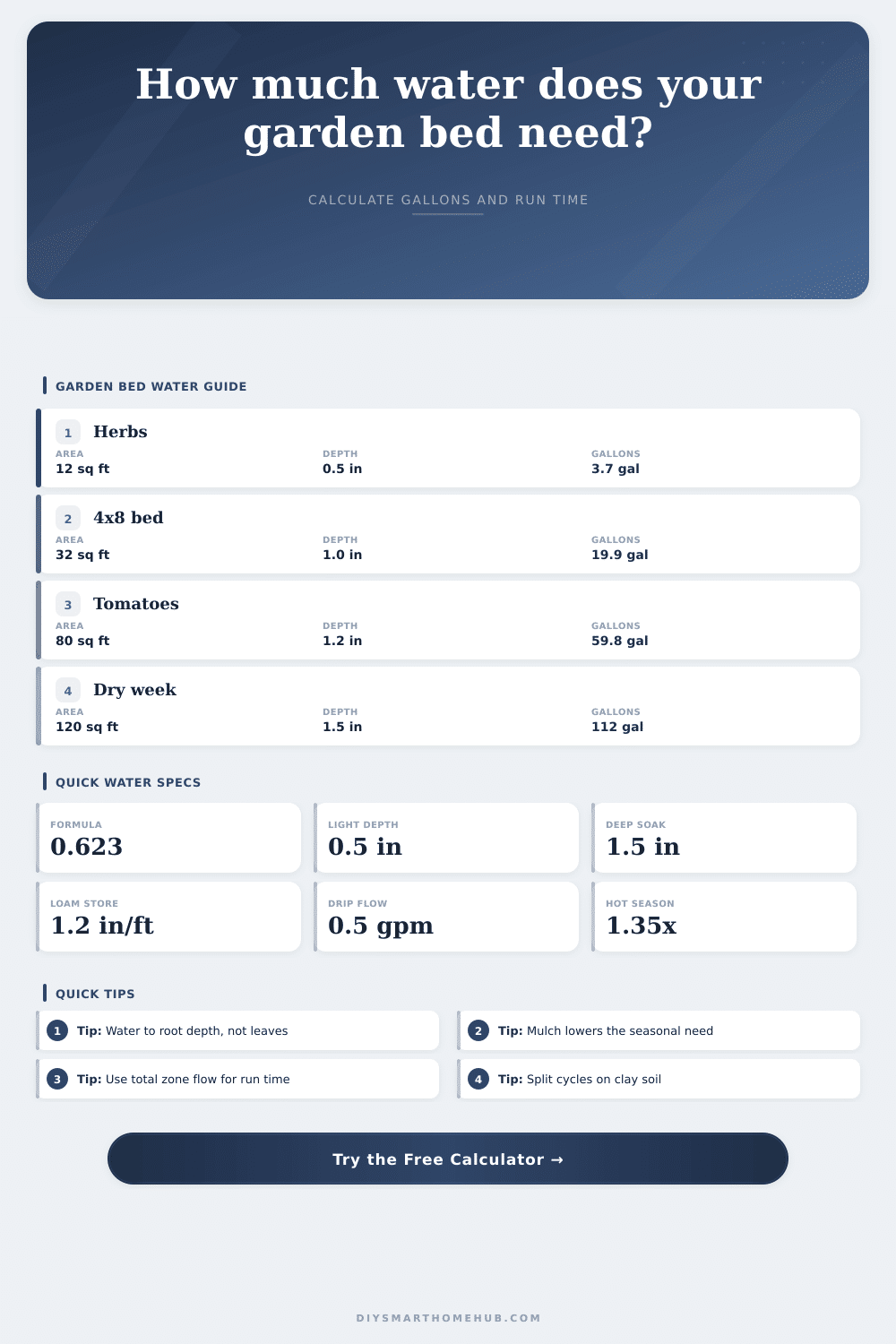
Think instead based off soil capacity and depth. Once you input size of your beds (and how much moisture you’re aiming for) the calculator will tell you exactly how much you need. It’s based on simple math: How many square feet does it has to reach? And by what depth (to avoid wasting water as run-off)? For example, one inch in a thirty two-square-foot raised bed means almost twenty gallons. That’s no joke.
How to Water Your Garden Correctly
Keep it within first few inches of your soil. There, it can do its job without washing away or evaporating before doing any good. What’s in the ground affects how long it will hold water. Different types of soil texture holds different amounts of water. Clay holds a lot of water, but it also drains slowly and puddling may suffocate roots. Sandy mix drain fast and lets gravity pull away available water before roots can take it up.
The calculation on the tool factors in your soil’s makeup, and uses that to estimate how much gets stored. You can adjust watering according to whether you have fine-textured or light soil, such as sandy loam, versus heavier stuff like heavy clay. This means you should of divide up your watering into smaller amounts. Let it soak in rather than letting it stand on the surface.
A lot of people think “DIRT” is just dirt, and therefore holds moisture just the same. Wrong! Fixed schedules don’t account for season. On a scorching July day in full sun with the wind stripping humidity off the leaves, I need more water then on a cool spring day. That’s where the base volume times the seasonal multiplier comes into play.
During extreme heat, plants lose water through their leaves to help them cool down; that means it’s pulled quickly from their roots. Unless you water at a moderate rate and unless it’s when the sun is beating down, you’ll never keep pace with evaporation. In hot spells, raise your depth target and get that water deep into cooler soils and deeper roots.
Volume theory becomes doable with runtime: “Okay, I know I want 20 gallons,” you say. But how many minutes will that take? How much is 20 gallons in minutes?” That depends on the total flow rate of your zone, because not all emitter are equal: A broad spray wand requires fewer minutes to deliver the same volume than a slow drip emitter does. The calculator adjusts for both, then tells you exactly how long to run them. This prevents overwatering, which wastes money and creates anaerobic soil conditions.
Mulch really slows down evaporation on top. In a mulched bed, all that thick organic material holds moisture longer and cools the soil, meaning that you’re not applying the same multiplier as you do in an unmulched area. Think of it like free insurance against drought. Insulate the soil so you don’t have to wet the surface repeatedly. This allows roots to tap into moisture reserves within the soil.
Water less frequently. You get water on demand because the input equals the output. In other words, what goes in has to be proportioned to your soil’s storage capacity. Because they have holes in them, you need to consider not only their ability to hold water but also how much will be taken up by plants (and evaporate). Using just the right amount of water means you don’t waste it, and keep your plant standing firm.
Turning this chore into an act of precision is about caring for each plant, not running one through a routine. When leaves wilt, longer isn’t better; deeper is better. Actualy, more water can be bad too. It feels naturaly easy to just pour more, but it makes the soil moddernly wet and messy. You should try to do it comfortabley.