Drip Emitter Count Per Plant Calculator
Size emitters per plant from root-zone diameter, weekly irrigation depth, emitter flow, soil intake rate, planned watering days, and smart valve zone capacity.
Detailed emitter sizing breakdown
| Plant type | Crop factor | Typical wet diameter | Minimum emitters |
|---|---|---|---|
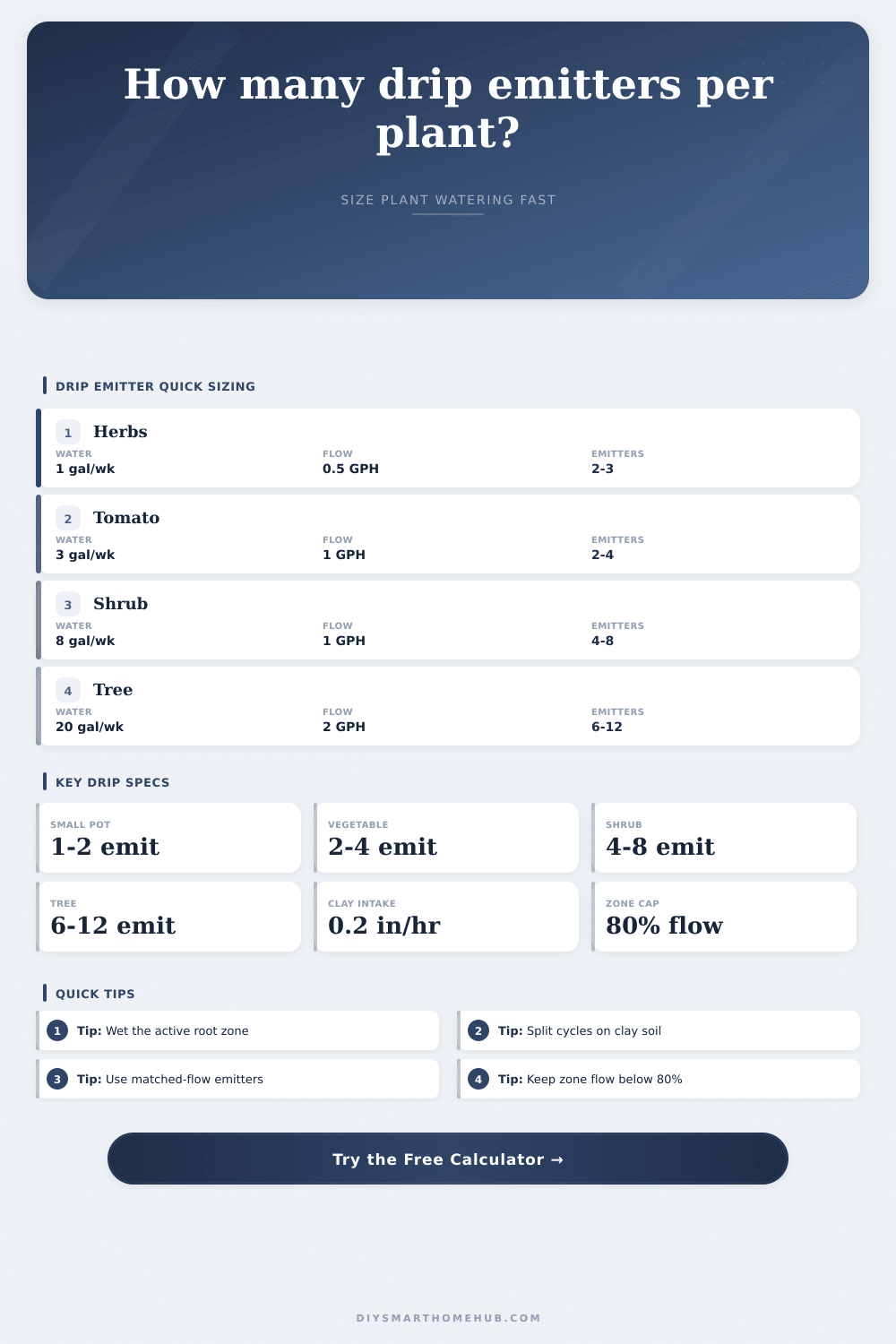
| Herbs and greens | 0.70 to 0.85 | 0.5 to 1.5 ft (0.15 to 0.46 m) | 1 to 2 low-flow emitters |
| Fruiting vegetables | 0.90 to 1.10 | 1.5 to 3 ft (0.46 to 0.91 m) | 2 to 4 emitters |
| Ornamental shrub | 0.60 to 0.90 | 2 to 5 ft (0.61 to 1.52 m) | 3 to 6 emitters |
| Grape vine or cane fruit | 0.75 to 0.95 | 2 to 4 ft (0.61 to 1.22 m) | 2 to 4 emitters |
| Citrus or subtropical tree | 0.85 to 1.05 | 4 to 10 ft (1.22 to 3.05 m) | 4 to 10 emitters |
| Deciduous fruit tree | 0.75 to 1.00 | 5 to 14 ft (1.52 to 4.27 m) | 4 to 12 emitters |
| Low-water native plant | 0.30 to 0.55 | 2 to 6 ft (0.61 to 1.83 m) | 2 to 6 emitters |
| Container plant | 0.90 to 1.30 | 0.5 to 2 ft (0.15 to 0.61 m) | 1 to 3 emitters |
| Emitter type | Rated flow | Best plant size | Runtime effect | Soil risk | Smart zone note |
|---|---|---|---|---|---|
| Micro button emitter | 0.25 GPH (0.95 LPH) | Seedlings, herbs, small pots | Longer, gentle cycles | Low runoff risk | Good for many plants on one valve |
| Low-flow button emitter | 0.50 GPH (1.9 LPH) | Containers, small vegetables | Moderate runtime | Good for clay or slopes | Easy to balance with smart timers |
| Standard button emitter | 1.00 GPH (3.8 LPH) | Vegetables, shrubs, vines | Common weekly runtime | Watch clay intake | Most flexible mixed-zone choice |
| Tree button emitter | 2.00 GPH (7.6 LPH) | Shrubs, young trees, citrus | Shorter cycles | May need cycle-soak | Check total GPM before adding rows |
| Adjustable bubbler | 4.00 GPH (15.1 LPH) | Large trees and basins | Shortest cycles | High runoff risk | Use sparingly on small smart valves |
| Soil or bed condition | Safe intake cap | Drip behavior | Cycle setting signal |
|---|---|---|---|
| Sandy soil | 0.75 to 1.00 in/hr | Water moves down quickly with smaller wetted width | Shorter, more frequent cycles may hold roots moist |
| Loam soil | 0.40 to 0.60 in/hr | Balanced spread and depth for most beds | Single daily cycle often works for modest run times |
| Clay loam | 0.25 to 0.35 in/hr | Slow intake with wider lateral movement | Split long runtimes into cycle-soak blocks |
| Clay soil | 0.15 to 0.25 in/hr | Puddling starts if application rate is too high | Use lower-flow emitters or multiple short cycles |
| Container mix | 0.70 to 1.20 in/hr | Fast intake but limited storage volume | Use frequent smart schedules and avoid drain loss |
| Sloped bed | 0.15 to 0.30 in/hr | Runoff can begin before soil is full | Use cycle-soak and lower emitter flow per plant |
| Project type | Typical plant count | Common emitter plan | Likely zone demand |
|---|---|---|---|
| Balcony herbs on smart hose timer | 6 to 12 containers | 1 to 2 emitters at 0.25 to 0.5 GPH | 0.1 to 0.6 GPM |
| Raised vegetable bed valve | 12 to 30 plants | 2 emitters at 0.5 to 1 GPH | 0.2 to 1.0 GPM |
| Mixed shrub foundation zone | 8 to 20 shrubs | 3 to 6 emitters at 1 GPH | 0.4 to 2.0 GPM |
| Citrus row on controller zone | 4 to 12 trees | 4 to 10 emitters at 1 to 2 GPH | 0.5 to 4.0 GPM |
| Young orchard lateral | 8 to 24 trees | 4 to 8 emitters at 1 to 2 GPH | 1.0 to 6.4 GPM |
IS IT DRY in there? That’s how you tell if the garden is well-watered, and therefore healthy. When is “dry” OK, or even preferable, such as when a plant wilts (some think this means crisis; I say it mean good job). Usually it means a drip system, one suited to both the plant and soil.
Most people guess at where to put emitters, based off intuition: Then they get soggy feet in clay soil, or no water for their roots in sandy soil. The math is done for you with the calculator, above, after you input the depth of desired wetness and size of the root area. You don’t have to guess at timing, or how fast things should drips.
How to Water Your Garden Correctly
Gallons per hour doesn’t matter to plants; what they want is for you to make sure there’s enough available moisture in the immediate root zone.’ Whether it arrives via one fast bubbler or three slower emitters won’t matter to a tomato plant, which want a certain volume applied over its active roots. To estimate the amount of ground surface to be wetted, the tool asks how big your plant’s canopy is. It then multiplies that by a ‘root-zone factor.’
This factor would be higher with a big shrub, where typically the dripline marks the end of moist soil but the thirsty roots are still dry. Why? You don’t want to waste water putting down an emitter right at the trunk of a big shrub if the thirsty roots lie beyond reach under the drip line. Usually spreading several lower-flow points all along the perimeter works best, not dumping it at the trunk.
Most don’t work because they ignore physics, specifically the soil type (no malice intended; just not thinking about it). Quick-draining sand require more short, repeated passes for thorough moisture to reach the root zone, but no longer or the dissolvable stuff will leach right out. Clay, though, absorbs water slowly and then holds onto it tightly, and likewise, won’t let go easy once you try. Pour too much on at once and what happens? You guessed it: water runs off, and soil is lost to erosion.
The table on the page compares soil absorption rates to the speed of safe application. In a heavy-clay zone, divide an otherwise long run into multiple shorter ones, each followed by a soaking period. This avoids puddles and often saves more water then any decrease in overall application volume.
The amount of emitter flow rate depends on how long you want something to run versus how complex you want the system to be. A typical workhorse emitter size for a shrub or vegetable would be the one gallon per hour type. It provides decent coverage and doesn’t take up a lot of time on the timer, which is a nice balance.
For more precise control, there are smaller half-gallon ones that also reduce runoff on slopes or in containers, but they will take twice as long to deliver the same amount of water. For big trees, the two- or four-gallon sizes are fine. This assumes you have enough pressure to push them and can get them into the ground where the water soak into the soil without ponding.
The calculator verifies that you won’t exceed the capacity of any given valve by overloading it with multiple high-flow outlets. Another thing to consider is how often you are going to water. If your system runs for three hours at a time just once weekly, you’ll have a very different soil moisture profile than someone who runs theirs for forty-five minutes four times a week.
Light frequent watering keeps the topsoil moist. This is good for shallow-rooted annuals, but it encourages weak root growth in perennials that want to grow deeper. Soaking deeply and infrequently pushes roots down, developing drought-resistance.
The tool has an exposure adjustment that takes into account wind and heat; for instance, a plant in morning shade will lose moisture far more slowely than one exposed to the baking afternoon sun. Dialing up this factor avoids both underwatering in the hottest part of the summer, and overwatering on cooler days.
Precision, not volume, is the point of drip irrigation. And that’s true whether you’re using trees, shrubs or pots: You’re aiming to approximate nature’s ideal rainfall… Steady enough to soak in but gentle enough to prevent run-off. That’s why getting the emitter count correct (as shown in the results box) comes down to matching each plant’s need. This ensures no single one drowns, none goes thirsty, and no water is wasted.
Those numbers aren’t laws of nature; they’re starting points. Adjust to match how your plants respond. Feel around to gauge the soil moisture with a simple probe. Stop guessing and begin measuring. The garden will stop being a battlefield and start behaving as a system again.
You will discover that a well-sized emitter isn’t perfect, but it is consistent. That’s good enough. You should of used it sooner.