Energy Per Cycle Calculator
Estimate kWh per appliance cycle, per day, and per year from cycle watts, duration, standby draw, preheat energy, duty phases, cycles per day, efficiency, and output units.
Cycle energy estimate
| Metric | Formula | What it means |
|---|---|---|
| Cycle hours | Duration converted to hours | Main operating time before preheat and standby are added. |
| Duty-adjusted cycle watts | Cycle W x high duty + low W x low duty + control W x control duty | Blends heating, motor, fan, pump, control, and pause phases. |
| kWh per cycle | ((Duty-adjusted W x cycle hours) + (preheat W x preheat hours) + standby Wh per cycle) / 1000 / efficiency | Energy for one complete appliance cycle after efficiency adjustment. |
| kWh per day | kWh per cycle x cycles per day + daily standby kWh | Daily use including cycles and idle time between cycles. |
| kWh per year | kWh per day x 365 | Annual energy for the selected cycle frequency. |
| Average watts | kWh per year x 1000 / 8760 | Continuous-load equivalent for backup and energy planning. |
| Appliance cycle | Typical running watts | Typical duration | Cycle note |
|---|---|---|---|
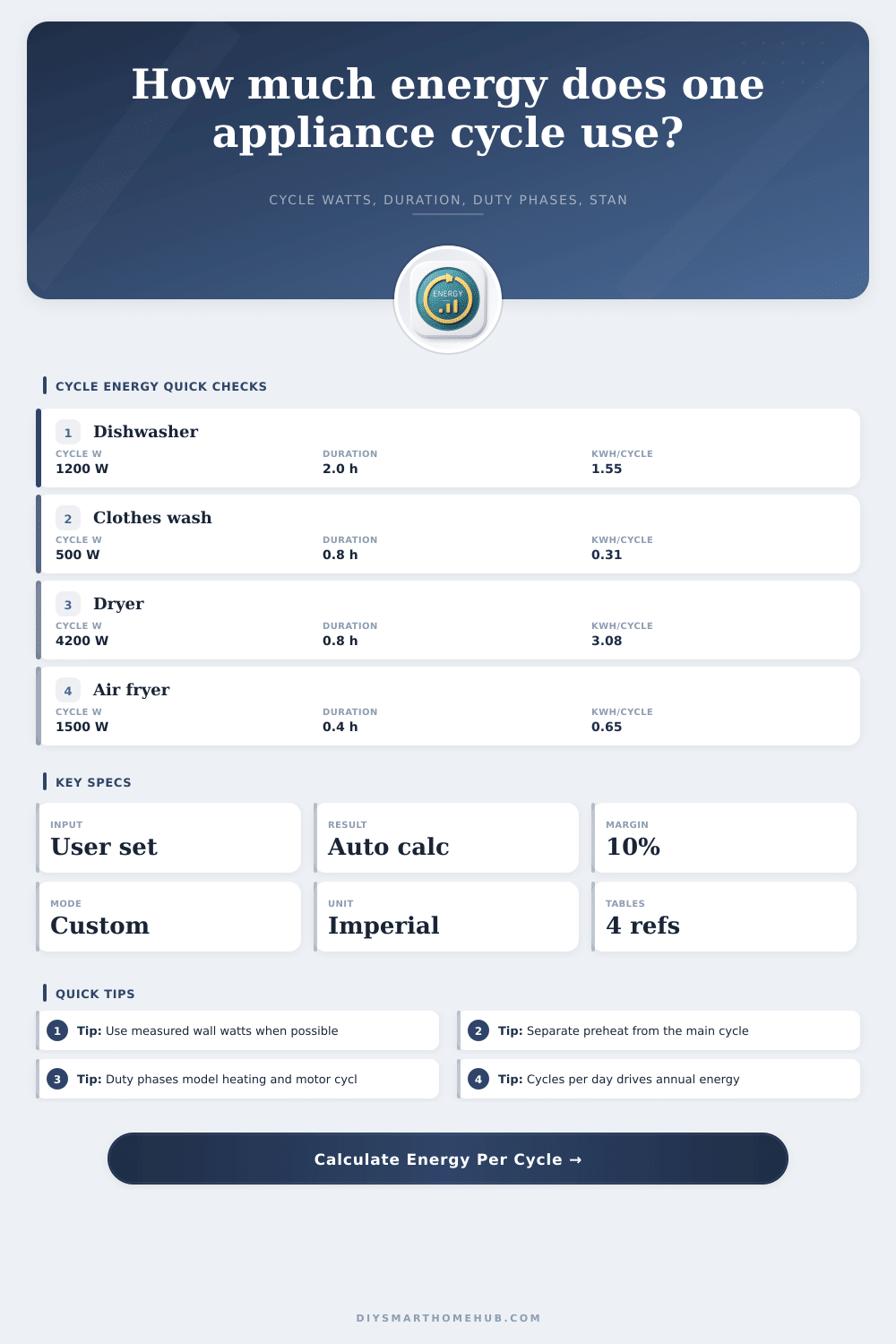
| Dishwasher normal or eco | 800-1800 W while heating | 1.5-3.5 hours | Water heating and heated dry dominate total energy. |
| Clothes washer warm cycle | 250-800 W | 35-75 minutes | Hot water source can shift energy outside the washer. |
| Electric clothes dryer | 3000-5500 W | 35-75 minutes | Heater duty cycle and moisture sensing drive the total. |
| Electric oven bake | 1800-3500 W | 30-90 minutes | Preheat is separate; baking cycles the element on and off. |
| Air fryer or countertop oven | 1000-1800 W | 10-35 minutes | Short duration can offset high nameplate watts. |
| Robot vacuum cleaning run | 30-90 W | 45-120 minutes | Charging energy may be better entered as preheat or standby. |
| Phase | Use this duty input | Typical share | Best examples |
|---|---|---|---|
| High-power heating or compressor | High-power phase duty | 20-80% | Dryer heater, oven element, dishwasher heater, dehumidifier compressor. |
| Low-power motor, pump, or fan | Low-power phase duty and low phase power factor | 10-70% | Wash motor, circulation pump, fan-only dry, tumbler rotation. |
| Control, sensing, or pause | Control phase duty and control phase power factor | 0-40% | Timer pauses, door locks, sensors, displays, and electronics. |
| Warm-up before the cycle | Preheat watts and preheat minutes | 0-20 minutes | Oven preheat, espresso boiler warm-up, steam boost, hot rinse. |
| Idle between runs | Standby watts and cycles per day | Remaining hours | Clock, WiFi, delayed start, charger dock, or smart controls. |
| Preset | Main cycle | Preheat and standby | Cycles/day |
|---|
Your monthly electricity statement doesn’t tell a very clear picture of how your house is using all that juice. Sure, it totals up the amount you owe in kilowatt-hours. But who knows what devices soaked up all those kWhs? How many people think that their dishwasher draws as much power as its nameplate rating suggests, 24/7? An oven turn on and off its heating elements when maintaining temperature, right? That’s why understanding your usage in terms of “cycled” products, appliances that turn off and back on during use, is important. It’s also why most residential energy audits aren’t worth your time. The difference between nameplate rating and actual usage is what fouls things up.
You input your exact spec on every appliance, and let the calculator do the math. No more guesswork based off duty cycles and such. Most appliances don’t run at full bore all the time; they have on and off phases, so you define what’s really happening when it runs. Typically, there is a high power phase (compressors/heaters), a low power phase (fans/motors), and a control phase (displays/sensors). You can set percentages for each phase with this tool.
Why Your Electricity Bill Is Not Clear
That’s important because a dryer might pull four thousand watts while heating but only three hundred while tumbling cool air. Unless you count the entire cycle as an average, you’ll never see those peaks that stress out your circuit breaker. You also won’t see the valleys where efficiency comes into play.
There are other sneaky variables like preheat (which fools everyone). Boiling water in your espresso machine or warming up your oven use some energy at the beginning, before the big timer kicks in. The calculator splits that startup energy from the rest of the time spent running the appliance. This is a small detail, but it keeps you from assuming the overall run time is more efficient than it realy is.
Then there’s standby draw: lots of appliances keep consuming energy on digital clocks and Wi-Fi chips even once they’ve done what you asked them to do. Multiply that one watt here, two watts there, times thousands of hours a year, and it becomes significant. The calculator turns all these tiny drips into a number you can compare against money saved, so you can weigh whether the convenience is worth the pennies.
The real trick here are duty cycles. Manufacturers will quote an appliance’s rated power at max output, but they don’t operate that way in the real world. Physics tell us devices cycle on and off as they heat and cool down. The compressor in my dehumidifier works full blast for a couple of minutes, shuts down, and the fan kicks on to circulate air. To get a good estimate of energy used, you model that actual pulsing operation by dialing back the duty percentage in the input fields. That makes it much more accurate different than just multiplying watts * time; it’s the difference between theoretical maximums and what actually happens in the real world.
Your washer/dryer (or even your dishwasher) might be thought of as a series of similar activities, so how many times do you use each appliance? The calculator assume daily use to calculate the total amount over the course of a year. This allows you to compare energy consumption between old appliances and newer Energy Star ones. It also gives you a good idea of what to expect annually in terms of energy costs.
Sometimes the most efficient washer/dryer is not the best option for you; perhaps you wash fewer loads but still want a high-efficiency machine. That’s where knowing how much electricity each model uses will help you make the right decision! To see whether or not what you’re putting into that calculator makes sense, there’s a set of reference tables on the page with typical ranges for common appliances. For example, an electric dryer pulls far more juice than a robot vacuum, and both has a very different place in your home’s energy budget. Knowing the difference will help you decide which upgrade to prioritize, maybe replacing an old, inefficient dryer instead of worrying about how much power your smart speaker uses.
All this comes back to one thing: visibility. To manage your energy use, you must realize that an appliance doesn’t just sit there like a box; it work in different stages and pauses. When we break the cycle down, we bring into view the kind of clarity that lets us turn off standby power. It lets us run fewer cycles. It allows us to change our habits based on real data instead of vague anxiety. Numbers don’t lie, unless you don’t ask the right questions.