Electric Radiant Floor Heating Calculator
Estimate heated floor coverage, installed wattage, thermostat amperage, breaker zoning, delivered heat output, and warm-up time for electric mat, cable, foil, membrane, and slab systems before you commit to a layout.
🔧Project inputs
📊Electric radiant floor results
🔍Selected system snapshot
📘Reference tables
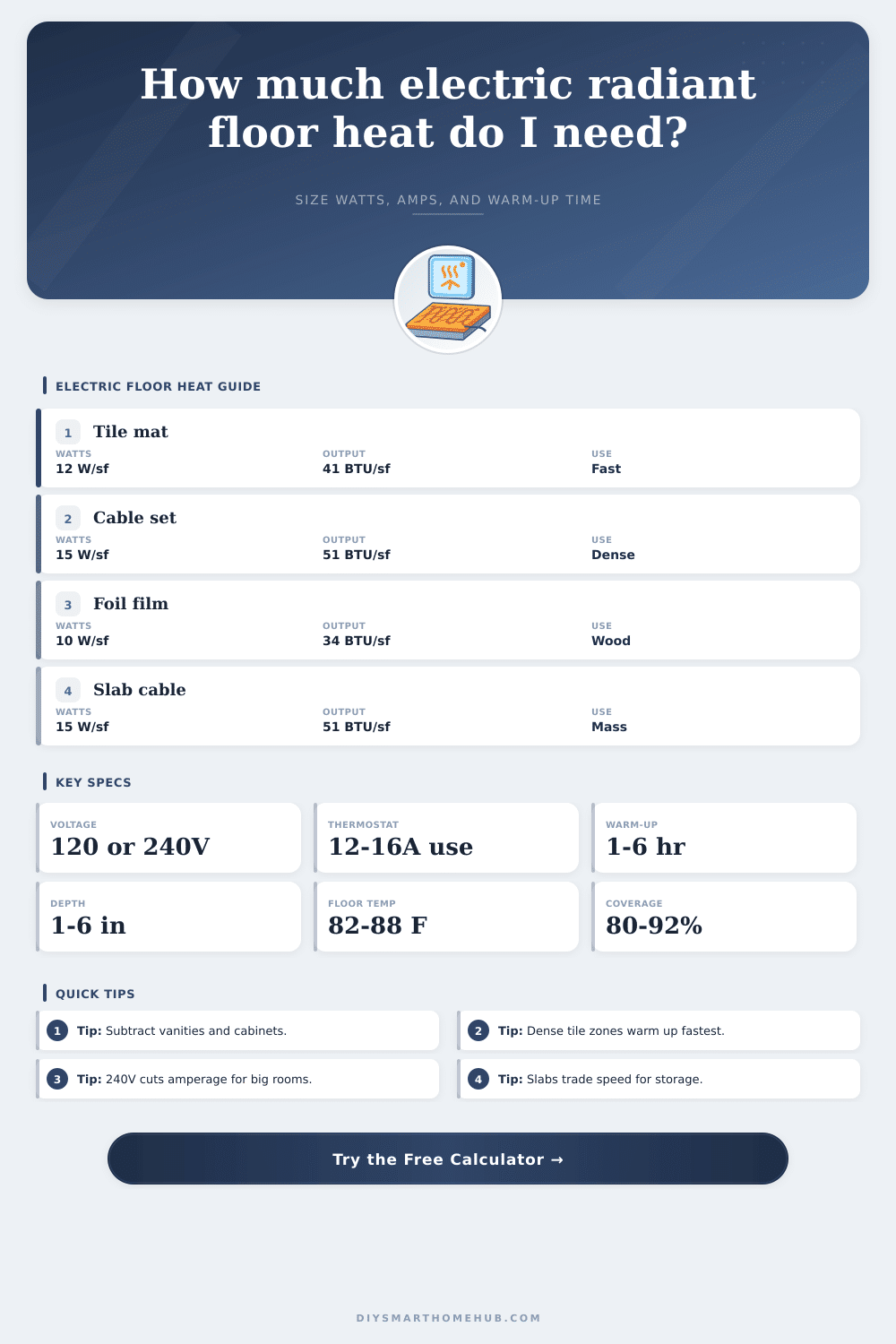
| System | Watts/sq ft | BTU/sq ft | Typical use |
|---|
| Finish | Transfer | Surface max | Best fit |
|---|
| Project size | Heated area | Power | Zones |
|---|
| Relay size | Usable load | 120V max | 240V max |
|---|
💡Practical notes
Electric radiant sizing becomes inaccurate quickly if you heat under permanent cabinets or vanity footprints. Keep the model focused on open walking area and fixture clearances.
Electric floors are often limited by thermostat relay amperage before they are limited by room area. Switching to 240V helps, but broad spaces still divide more cleanly into separate zones.
Electrical radiant floor heating give permanent warming to the home. It operates in various places, for instance in kitchens, bathrooms, bedrooms, basements and sunrooms. Those spaces commonly are difficult to keep pleasant.
The systems heat the house from below upward. Like this the warm source stays efficient for keeping folks as comfortable as possible. That heating method spread heat across the whole floor equally, so there escape cold corners.
How Electric Radiant Floor Heating Works
The devices operate by means of electrical heating cables or heating mats. They recline under the floor surface and connect to the main electricity. When one switches the system, current flows through the cables.
Some variants apply heating film. Radiant floor heating issue infrared warming. That likes the warmth of campfires or sunrays.
The heat reaches objects and folks directly, not the surrounding air as blown air devices. Hence it escapes dust motion. Rather than other heaters, that wastes energy by means of warming air that climbs to the ceiling, radiant heat stays on the floor.
Electrical radiant floor heating are energetically efficient. Correctly installed and programmed, it consumes 25, 30% fewer energy than blown air systems. You can use it for additional warming and comfort.
Available many sizes and potentials for special needs. Some mats are extremely slim, only 1/8 inches thick. They easily insert under china, stone or tile without a lot raising the floor.
Others, as warm step mats, only add 1/16 inches to the thickness. Some mats answer for RVs and use in truck driver accommodations or in vans. Here the warming starts in the floor and climb through tile and furniture.
Implementation requires various materials. For instance, DITRA-HEAT is electrical floor heating system that uses uncoupling. It protects against cracks in grout and tile.
Tile well coincide with those devices because of its heavy warm skill. Normal electrical floor heating give 15 watts each square foot. In little 35-square foot bathroom, running 8 hours day, it uses 4.2 kWh daily.
Many products take around 12 watts each square foot. The systems usually have thermostats for control the warming. Important are programmable thermostats, that best operates with floor heat.