Deck Stain Coverage Calculator
Estimate stainable deck area, gallons, material cost, dry and recoat timing, plus wash and sanding prep time using deck boards, rails, stairs, coats, stain coverage, wood porosity, and weather conditions.
Deck Stain Estimate
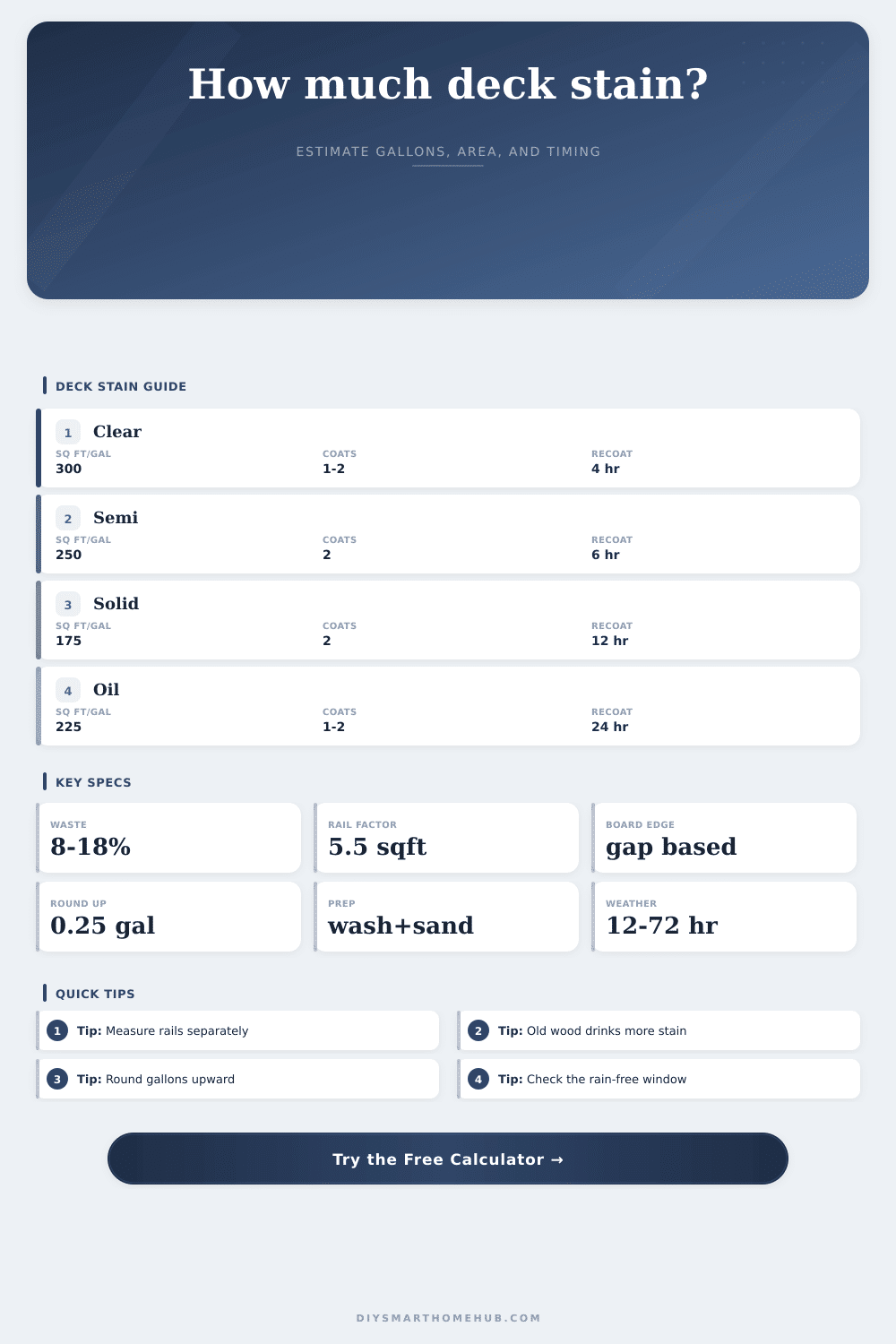
| Stain type | Base coverage | Typical coats | Best use |
|---|---|---|---|
| Clear sealer | About 300 sq ft/gal | 1-2 coats | Newer wood, light protection |
| Semi-transparent | About 250 sq ft/gal | 2 thin coats | Visible grain with color |
| Semi-solid | About 200 sq ft/gal | 2 coats | Uneven boards, stronger color |
| Solid color stain | About 175 sq ft/gal | 2 coats | Older decks with patched boards |
| Penetrating oil | About 225 sq ft/gal | 1-2 coats | Dry wood that accepts oil |
| Surface | Calculator factor | Why it matters | Input used |
|---|---|---|---|
| Main deck top | Length x width | Primary walking surface | Deck dimensions |
| Board side edges | Lineal ft x 2 x thickness | Gaps expose vertical edges | Board width and gap |
| Rails and pickets | 5.5 sq ft per linear ft | Both faces plus caps and posts | Rail length |
| Stairs | Width x tread allowance | Treads, risers, and side faces | Stair count |
| Condition preset | Porosity multiplier | Waste used | Weather effect |
|---|---|---|---|
| New smooth wood | 0.92x | 8% | Normal drying |
| Maintained deck | 1.00x | 10% | Normal drying |
| Weathered porous wood | 1.14x | 14% | Slightly slower drying |
| Aged gray/sanded | 1.22x | 18% | Longer open window |
| Humid short window | 1.08x | 12% | Drying slowed by humidity |
| Stain type | Touch dry estimate | Recoat window | Weather caution |
|---|---|---|---|
| Clear sealer | 2-4 hr | 4-8 hr | Needs dry boards |
| Semi-transparent | 4-8 hr | 6-12 hr | Avoid damp evenings |
| Semi-solid | 6-12 hr | 8-16 hr | Humidity stretches timing |
| Solid color stain | 8-16 hr | 12-24 hr | Give it a longer rain-free window |
| Penetrating oil | 8-24 hr | 12-24 hr | Wipe excess before it skins |
| Project | Deck setup | Usual gallons | Prep load |
|---|---|---|---|
| Small platform | 10x12, no rail | 1.5-2.5 gal | Light wash and spot sand |
| Townhome deck | 12x16, rail | 3-4.5 gal | Rails add brush time |
| Family deck | 16x20, stairs | 4.5-6.5 gal | Plan a full prep day |
| Wraparound deck | 24x28, long rail | 8-12 gal | Prep and stain in zones |
Clear Sealer
Highest coverage, lightest color change, best when the deck is clean and uniform.
Semi-Transparent
Balanced coverage and grain visibility, usually a good fit for routine deck maintenance.
Semi-Solid
Lower coverage but better hiding power for weathered boards with color variation.
Solid Color
Lowest coverage in this calculator, strongest hiding, and often the longest recoat timing.
You are standing in hardware store with a gallon of stain in hand, wondering whether it’s enough for project. The label states that the one gallon will cover three hundred square feet. In twenty minutes, you’ve watched a hundred square feet dissapears into your dry deck.
That discrepancy between label and reality is the reason so many DIY stains go bust. With the calculator tool, we does the math for you. Your dimensions plus your wood condition equals no more guessing. It makes you honest about what you’re buying.
How to Use the Deck Stain Calculator
Your deck isn’t a piece of paper. It’s a complex shape with stairs, rails, gaps, and edges, all of which absorbs stain. So what do you measure? You measure the width and length of your main floor: that’s the top surface area. That’s the easy part.
The deck calculator also takes into account side edge of your boards based off the gap size you choose. More vertical wood = wider gap = more wood surface exposed to elements. Need more stain. This hidden area is one people frequently overlook. Result: Half-empty cans halfway through the job.
Use the reference table to convert rail linear feet into square footage. Add ’em up fast.
All wood ages; it changes thirst levels. Newly milled pressure treated pine is pretty relaxed. Three year-old wood drying in the sun are thirsty. By choosing the condition of your wood, the calculator apply a porosity multiplier to adjust accordingly.
Eighteen percent additional material on aged gray wood can account for wastage and absorption of that initial coat. It is not just about purchasing more, but about knowing how much extra material you should of use because of the nature of the wood. Old wood absorbs first coat like a sponge. You need that as a buffer if you don’t take into account history of the wood. When you’re tired and coated in fumes, you’ll be running out of product if you neglect this fact.
Keep in mind that choosing your stain affects both your schedule and final appearance. Semi-transparent stain falls somewhere between solid color stain (more like paint) and clear sealers (the most coverage but provides no UV protection). Clear sealers cover the most ground but offer least protection against UV damage. Solid color stain covers them best and peels over time.
The calculator considers your stain choice’s coverage rate as well as recoating time. That’s the portion most folks overlook. Drying time is not something to skimp on. Don’t know whether your stain requires twelve hours or two days before it can be walked on? Want to know if it’ll rain on Sunday and you’ll be stuck with a tacky, wet deck all weekend? The tool calculates how long your stain must dry.
So there you have it: A simple online tool to help you estimate the amount of stain required for your deck project. I hope this saves you some headaches the next time you tackle a staining project!
Here is the nitty gritty, and that’s where the unsexy comes in. Sanding and washing will not be as fun as staining. But they’ll make your stain last. And I’ve built a prep-time estimate into the math.
If you’re working with a well-maintained deck, you can get away with a quick scrub. What if you have a weathered deck? You’ll need a pressure washer, a deck stripper and perhaps some sanding. That’s what opens up those fibers. Not doing so will trap moisture beneath the stain and cause it to fail too soon. Do you want two days of prep or two years of fixing? Make the right choice.
To round up. When shopping for supplies, there is no such thing as 3.4 gallons. Four gallons is what you get. To create a real-world list of items to buy, the calculator rounds up to the next whole quart. That little change saves you from running out to the store at five o’clock because you ran out. And it factors in spills, waste, and those pesky post caps and corners that require additional coverage.
Successfully staining a deck involve managing resources and managing expectations. Staining a deck is a fight against the wood (which wants to drink up all the liquid), as well as the weather (which wants to rearrange your plans). Know what kind of wood you’re working with, know how much actual space exists to cover, and you take control of an otherwise crazy weekend project.
You will have a longer lasting deck that actually looks decent. It is better than paying someone else’s price to learn just how far off those labels can be. It’s not rocket science. All it takes is some respect for the materials.
Get the right dimensions first. Give them time to dry. Listen to the numbers when you make your shopping list. Trust me, your deck will appreciate it.