Counter Stool Height Calculator
Find a comfortable stool seat height from counter height, cushion compression, knee gap, overhang, foot rail reach, stool type, and sitter height.
Room and Stool Presets
Measurements
Calculation Breakdown
Stool Spec Grid
Seat Height Reference
| Surface height | Common name | Typical advertised seat | Target seated drop |
|---|---|---|---|
| 30 in | Table height | 17-19 in chair | 10-12 in |
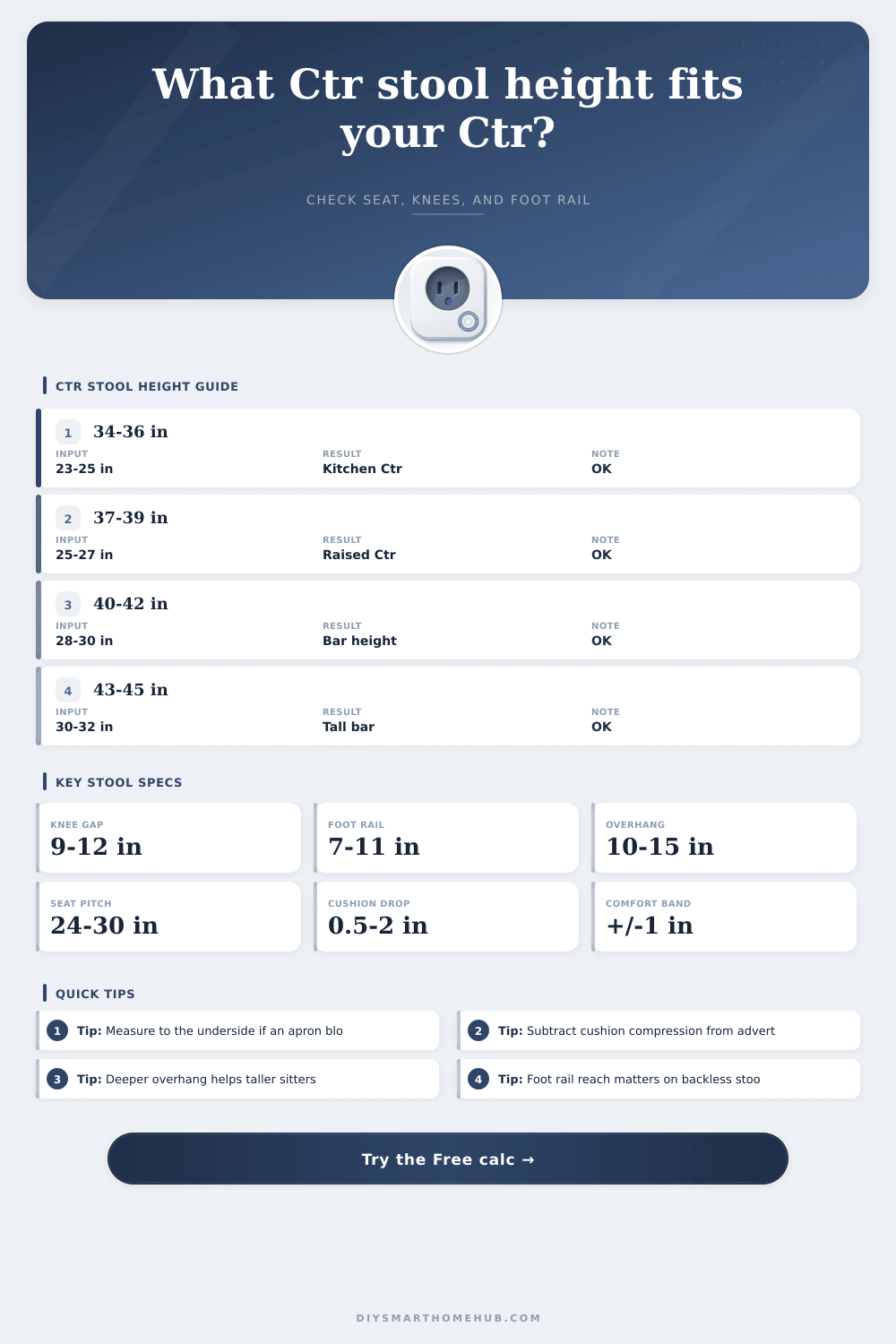
| 34-36 in | Counter height | 23-26 in stool | 9.5-12 in |
| 37-39 in | Raised counter | 25-28 in stool | 10-12 in |
| 40-42 in | Bar height | 28-30 in stool | 10-13 in |
Clearance and Overhang Checks
| Item | Tight | Comfortable | Notes |
|---|---|---|---|
| Vertical knee gap | 8-9 in | 10-12 in | Use underside height if an apron or thick edge reduces space. |
| Overhang depth | 8-10 in | 11-15 in | Taller users and full-back stools benefit from deeper recess. |
| Seat-to-foot-rail drop | 5-6 in or 12+ in | 7-11 in | Backless stools need a reliable foot perch. |
| Stool spacing | 22-24 in | 26-30 in | Use the wider number for arms, swivel, or broad seats. |
Stool Type Adjustments
| Stool type | Seat height effect | Foot rail target | Layout allowance |
|---|---|---|---|
| Backless | Neutral | 8-10 in drop | Compact pull-back, but foot support matters most. |
| Low-back | Neutral to +0.25 in | 8-11 in drop | Add a little space behind the counter run. |
| Full-back | Often -0.25 in | 8-11 in drop | Needs deeper overhang and more pull-back room. |
| Swivel | Neutral | 7-10 in drop | Allow wider spacing so knees do not collide. |
| Saddle | Often +0.25 in | 7-10 in drop | Works well at compact islands with shallow backs. |
| Upholstered | Compression-driven | 8-11 in drop | Check real seated height after cushion settles. |
Quick Buying Tips
When we see an image of some cool-looking kitchen island onscreen, it all seems just right. But then you try to sit down and your knees is jutting into the cabinetry, or else you’re sitting with your shoulders hiked up and your feet dangling. To prevent such regrets, lets make those ideas real: That’s where the counter stool height calculator comes in.
Contrary to what most folks think for instance a thirty-six-inch counter doesn’t necessarily need a twenty-four-inch stool. It’s not mathematics of addition and subtraction (no, no, there are no set numbers). It’s about the negative space between you and hard edges in your environment. The tool assume you’ll have about 10-12 inches from your leg to the surface below to find the best place for your bum to sit against the counter. That vertical dimension is important, as we all require breathing room to move our bodies around, place our elbows down, slide up toward the counter, etc., without scraping our shins on a bulky stone ledge or apron.
How to Choose the Right Counter Stool Height
There might be a decorative wooden frame under a countertop. Hefty waterfall edge to a countertop? Your total effective height goes way down, and the tool factor this into its calculation, allowing you to select the exact spot where that obstruction occurs. So you don’t end up with a stool that’s great for the counter but not-so-great-for-the-knee.
The other factor that spoils meals is cushion compression. It’s one thing for a restaurant chair or barstool to have an advertised 26″ seat; it’s quite another to find yourself sitting on a 25″ perch when you’re done sinking into its plush upholstered frame. Losing just an inch reduce your knee clearance by that amount and shortens your reach distance to the foot rail, altering the whole ergonomic equation. If you account for the effect of the padding you’ve decided on (i.e., how much it’ll compress with your bodyweight), the tool will make the adjustment for you. Otherwise, you can wind up with stools that seem okay to sit on while trying them out in the store, yet is too high to be bearable after an hour of eating dinner.
For all-day comfort, particularly with backless models, proper foot support matter greatly. With no back to prop you up, you’ll want a foot ring or rail to help maintain your posture and reduce pressure on your thighs. Too high and your knees start crowding the countertop once more; too low and your feet goes numb. The chart below establishes a recommended drop zone from seat to footrail; ideally somewhere between seven and eleven inches. Sounds insignificant? Try standing for hours at a time with nowhere to rest your legs… your calves will be working overtime to keep you balanced.
Beyond looks, stool type matters. Deeper overhangs are necessary with full-back stools whose back rest extends farther outward from the cabinet face. Swivel ones needs more space between them to avoid hitting each other when moving away from the counter. Seat shapes vary. A saddle seat provides a different hip angle, which may suit one person’s preference but limit mobility in another. This affects the calculator’s comfort recommendations. It’s not simply a question of height, it’s also a matter of how much three-dimensional space the stool take up around you.
To that end, before you buy, sit down on a temporary chair with some boxes (or some stacks of books) to mock up the size. Then measure from your fake seat to the ground and test how much space is under your knees by hand. Spend a few minutes sitting there. Does your lower back ache? Are your feet hanging out in mid air? You would of learn what spreadsheets can’t show you about your own anatomy when you test it physically. The calculator give you the perfect set of starting values, but the real final verdict comes from your body.
Once the proportions are dialed in, an island that might have been a showpiece becomes something practical, a place for conversation, gathering, sitting down and talking. If it’s tall enough, you don’t even think about tucking your feet under the stool or angling your hip in any particular way; you simply sit. That’s when you know: The island isn’t just something beautiful to look at across the room; it’s somewhere you’d like to be.