Chair Seat Height Calculator
Estimate the chair height that fits your legs, desk, knee angle, shoes, cushion compression, footrest setup, task type, and armrest clearance.
⚙Quick presets
📏Your measurements
Formula Breakdown
📋Chair spec grid
📖Reference tables
| Fit Target | Common Range | Use It For |
|---|---|---|
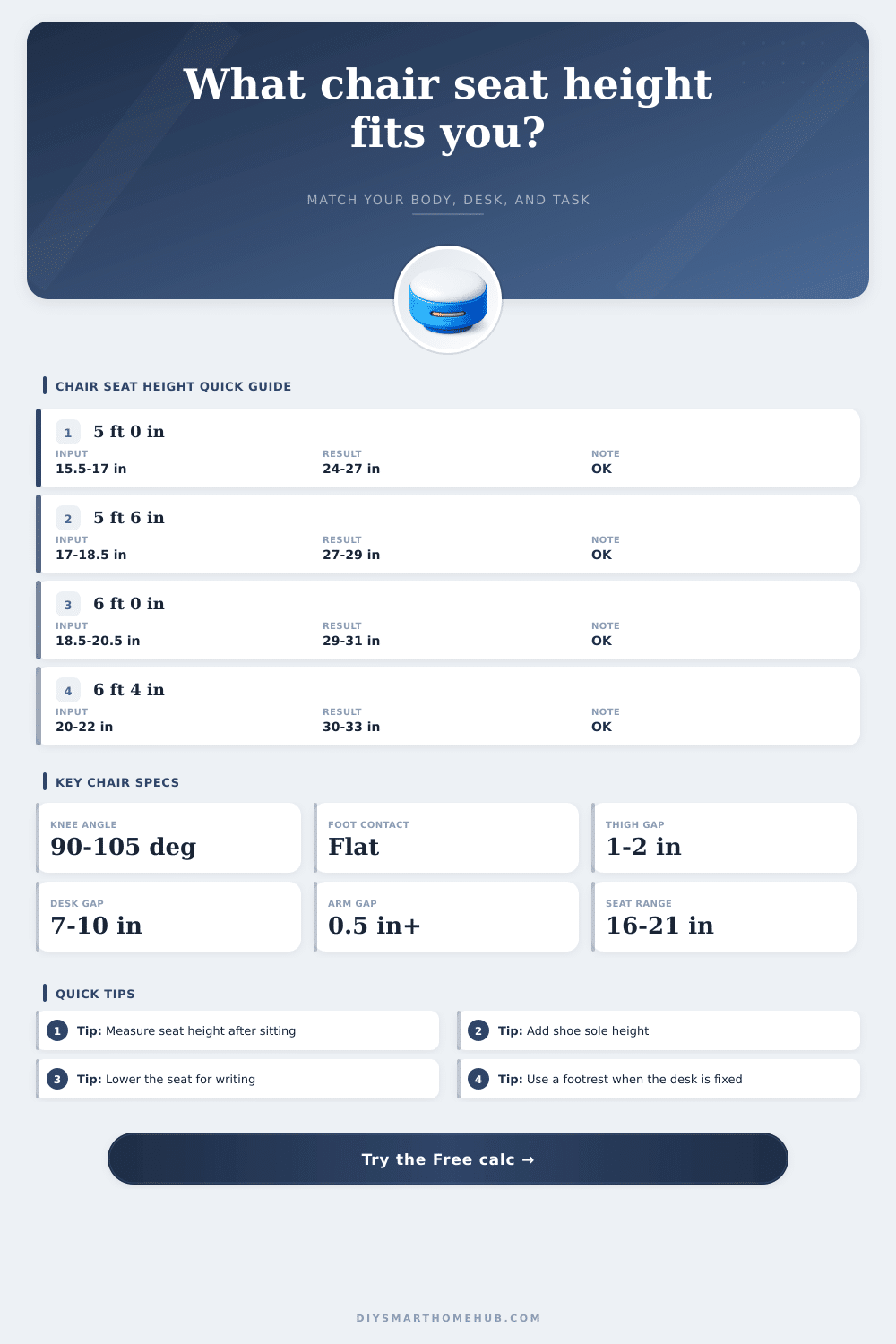
| Knee angle | 90-105 deg | Leg posture and seat height |
| Thigh to underside | 1-2 in clear | Desk apron and drawer checks |
| Elbow to keyboard | 0-1 in below elbow | Typing comfort |
| Armrest to desk | 0.5 in clear | Rolling under desk |
| Task | Seat Adjustment | Desk Bias |
|---|---|---|
| Computer | Neutral | Elbows near keyboard height |
| Writing | 0.3 in lower | Desk can feel slightly higher |
| Sewing | 0.4 in higher | Better pedal control |
| Drafting | 1.5 in higher | Footrest normally required |
| Preset | Height | Desk |
|---|---|---|
| Petite laptop | 5 ft 1 in | 27 in desk |
| Average desk | 5 ft 8 in | 29 in desk |
| Tall office | 6 ft 2 in | 30.5 in desk |
| Drafting stool | 5 ft 10 in | 38 in counter |
| Chair Type | Typical Range | Best Match |
|---|---|---|
| Task chair | 16-21 in | Most desks |
| Petite chair | 14.5-19 in | Shorter users |
| Tall chair | 18-23 in | Taller users |
| Drafting chair | 23-33 in | High counters |
✓Setup tips
If you’ve ever been seated in a chair that felt uncomfortable, without being sure why, then this is for you. Maybe your shoulders hunched closer to your ears, or your feet hung limply off the ground. Or maybe it was just the way that the edge of desk cut into your thighs, as if the shape of the chair were at fault.
There’s one parameter of a chair which is the key to comfort: how high the seat pan is off the ground (a.k.a. The “seat height“). The “seat depth“). Office chairs ship from factory with a generic adjustment range based off some notion of average, but no such thing exists for nearly anyone. With this tool, we begin with your real-world anatomy, not some arbitrary manufacturer’s default, to get you dialed-in correctly.
Why Chair Height Matters for Comfort
Popliteal height is measured as the distance from floor to the back of your knee. This is main measurement for determining where your seat needs to be. It ensure that the bottom of your leg hangs vertically while your thigh sits horizontally.
Too high: Your thighs will press against your chair’s underside. You’ll feel pressure on the bottom of your legs. This cuts off your circulation, leaving your feet floating in the air.
Too low: You’ll slouch forward and attempt to reach your keyboard, your hips will complain, and your rib cage will collapse. When you get this length correct, your body will naturaly support its own spinal shape, no effort required.
Half of the equation, though, is what you’re sitting at. Most desks has a standard height: Twenty-nine inches off the ground. If you’re below average, and you raise your chair up to reach this level, your feet aren’t going to be touching anything. Enter the tool, taking into account whether you need a footrest or any other kind of adjustment for tasks you’ll be performing. You might sit behind a drafting table, which needs your seat raised quite a bit. However, you also need solid footing; otherwise, your dangling leg will get tired after long periods. The tool takes all this into consideration (without compromising leg support for desk clearance).
The 1/2″ of sole on your every day sneakers or the heel’s wedge in your dress heels shifts your effective height relative to the chair; it matters far more than most people realize. Measure your inseam with the shoes you’ll be wearing at work. Furthermore, a plush foam seat squishes as you sit, sinking and lowering the seat height by an inch or more over time (a variable we call cushion compression). If you don’t account for this, you end up setting things “perfect” when you first sit down, only to find yourself discomfortaly mid-morning.
Another spatial issue involves the armrests. They has to be low enough for you to roll completely underneath the desk, and you want them to support your forearms. When your arm rests contact the desktop, then you’ll perch on the front of your chair in an attempt to get closer to the monitor, defeating the purpose of having adjustable arms! This clearance check also accounts for your unique desk apron height, and it’s frequently neglected. Many new desks has drawers that stick out into the knee area. This adds unnecessary bulk below the desktop, forcing you to sit farther from your desk then necessary.
The best position for your knees depends on task type: For example, when typing, you need a bit more open hip angle (to relax shoulders and easily move fingers). When writing or sewing, you may prefer a position that is more stable than one that allows for easy movement. That’s why there are presets in the calculator, they provide a starting point, and give a good idea what to expect from some common situations. But remember that these are just general guidelines. Your most comfortable way trumps general rules.
Use the calculated height as a starting point. Then adjust it based on how you notice yourself using your body. Is your neck neutral? Are your feet flat?
Seat design: A pneumatic cylinder moves within a fixed range of motion, and knowing this help select the appropriate chair. A cushion can’t compensate for a seat that’s too high or low for your ideal position. This means models with generous ranges of adjustment are particularly important if you’ll be sharing work space. Additionally, seat depth is frequently correlated with height adjustability (longer legs require deeper seats to avoid putting pressure on the back of the knees).
In short: It’s not about a magic number; it’s about building an ergonomic system that you can move with. Sure, the first measurement helps set the stage. But day-to-day adjustment is what really counts. You should of used this sooner.
Stand up. Change positions. Adjust again at lunchtime (your digestion changes the size of your torso). Make sure your seat height eliminates any friction between you and your surroundings. If your chair height gets it right, eventually you’ll forget you’re sitting on anything at all, which is the ultimate mark of a job well done.