Camera Night Vision Range Calculator
Estimate usable night reach from rated IR range, sensor lux, aperture, scene reflectance, target size, mounting geometry, IR wavelength, weather loss, and pixels per foot.
Calculation breakdown
| Night factor | Typical multiplier | Calculator use | Range effect |
|---|---|---|---|
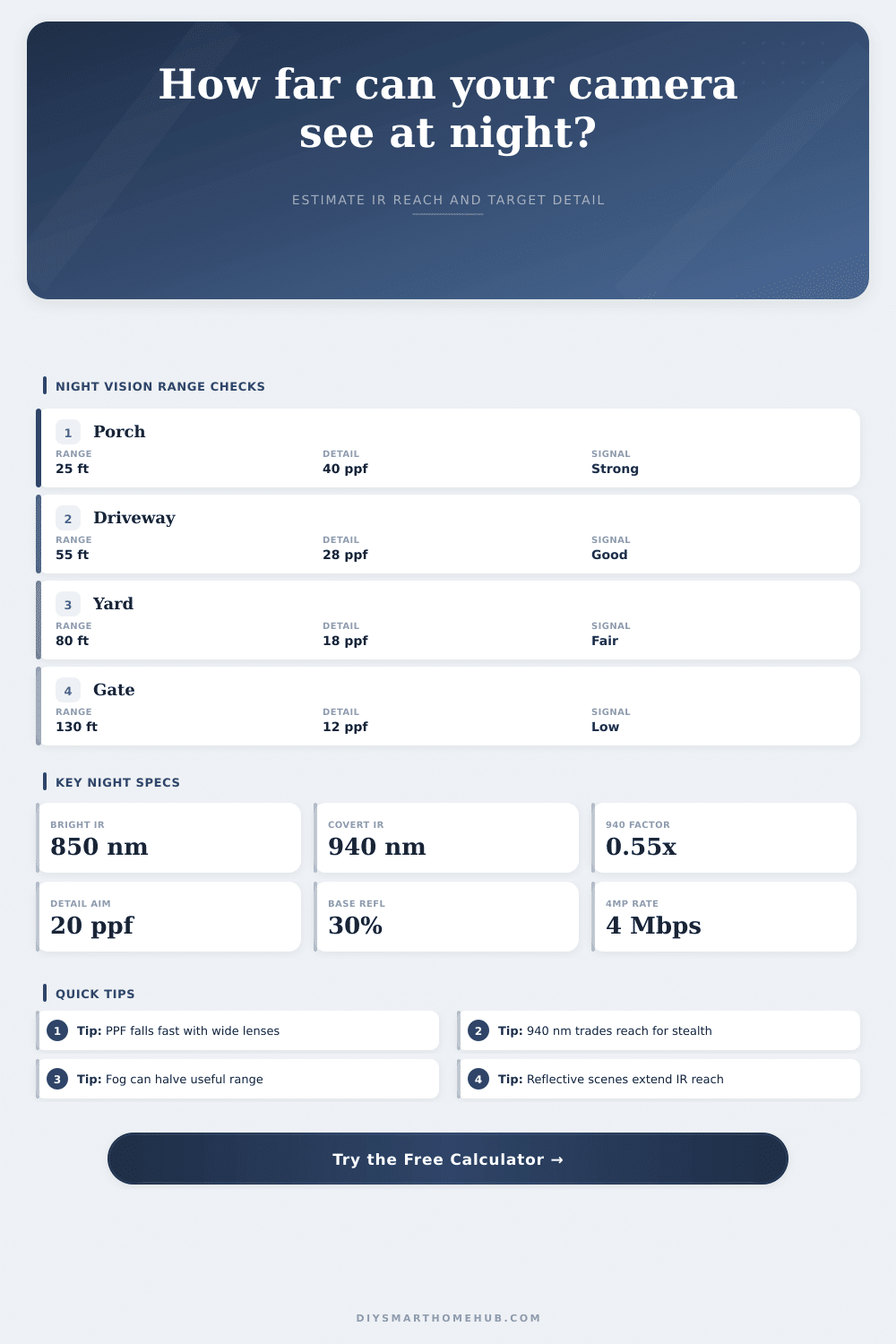
| 850 nm IR LEDs | 1.00x | Rated range baseline | Best built-in IR reach with a faint red emitter glow |
| 940 nm IR LEDs | 0.55x | Covert wavelength factor | Shorter range because sensors and LEDs are less efficient at 940 nm |
| Mixed yard reflectance | 30% | Scene reflectance baseline | Dark surfaces reduce returned IR; light concrete or siding improves it |
| Clean window path | 0.58x | Glass loss factor | Glass reflects nearby LEDs and absorbs part of the return signal |
| Fog or dusty air | 0.42x | Weather loss factor | Backscatter and moisture can cut usable contrast sharply |
| Detail target | Pixels per foot | Best use | What to watch |
|---|---|---|---|
| Motion detection | 10 ppf | Knowing someone or something is present | Wide lenses can still detect far targets with little detail |
| Recognition | 20 ppf | Recognizing familiar people, vehicles, or repeated activity | Good general planning target for home cameras |
| Identification | 40 ppf | Clearer faces, clothing, and object details | Often requires narrower FOV or a closer mounting point |
| Plate/detail view | 60 ppf | Small target detail such as plates or labels | Night glare and shutter blur matter as much as pixel count |
| Resolution | Pixel width | Typical night bitrate | Storage note |
|---|---|---|---|
| 1080p | 1920 px | 2-3 Mbps | Works for entries and compact rooms at moderate distances |
| 4MP | 2560 px | 3-5 Mbps | Balanced detail for porches, driveways, and yards |
| 5MP | 2688 px | 4-6 Mbps | Slight detail gain when lens quality and focus are good |
| 4K | 3840 px | 6-10 Mbps | More PPF at the same FOV, with higher storage demand |
| Camera type | Typical rated IR | Common FOV | Night planning role |
|---|---|---|---|
| Doorbell camera | 15-30 ft | 120-150 deg | Close faces and packages, not distant driveway detail |
| Turret camera | 80-120 ft | 80-100 deg | General porch, side yard, and driveway coverage |
| Bullet camera | 100-180 ft | 45-90 deg | Longer outdoor lanes when the lens is not too wide |
| PTZ camera | 200-500 ft | Variable | Large yards, gates, and long approaches with zoomed detail |
Wide 2.8 mm lens
Strong scene awareness, but PPF drops quickly. Best for close porches, rooms, and short side yards.
Narrow 6 mm lens
Higher PPF at the same distance. Best when the target lane is known, such as a gate or driveway.
850 nm IR
Highest built-in IR reach for most security sensors. Choose it when visible LED glow is acceptable.
940 nm IR
More discreet illumination with shorter reach. Works best for close, reflective, low-glare scenes.
In the grainy video shot online it’s just a shadow passing by in the dark.
That is the gap between what a product promises and how it actualy works. A hundred feet of night-vision range on a camera box was measured under ideal conditions that is never found outside the test lab. Weather cooperation, how much light are reflected off the scene, and how well your lens resolves an image can reduce usable range in no time flat. You can put the numbers into the calculator above, or get more use out of them by knowing which ones affects results.
The Truth About Night Vision Range
The choice of lens is the first step; it determines how much you can actualy see instead of just guessing. Wide angle lenses offer an overall view of a property. Safe feeling. But they spread pixels thin over distance. Those same pixels must stack up to read a license plate, or to pick out a face. That’s when pixels per foot becomes the critical metric. Yes, you may be getting a lot of infrared on the target from eighty feet away, but there might not be enough detail density in the resolution to read anything. It sounds minor but it matters.
Narrowing the lens concentrates the resolution, sacrificing width for clarity at distance.
Oh, and there is the light. Most security cameras uses eighty-five nanometer infrared LEDs. Effective enough, but anybody who looks at you from within beam of those lights can see the faint red glow and know they’re under observation. Consider switching to a less noticeable 94 nanometer instead. It’s undetectable by the human eye, but it’s not free. Range suffers a steep penalty as it’s much less efficient. The page tool does the math for you, and spares you having to overestimate effective range of that sneaky light. It’s a stealth-versus-range tradeoff. You choose.
Remember to consider where the light strikes. Dense shrubbery or a dark fence will absorb most of the energy instead of reflecting it back. Even when the LEDs are on full blast, the camera see black. Concrete or a light-colored wall reflects it right back, increasing the useful range nicely. This is how you get different performance from exact same camera in two different locations. What the sensor can see depends on scene reflecting it back.
Toss in some weather losses and it’s worse. Heavy rain and fog scatter infrared light, which washes out the image with a wall of glare. You might have one-hundred foot theoretical range, but a humid night cuts that in half.
The last bit of the equation is one that doesn’t impact the picture directly, mount geometry. If you’re mounted too steep, ground fills up the shot and causes objects to dissapears from the image before they reach full resolution. Mounting very flat allows for more distance by keeping the horizon visible. That’s where a calculator comes into play. It calculates how far something needs to be for you to actualy see it horizontally, taking into account your own mounting angle and height. This is different than the manufacturer’s measurement of their straight-on line of sight in a studio. It connects the optics of what you can do versus what you have build.
Lastly, think about how much storage you can afford for your ambition. Recording at higher resolution, along with longer recordings, use up SD card capacity (or hard drive space) quickly. Maybe you want to record in 4 kilopixels of detail. But maybe your storage system won’t cope with that kind of bitrate for a month of night-time recording. That’s where the estimate should of come into play: balancing practical capacity vs image quality.
When planning out your own security system, it’s not so much about running after big numbers on a spec sheet as it is understanding tradeoffs. You must understand that in order to get details where you want them, you might need to compromise other areas of coverage. Your objectives define the bounds, while math informs how far they go. When you line up the storage, the light, and the lens with your requirements, the grainy shadows fade away and the footage becomes useful.