C Rate Charge Time Calculator
Estimate battery charge time from amp-hours, charger amps or target C-rate, starting and ending SOC, charge efficiency, taper time, temperature current derating, and the battery maximum charge C limit.
⚡Battery Charging Presets
🔋Battery And Charger Inputs
Charge time estimate
Formula breakdown
📊C-Rate Spec Grid
📘Reference Tables
| Battery profile | Conservative charge C | Common max input | Planning note |
|---|
| C-rate | Charge current for 100 Ah | Ideal 0-100 time | 70% SOC window |
|---|
| SOC window | Battery Ah returned | At 0.2C | At 0.5C |
|---|
| Charging scenario | Battery size | Charger input | Typical result |
|---|
⚙Battery Profile Comparison
💡Charge Planning Tips
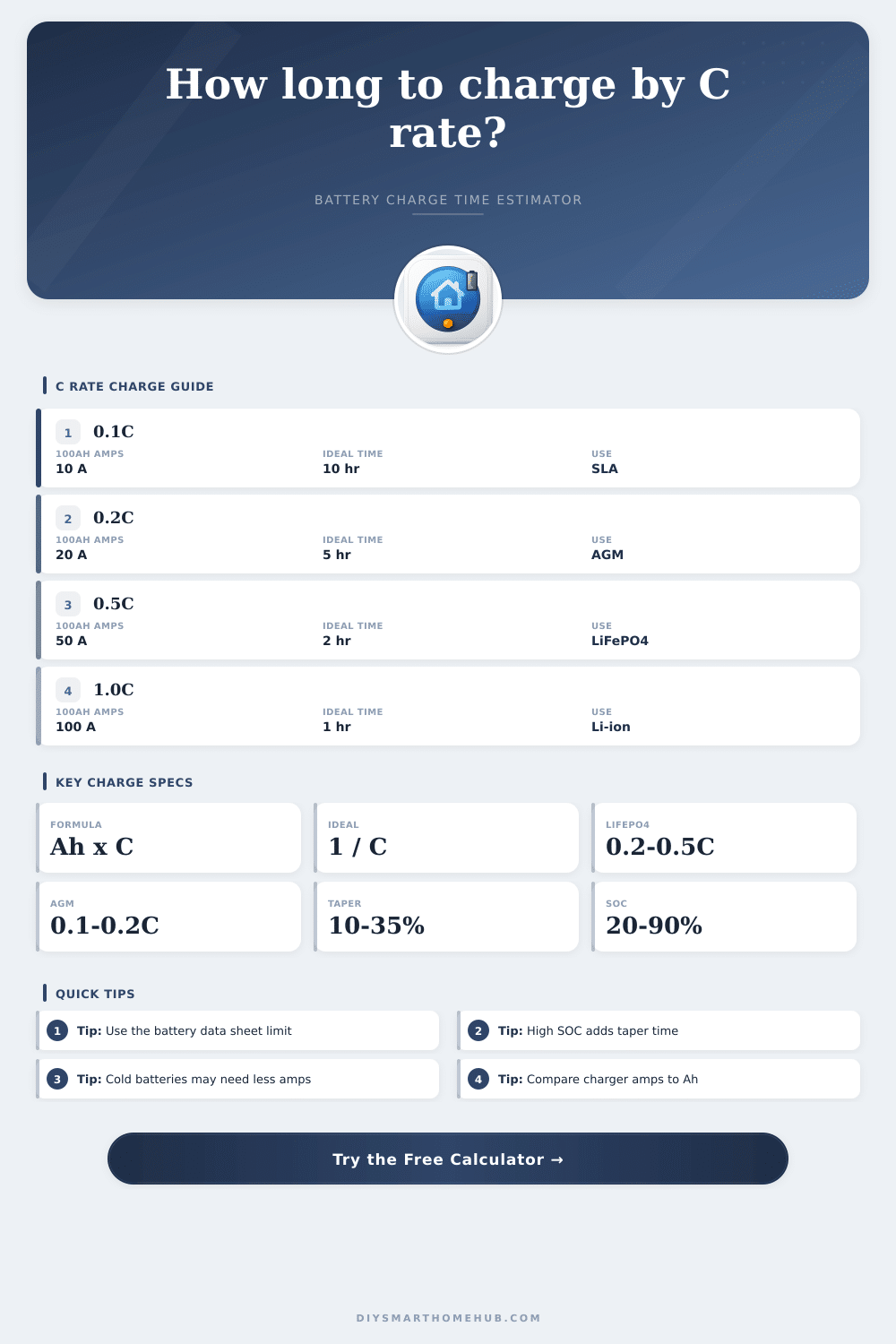
But after you put your specs into it, the calculator do all the math for you (above). There is no guesswork as to taper time or efficiency losses. To keep your equipment healthy, here’s what those inputs mean: The C-rate is just a capacity multiplier for the battery. So if it says 1C, then you are charging at the capacity of the cell in amps. At 1C rate, the cell can handle its full amp-hour rating. So if you have a 100 Ah pack, that’s 100 amps coming in.
And yes, that sounds awesome… UNTIL you realize that heat generated will scale with the SQUARE of the current. Double the speed = QUADRUPLE the thermal load. That’s the missing piece for most folks. They see the speed but don’t see the thermal cost.
How Charging Time Works
This is also where lead-acid batteries has their quirks. A flooded cell requires gentle sipping so you don’t gas out its electrolyte. An AGM variant will handle a slightly faster rate, but if you go too far you will warp plates inside. Lithium technologies turn entire conversation on its head. A LiFePO4 pack will easily take up to 0.5C and sometimes 1C without batting an eye, assuming your BMS permits that load. That’s part of what makes context important rather than just voltage. Don’t try to use a golf cart battery instead of an e-bike pack. The chemistry sets the timeline.
Here’s where temperature comes in silently and brutally. Cold makes lithium ions move sluggishly. When you pour current into a chilly cell, that current will force the lithium metal to plate on the anode rather than intercalate correcty. That forms what are called dendrites. These little spikes shoot through separator and create shorts. It is a minor detail but hugely important for safety. Derating does this: it imitates cutting back your amperage when it’s cold out. Smart chargers senses resistance and do this for you automatically, but with manual systems, you’re the brain.
And then we have the taper phase. Once your battery reaches 100%, you think charger shuts off right? Nope. It moves into an absorption phase where it keeps charge at a constant voltage but lowers the amperage. The last few percentage points can be just as long (if not longer) than the original “bulk” phase. In fact, charging from 80% to 90% is frequently faster per amp-hour then charging from 90% to 100%. That is exactly why. You sacrifice expediency in exchange for efficiency.
Your plans get eaten up with efficiency losses as well. Nothing is 100%. There’s some loss during conversion that creates heat. Wire resistance drops voltage. Most calculators uses a realistic efficiency percentage rather than an optimistic one. This is often around 95%, which is very good for moddern lithium systems. Lead acid loses even more to heat and gassing. If you ignore this then your trip planner will always be optimistic. Optimism doesn’t work on the road, realism gets you home.
The chart above will help you see where various chemistries stack up. It points out the tradeoffs quite clearly. Ten hours at a gentle 0.1C preserves a flooded lead-acid bank for decades while an RC LiPo pack needs it in less than one hour. Neither is wrong. Each serves the master it was created for. Match your charger to the personality of the battery. Don’t make it do something it doesn’t want to do. Don’t force a sprint when the cell wants a jog, don’t force a sprint when it wants to jog.
So in a nutshell, how long does it take? How long is a piece of string? Planning, that’s what charge time is. When do I go home? What size power supply do I need? Do I need more than one charger? Beyond those answers, though, patience is what charge time teaches us. There’s no magic with energy storage. It’s just science (physics + chemistry) with limits. Respect them and the battery will respect you. You should of remembered that if you forget where the wall was built, do you come up against it.