Blind Slat Count Calculator
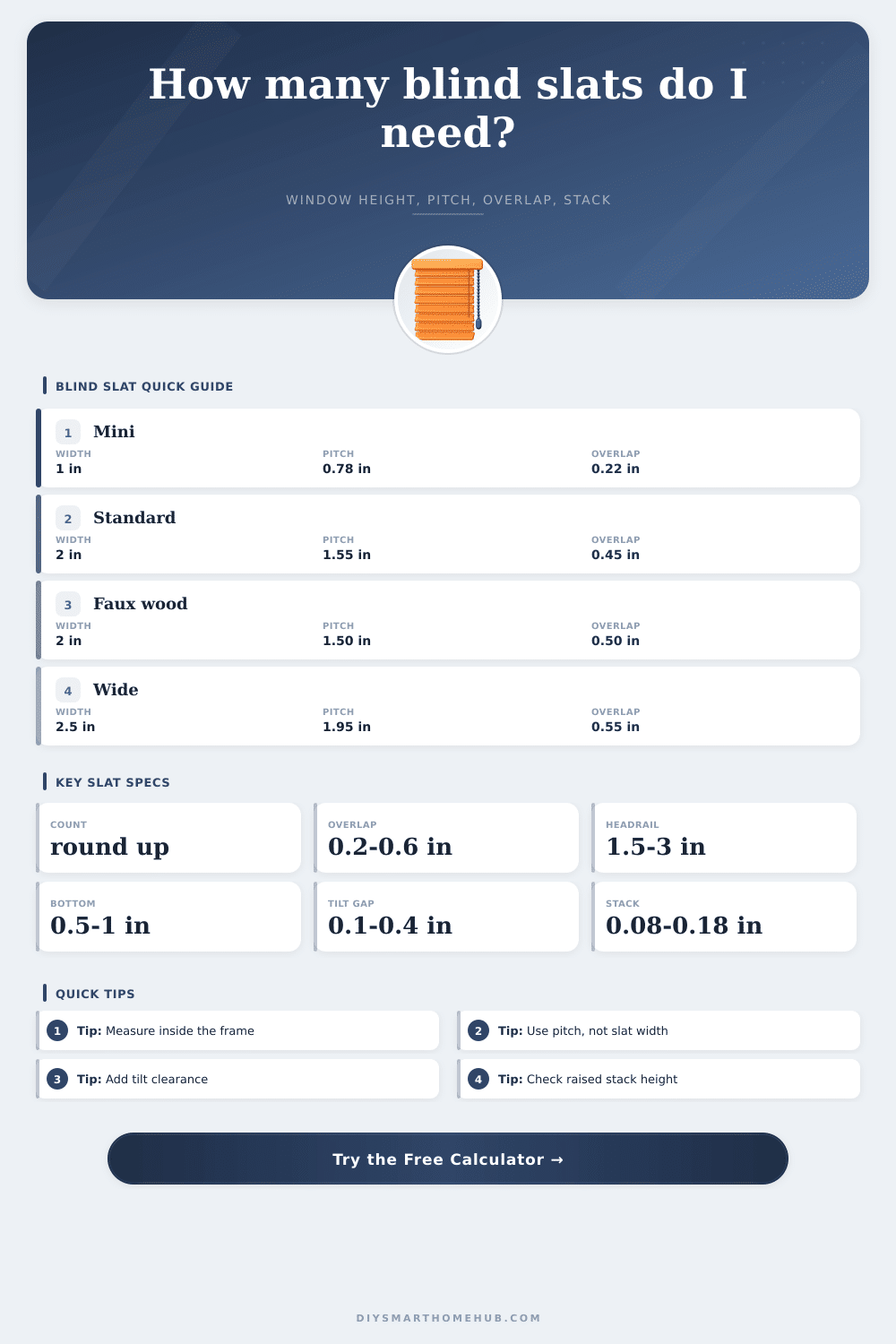
Estimate horizontal blind slat quantity from window height, slat pitch, slat width, target overlap, headrail and bottom rail allowance, tilt clearance, stack height, and unit system.
📌Blind Size Presets
📏Window, Slat, Clearance, And Stack Inputs
Slat Count Results
Count and stack results will appear here.
Calculation Breakdown
📊Blind And Slat Spec Grid
📋Slat Profile Reference
| Profile | Typical Slat Width | Typical Pitch | Overlap Range | Stack Note |
|---|---|---|---|---|
| 1 in aluminum mini blind | 1.00 in / 2.54 cm | 0.75 to 0.82 in | 0.18 to 0.28 in | Low stack, more slats per drop. |
| 1 in vinyl mini blind | 1.00 in / 2.54 cm | 0.78 to 0.86 in | 0.14 to 0.24 in | Slightly thicker stack than aluminum. |
| 2 in standard horizontal blind | 2.00 in / 5.08 cm | 1.48 to 1.62 in | 0.38 to 0.55 in | Common room-size balance. |
| 2 in faux wood blind | 2.00 in / 5.08 cm | 1.45 to 1.58 in | 0.42 to 0.60 in | Heavier slats usually stack taller. |
| 2.5 in wide slat blind | 2.50 in / 6.35 cm | 1.85 to 2.05 in | 0.45 to 0.70 in | Fewer slats, taller slat face. |
🗂Pitch, Overlap, And Count Guide
| Design Choice | Count Effect | Coverage Effect | Stack Effect |
|---|---|---|---|
| Smaller pitch | Raises slat count | Increases overlap and privacy | Raises compressed stack height |
| Larger pitch | Lowers slat count | Reduces overlap and may create gaps | Lowers compressed stack height |
| More target overlap | May force more slats | Improves closed coverage | Usually raises stack height |
| More rail allowance | Lowers slatted drop | Less slat coverage needed | Base stack still occupies opening |
| More tilt clearance | May add one slat | Reduces bottom gap risk | Can slightly reduce clear opening |
🏠Common Window Size Examples
| Opening | Height | 2 in Slat Estimate | 1 in Mini Estimate | Raised Stack Check |
|---|---|---|---|---|
| Small bath window | 36 in / 91 cm | 24 to 26 slats | 44 to 47 slats | Usually under 7 in |
| Kitchen window | 42 in / 107 cm | 28 to 30 slats | 52 to 55 slats | Check faucet clearance |
| Bedroom window | 60 in / 152 cm | 39 to 41 slats | 74 to 78 slats | Stack often near 8 to 12 in |
| Door lite | 66 in / 168 cm | 43 to 45 slats | 81 to 85 slats | Bottom rail clearance matters |
| Tall room window | 84 in / 213 cm | 55 to 58 slats | 103 to 108 slats | Confirm raised view opening |
⚙Formula Reference
| Step | Formula | Why It Matters | Output Used |
|---|---|---|---|
| Slatted drop | Window height - rail allowance | Removes non-slat hardware height from the coverage span. | Coverage need |
| Working pitch | min(pitch, slat width - overlap) | Prevents the count from ignoring the target overlap. | Slat spacing |
| Slat count | ceil((need - width) / pitch) + 1 | Counts the first slat face plus repeated pitch increments. | Required slats |
| Coverage | width + (count - 1) x pitch | Shows whether the count covers the adjusted drop. | Surplus |
| Raised stack | base stack + count x stack per slat | Estimates the height left at the top when raised. | Clear opening |
📝Calculator Tips
You get blinds on-line and they don’t fit your window. Maybe there’s a big gap, or maybe there are to many slats. Why? Because most people takes a measurement of their window, divide by the number of slats and order accordingly. Bad idea. There’s more math to it than that.
There’s stack height, pitch, overlap and tilt clearance. All of this have to be figured out. And they all determine how many slats you’ll need. How much you raise the blind is decided by the height of the stack. These variables make up the appearance of the window treatment. They are what determine whether the install appear custom, or like an accident.
Why Your Blinds Do Not Fit Well
After measuring your windows and plugging those numbers into the calculator (above), you get the rest. No need for math mistakes. It makes you think about pitch: How far apart is the slats? You have to decide on this number, because it determines how many slats will fit vertically across window. Pitch is also important for privacy, since not accounting for overlap can mean that even when the blind is tilted, it could still reveal what’s on your floor. That is not good. It turns the window’s height into an exact number of slats. So there won’t be any uncovered area at the base; the slats will block it all.
Half the battle is understanding what goes in. One input that many homeowners don’t consider is rail allowance. The thinking is that the slats extend all the way from the top of the frame down to the bottom. But there are bottom rails and headrails that uses vertical inches. For example, a typical headrail can be as much as two and a half inches high. So unless you account for that amount before ordering your slat length, odds are you’ll end up with more than needed. The blind could touch the windowsill or hang lower different than desired. Enter the correct rail allowance, and the calculator will adjust the math so the slats fits perfectly into the remaining drop height.
Other things to consider are the stack height and tilt clearance. When you raise horizontal blinds they will move vertically as the slats changes position. With insufficient tilt clearance, the bottom edge come off the sill. This allows light through and reduces your privacy. Simply increasing the tilt clearance by a quarter inch can eliminate this defect.
Then imagine having raised the blind all the way. The slats must stack up on each other at the top of the window. On a tall window with thick faux wood slats, that stack might be bulky enough to obstruct a good chunk of glass area, even with the blind fully raised. Knowing the stack height will help you determine if horizontal blinds is suitable for that window.
The Geometry are affected by material choice. Real wood or faux wood blinds is heavier and thicker. More space per slat are needed when they’re compressed. That means more stack height above the window in the raised position too. Aluminum mini blinds is much lighter and thinner. A slimmer stack is possible with them, and tighter pitches are possible. It’s an interesting trade-off, do you want the look of real wood or faux wood? Do you have a short window where the stack height will block your view? It is aesthetics versus function.
The page has some typical dimensions laid out in tables as a reference. Use these to check against your own measurements. This helps you make sure you know what will work for you before you commit to a design. You should of checked this first.
Window treatments are about precision not approximations. A well-fitting blind says “I meant to do that”. An awkwardly hanging blind invites scrutiny, but for all the wrong reasons. When you factor in overlap, pitch and allowance for hardware you transition from guessing to knowing precisely what will fit. These little details of geometry make all the difference between a good install and a great one. They provides the privacy where required and keep your views clear when needed. Actualy it is naturaly a moddern way to look at it. It looks more luxurius too.