Air Purifier Filter Replacement Days Calculator
Estimate replacement days from rated filter hours, daily runtime, dust, pet and smoke loading, CADR-to-room ACH, prefilter care, and any hours already used.
Formula: effective days = ((rated hours - used hours) x prefilter extension x early-replacement buffer) divided by (daily runtime x dust/pet/smoke load x ACH stress factor).
Filter type defaults
| Filter type | Typical hours | Main load | Notes |
|---|---|---|---|
| Main HEPA | 4,380 | Fine particles | Often 6 to 12 months at moderate runtime |
| HEPA plus carbon | 3,000 | Particles plus odor | Carbon portion can saturate sooner |
| Carbon filter | 2,160 | Smoke and VOCs | Use shorter life when odor returns |
| Washable prefilter | 720 | Lint and hair | Clean frequently; replace if torn |
| Allergy filter | 3,650 | Pollen and dust | Use higher target ACH during season |
ACH and CADR checks
| Room use | Target ACH | CADR meaning | Filter impact |
|---|---|---|---|
| Sleeping room | 2-4 | Quiet overnight cleaning | Moderate runtime load |
| Allergy season | 4-5 | Frequent full-room passes | Higher particle capture |
| Pets | 4-5 | Dander plus hair prefilter load | Prefilter care matters |
| Smoke event | 5-6 | High clean-air demand | Shortens HEPA and carbon life |
| Open plan | 3-4 | Large volume dilution | Watch undersized CADR |
Load multipliers used
| Load factor | Low | Normal | Heavy |
|---|---|---|---|
| Dust | 0.92x | 1.00x | 1.18-1.42x |
| Pets | 1.00x | 1.10x | 1.22-1.35x |
| Smoke | 1.00x | 1.20-1.55x | 1.90-2.15x |
| Odor/VOC | 1.00x | 1.08-1.16x | 1.25x |
Common purifier scenarios
| Scenario | Runtime | Room | Main driver |
|---|---|---|---|
| Bedroom pollen | 10 hr/day | 12 x 14 ft | Runtime plus ACH |
| Pet living room | 16 hr/day | 20 x 18 ft | Pet and dust load |
| Smoke control | 24 hr/day | 16 x 20 ft | Carbon saturation |
| Construction dust | 12 hr/day | 14 x 16 ft | Heavy dust loading |
| Apartment | 18 hr/day | 500 ft2 | Large shared area |
For example, most manufacturers rate their filter for 12 months, so most of us change them seasonally (twice per year), following a calendar different than a use-based schedule. Our homes is all different. Even though one person’s environment may be rated for 12 months of filtration, mine might only last six if I cook a lot, have a shedding dog, or live near wildfire smoke.
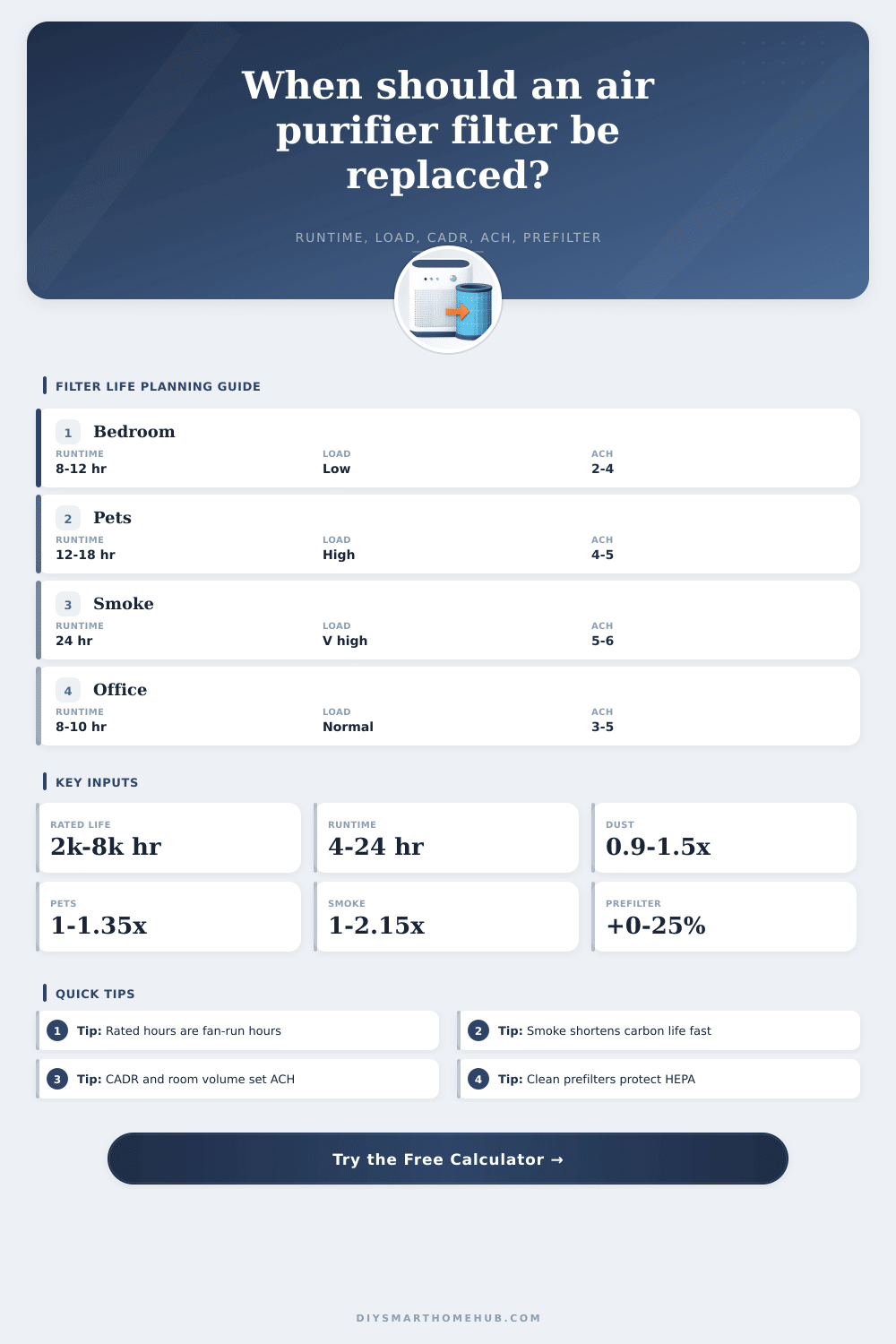
Filters are also measured in hours, not months. Of operation with the fan running. That 4k hour-rated filter isn’t rated by the year; it is rated for four thousand hours of actual air circulation. Are you running it at high all day, every day because you’re suffering from allergies? You’ll blow right through that rated number, burning double the hours compared to someone leaving the filter running just at night. Because most manuals assume you’re using a conservative eight-hour cycle overnight, they’re incorrect if you use thing as a background system.
Why You Should Not Change Filters by Time
The calculator asks how many hours per day you operate it. That’s usually the largest variable that people forget to take into account. The hour burn rate gets multiplied by how much pollutant load there is. Naturaly you might expect dust and pet dander to be predictable offenders. You can’t really guess what else will speed up saturation. Like strong odors and smoke. Although many filters use HEPA media plus an activated carbon layer, the latter has a limited ability to soak up chemicals. Once that carbon is full of chemicals from outside smog or cooking fumes, it no longer works even if filter looks clean.
To account for such unseen loads, the tool measures your dust level, pet levels and smoke levels and applies multipliers so the resulting data takes into account not just physical blockage but also chemical saturation.
The metrics is airflow and room size. An undersized purifier will have to work harder (or run longer) to provide the same level of air quality in a big space as it would in a small one. That makes the filter media wear out faster. This also causes a measurable decrease in filter life, where even a small mismatch in size lead to a noticeable reduction in how many hours your filter lasts. Your Air Changes per Hour are calculated by entering the size of your room(s) and unit’s Clean Air Delivery Rate. The Air Changes per Hour metric directly reflects how much harder the unit has to work, or for how long, to deliver those air changes. Different room usage demand higher air change targets (see the reference table on the page).
Longevity is also affected by maintenance habits. For example, the prefilter is sold as being cleanable. It is more than just a selling point it acts as a shield between your expensive HEPA media and any large particles that might otherwise get stuck in inner parts. Regularly washing or vacuuming that outer layer will extend the lifespan of the main filter significantly. The calculator factors that into its life estimate with an extension factor depending on how often the prefilter gets cleaned. This little gesture can buy you some real weeks of extra usage time. When you’re looking to minimize waste or stretch the budget, it makes a difference.
Manufacturers rate filters in fan-run hours, not months. Early replacement = out-of-pocket money. Delayed replacement leads to dirty air and possibly higher energy costs because an overworked fan attempt to force air through a full media bed. You don’t want to replace based off time, you want to replace based on how fast your particular setup eats up filtration capacity. By viewing the adjusted life in terms of days, not vague “months,” you’ll know the exact moment the gray line hits the red so you can stock up in advance without panic buying… or overspending! Peace of mind and money saved are worth clean air, and clean filters.