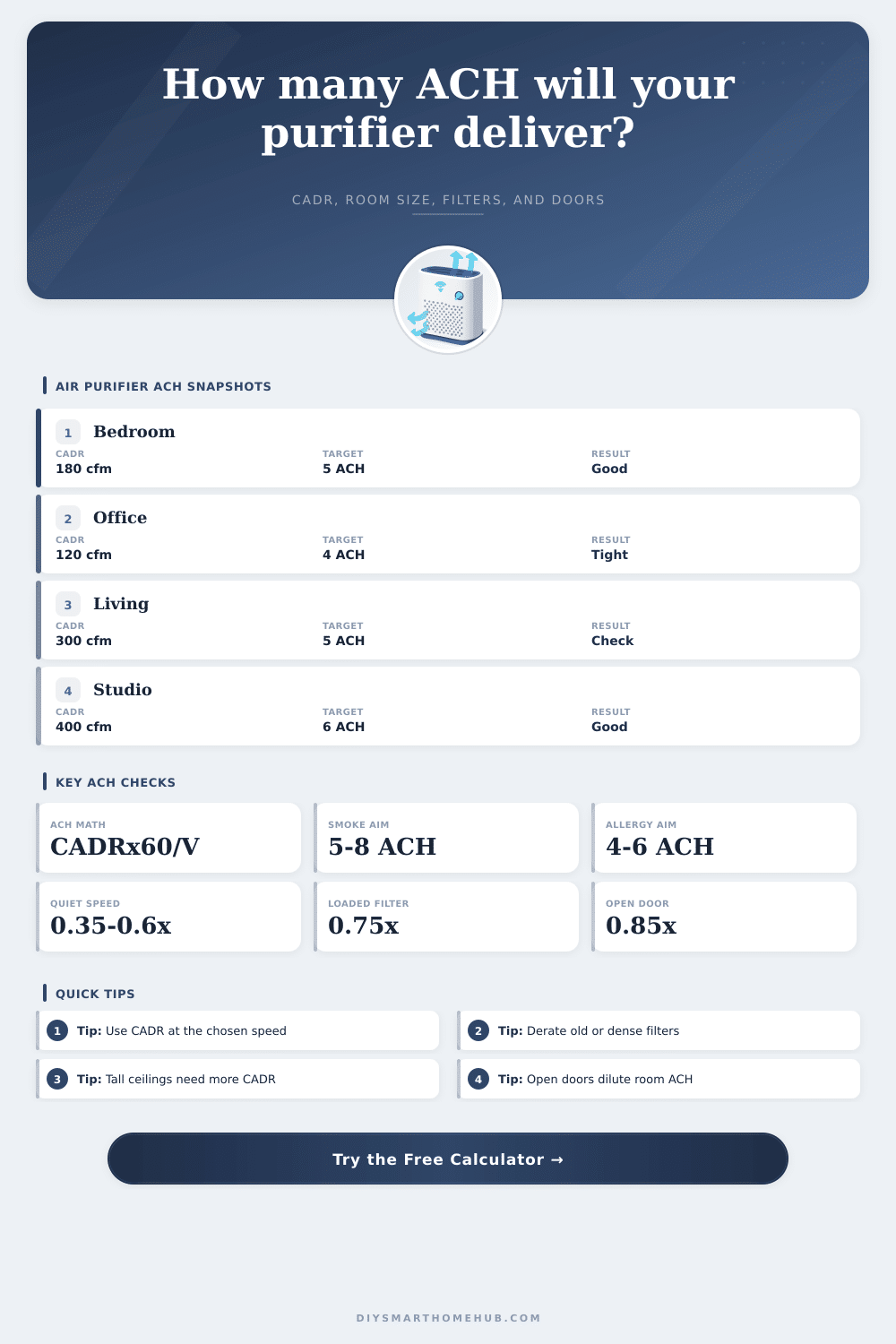
Air Purifier ACH Calculator
Estimate delivered air changes per hour from CADR, room dimensions, ceiling height, purifier count, fan speed, filter condition, door mixing, and your target ACH.
⚙Room And Purifier Presets
📏Calculator Inputs
Air Cleaning Result
Delivered ACH and CADR will appear here.
🧮Live Formula Grid
Length x width x height.
Speed x filter x door factor.
Target ACH x volume / 60.
Rounded up at current settings.
📊ACH Target Reference
| Use case | Typical ACH target | CADR formula | Planning note |
|---|---|---|---|
| Light background cleaning | 3 ACH | Volume x 3 / 60 | Useful for mild particle reduction when noise is the priority. |
| General bedroom or office | 4 ACH | Volume x 4 / 60 | A common practical room target for continuous operation. |
| CADR room-size comparison | 5 ACH | Volume x 5 / 60 | Many purifier room claims are easiest to compare around this level. |
| Allergy or high occupancy | 6 ACH | Volume x 6 / 60 | Adds margin for people, pets, and repeated particle sources. |
| Smoke event or fast cleanup | 8 ACH | Volume x 8 / 60 | Requires substantially more clean air or more purifier count. |
🌬Purifier Spec Grid
| Purifier class | Typical CADR | 5 ACH coverage at 8 ft | Best fit |
|---|---|---|---|
| Compact desktop | 60-100 CFM | 90-150 ft2 (8-14 m2) | Small office, nursery corner, or focused desk zone. |
| Small room tower | 110-180 CFM | 165-270 ft2 (15-25 m2) | Bedrooms, closed offices, and modest media rooms. |
| Large room purifier | 220-350 CFM | 330-525 ft2 (31-49 m2) | Living rooms, primary bedrooms, or open dining areas. |
| High CADR console | 400-600 CFM | 600-900 ft2 (56-84 m2) | Studios, open plans, and high-load smoke periods. |
| Two medium purifiers | 360-500 CFM | 540-750 ft2 (50-70 m2) | Long rooms where distribution matters as much as total CADR. |
📐Common Room Size Table
| Room size | Volume at 8 ft | CADR for 5 ACH | CADR for 8 ACH |
|---|---|---|---|
| 10 x 10 ft (9.3 m2) | 800 ft3 | 67 CFM | 107 CFM |
| 12 x 14 ft (15.6 m2) | 1,344 ft3 | 112 CFM | 179 CFM |
| 15 x 18 ft (25.1 m2) | 2,160 ft3 | 180 CFM | 288 CFM |
| 20 x 20 ft (37.2 m2) | 3,200 ft3 | 267 CFM | 427 CFM |
| 20 x 30 ft (55.7 m2) | 4,800 ft3 | 400 CFM | 640 CFM |
🧰Derating And Coverage Table
| Adjustment | Factor range | Formula impact | When to use |
|---|---|---|---|
| Fan speed | 0.35-1.00x | Rated CADR x speed factor | Use lower factors for sleep, low, or quiet operation. |
| Filter condition | 0.65-1.00x | CADR after speed x filter factor | Derate for loaded filters, dense carbon, or restrictive replacements. |
| Door opening | 0.65-1.00x | Effective CADR x mixing factor | Open doors and connected halls spread cleaning across more air. |
| Runtime duty | 0.01-1.00x | Live ACH x runtime fraction | Use this only when the purifier cycles off during the hour. |
| Coverage at target | CADR x 60 / ACH / height | Turns clean air into supported area | Compare supported floor area with actual room area. |
💡Planning Tips
Why did you buy an air purifier? Because you wanted clean air. So you read the box, saw that big CADR number, and pictured your livig room being scrubbed fresh every hour. Now you turn it down to medium speed because it sounds like a jet engine otherwise. You crack the door open because you need some light. You wonder why you can still feel the pollen count so high.
Most people gets confused at gap between what marketing says and what actualy happens. This is where this calculator is useful. It bridges that gap by considering your actual habits different than assuming perfect lab conditions.
Why Your Air Purifier Does Not Work Well
The key number here is air changes per hour, or ACH. Simply put: ACH represent how many times an hour your whole room’s volume of air gets swapped out by clean air. An ACH of five are considered the sweet spot for comfort indoors. That means the air in the room are getting turned over five times an hour.
The math is straightforward enough that there is calculators like the one above that do all the work for you as soon as you plug in your room size and your device details. However, inputs is what become important here, not the equation. Use a ceiling height of ten feet rather than eight? Your room volume will increase a lot, and that added cubic footage need to be moved around just as much to keep up with the same cleaning rate.
It’s why people frequently think about the floor area they’re covering but overlook the vertical volume. High-ceilinged rooms gets underpowered because of this.
There are also other variables, such as fan speed. The CADR ratings published by manufacturers assumes maximum fan speed, which means aggressive, loud performance that most of us wouldn’t be running all night long. To keep the noise down, most users wind up settling for low or medium speeds. If you drop the fan speed from one-hundred percent to, say, fifty-five percent for sleep mode, then your effective cleaning power will drop right along with it. With this tool you can model that trade-off and see if a unit still meet your needs when it’s actualy quiet enough to use.
Another reason filters alter their performance: They degrade with age. The newer they are, the easier the air flow through them. After six months of catching dust, the HEPA filter will be full and air will flow slowly. Even though the fan motor may be running at full blast, more resistance mean less clean-air delivery. If you compensate for that falloff, you won’t assume that your purifier’s doing its job when in fact it’s barely breathing.
And then there’s the factor of open doors. How does one clean an open plan living area linked to a hallway compared to a sealed bedroom? When the barriers are removed the air gets mixed up and diluted. That mixing factor is built into the calculator. It explains how a unit may be fine in a closed room but not work as well in a large connected space. Such a space would of require more air changes to clear out the particles, such as during allergy season or when dealing with smoke from wildfires.
Beware of chasing specs; go by how your room volume will interact with your actual usage pattern. A large machine may be too much if all you want is mild background cleaning. Conversely, if you need superfast smoke clearance, you will probably need multiple machines or something much bigger. Distribution is as important as total airflow, so splitting a long room into two with two smaller purifiers can work better then having one giant unit. You want clean air in the corners not swirling around the intake.
When buying an air purifier (or any appliance), you need to think about your whole environment. Does the room’s shape matter? Do you care how loud the thing is? Use those as starting points; fill in the gaps from there until you’re down to one machine that meets your requirements. Then let the numbers do their jobs; not tell you what to buy.