Sit Stand Ratio Calculator
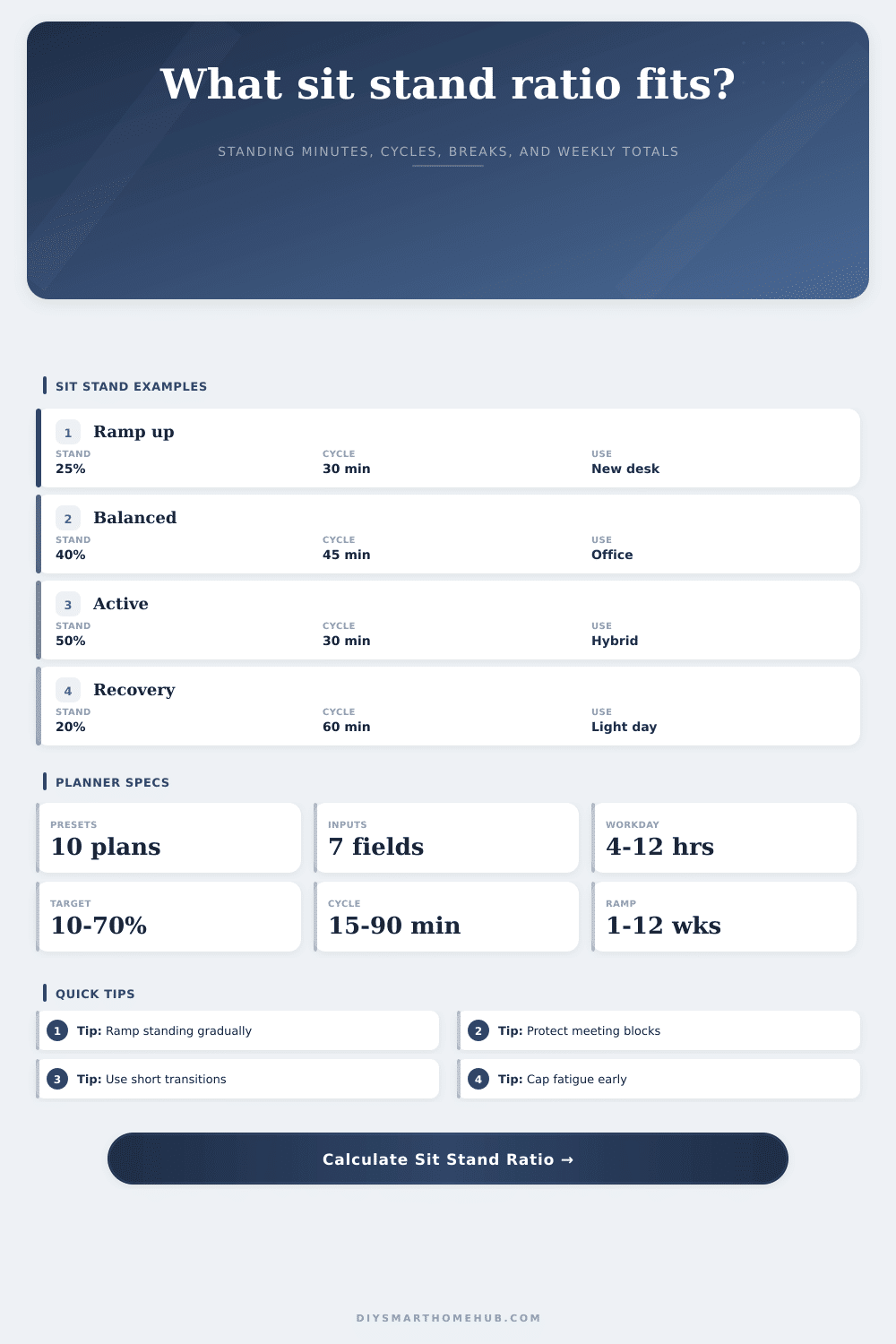
Plan a sit stand desk routine from workday hours, target standing share, interval length, meeting time, current standing, breaks, and ramp weeks.
Sit stand plan
cycle count = ceiling((workday minutes - meetings - break) / interval length)
standing per cycle = interval length x target stand percent
transition count = max(0, cycle count x 2 - 1)
calorie delta = max(0, target standing - current standing) x 0.2 kcal/min
fatigue cap = min(target standing, workday minutes x cap percent, cycle count x max stand block)
weekly total = daily standing x 5
| Target style | Standing share | Example 8 hour day | Best fit |
|---|---|---|---|
| Gentle ramp | 20% to 30% | 96 to 144 minutes standing | New standing desk users or recovery days. |
| Balanced routine | 35% to 45% | 168 to 216 minutes standing | Typical office work with moderate switching. |
| Active routine | 50% to 55% | 240 to 264 minutes standing | Short focused blocks and flexible tasks. |
| High standing | 60% to 70% | 288 to 336 minutes standing | Experienced users who tolerate longer stand blocks. |
| Preset | Workday | Target | Stand/day | Cycle split | Transitions | Calorie delta | Status |
|---|
| Interval length | 40% stand block | 60% sit block | Typical use |
|---|---|---|---|
| 15 minutes | 6 minutes | 9 minutes | Very frequent motion with many desk-height changes. |
| 30 minutes | 12 minutes | 18 minutes | Short blocks that are easy to place between tasks. |
| 45 minutes | 18 minutes | 27 minutes | Balanced work sessions with manageable transitions. |
| 60 minutes | 24 minutes | 36 minutes | Fewer interruptions for deep work or long calls. |
| 90 minutes | 36 minutes | 54 minutes | Low-transition days with longer posture blocks. |
If you have a standing desk, chances are pretty high you got it with the best of intentions. You’d be standing tall, looking and feeling great as you work efficienty through the day… switching back and forth between sitting and standing in a perfectly rhythmic beat.
Instead, chances are it was far more mundane (and maybe even painful), you had some lower back pain in the afternoon; you forgot to do this or that because you were too busy figuring out how to split your day.
How to Use a Standing Desk Plan
Hardware isnt really the problem. It’s that you don’t have a plan. Most people guess. Then they stands too much. They crash in week two. Then go back to being in the chair for next 12 months.
Sit stand ratio calculators help you not do that, instead of guessing, you get to do math. This concept is so straightforward that it’s easy to miss.
Here’s what you want to know: How many minutes do you realisticly think you can stand before hating your own legs? That’s the hard part. Thankfully, the tool on this page does all the math. It takes your total hours worked in a day and then removes your non-negotiable items.
What are they? They’re any large chunks of time that you can’t stop. Like a long conference call, a dedicated deep work block or a lunch break when you walk away from your desk. Ignore those blocks, and when you hit a meeting that runs over, your plan will fail. This tool prompts you for such details because it wants to assigns the standing minutes only within the flexible portions of your day. That distinction matter more than you’d expect.
Lastly, I want to highlight one input: ramp period. All of the advice says go all in right now and get that nice even 50/50 ASAP. It is not possible most days. Your body has to adjust to the postural load. A ramp period creates a slow march toward progress. You don’t jump from sitting 30 min/day to standing 300. You increment by tiny bits per week. It is humble but doable. Consistency trumps intensity every day of the week.
This is clear on the page: a humble beginning results in better long-term compliance then an aggressive makeover.
The next topic is intervals. How often do you want to switch? Once per hour? Every fifteen minutes? Try out various cycle durations in the calculator. If your cycle is shorter (more switches), it’s going to be disrupting when you’re trying to focus and get into a groove, but you’ll be keeping that blood flowing. If your cycle is longer (less switching), it reduces the friction of constantly readjusting, but would of tire you out if the standup block is too lengthy. No one-size-fits-all solution here. Your work determines what works best.
If you have a customer support job with lots of quick phone calls, you may find value in fast switches. But someone who writes code may find they’d like to have some continuous time at their seat/standing spot so that they can keep on a roll.
The calorie delta output is often a nice side effect rather than the main driver. Yes, standing burns a few more calories per hour compared with sitting, but those aren’t the primary benefits; they’re pain relief and improved metabolic health. Seeing that number still helps if my feet are complaining as I’m plodding along, it says, “It hurts now but it will be worth it.” And it is: The change is tangible.
So: How much standing should I do? In short: as little or as much as feels right for you. The goal isn’t to stand as long as possible; it’s to identify a pattern that feels natural and sustainable, something you can execute automatically, without having to negotiate it every day. Ideally, you want your standing routine to be such background noise during the day that you don’t even notice its there.
If you’re starting out, set a slightly lower bar than you feel comfortabley with. Let yourself creep up on it gradually over time. Guard your meeting carefully. And don’t push through the wall if you run into it; pull back instead.
The desk is not a punishment. It’s a tool. Let it help you get stuff done, not get distracted by it. That’s how you end up sticking to it.