Printer Toner Page Yield Calculator
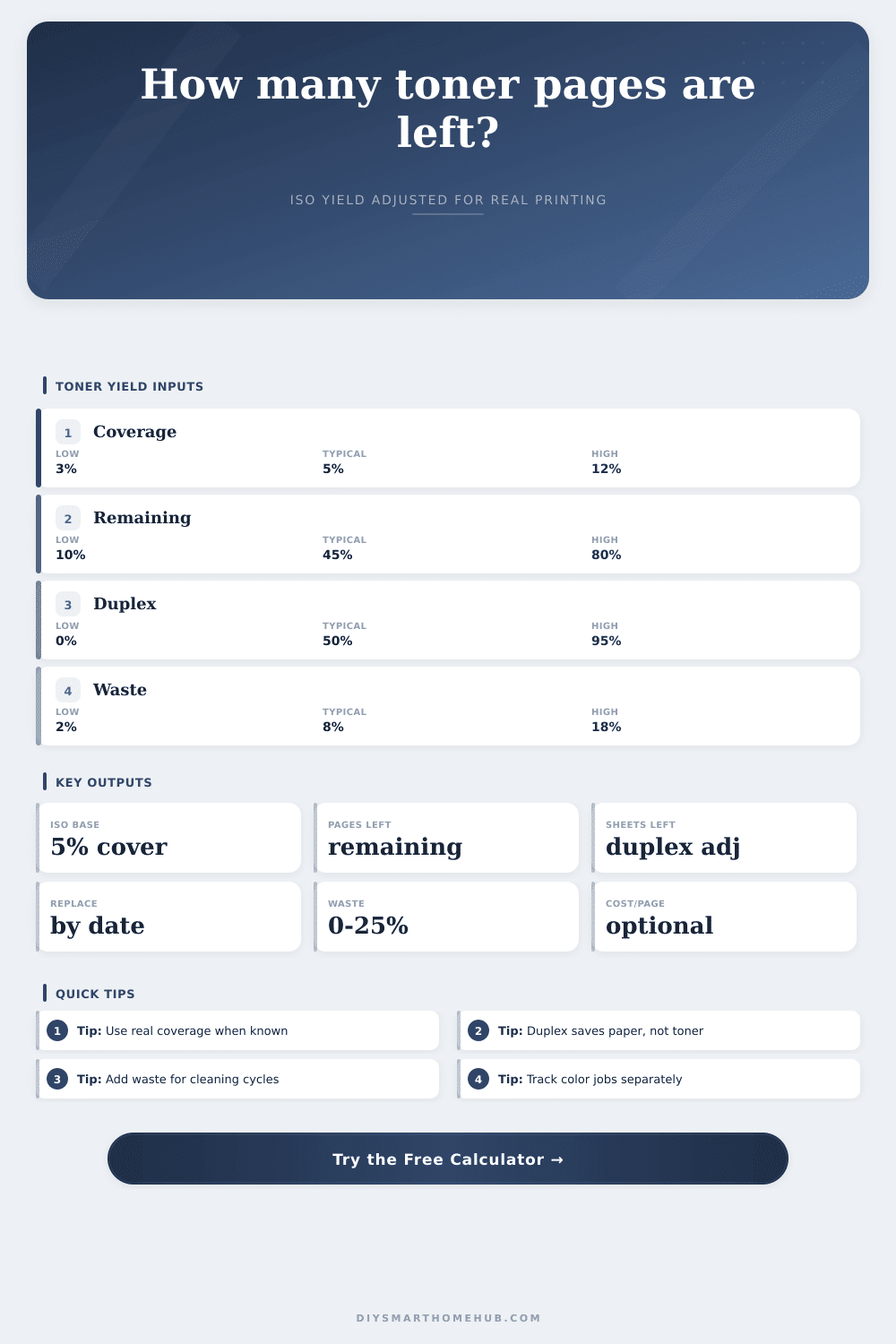
Estimate real toner yield from ISO rated pages at 5% coverage, actual coverage, remaining toner, duplex share, color and mono mix, waste, pages per day, and optional cartridge price.
Loaded preset: Home Mono. Adjust rated yield, actual coverage, remaining toner, pages per day, duplex share, color mix, waste, and optional cartridge price.
ISO 5% coverage keeps rated yield unchanged.
Based on cartridge type and color page mix.
Duplex affects paper sheets, not page impressions.
Loss is applied after coverage and mix adjustments.
Coverage reference
| Printed page type | Typical coverage | Yield effect | Planning note |
|---|---|---|---|
| Plain text letter | 3% to 5% | Near or above rating | Simple correspondence may beat the ISO page count. |
| Text plus logo | 5% to 8% | Moderate reduction | Letterhead, small logos, and dense paragraphs raise toner use. |
| Charts and reports | 8% to 15% | Large reduction | Shaded tables and graphics consume more toner per side. |
| Shipping labels | 12% to 25% | Very large reduction | Barcodes, black blocks, and label waste can move yield sharply. |
| Photo-like laser page | 25% to 60% | Severe reduction | Color toner estimates should be tracked separately from mono jobs. |
Cartridge mix factors
| Cartridge tracked | Mono page factor | Color page factor | Use when |
|---|
Common cartridge planning ranges
| Cartridge class | Rated yield | Good workload fit | Watch item |
|---|---|---|---|
| Starter toner | 500 to 1,500 pages | Light home testing | Often much smaller than retail cartridges. |
| Standard mono | 1,500 to 3,000 pages | Home office documents | Dense pages can halve the label yield. |
| High-yield mono | 5,000 to 12,000 pages | Shared office printing | Daily volume determines replacement timing. |
| Color laser CMY | 1,000 to 6,000 pages | Reports and graphics | Each color can drain at a different speed. |
| Extra high-yield | 10,000+ pages | High monthly duty | Waste percentage matters on low-volume printers. |
Preset comparison
| Preset | Coverage | Pages/day | Expected pressure |
|---|
You get a toner cartridge rated for two-thousand pages, and see it run dry at eight-hundred. It feels like a lie, but it’s rarely deception. Liar! But mostly it’s not lying; it’s just using a different definition of “page” than you are.
The box says two-thousand pages because it defines “page” as a standardized test condition called an ISO yield rating. In this case, it mean five percent coverage. That’s all; it’s enough ink for a proof-of-function test page, but nowhere near enough for anything resembling a typical document. If you print heavy paragraphs, images, or charts, you are doing math in a different universe than the one the manufacturer imagined.
Why Your Toner Runs Out Faster
You can use the calculator above to do the math for you… And it’s going to translate that cold lab standard into messiness of day-to-day office work.
First, it adjusts for coverage, easily the most critical variable in the equation. While a big barcode or a shaded background on a page require a fraction of the toner as a small logo does. So it takes your actual average coverage (enter it here) and then scales the rated yield up or down to reflect how much plastic pigment is actualy hitting the paper. The heavier your documents, the bigger hit your effective yield take, so if they’re heavier than the five percent standard, your effective yield gets seriously cut down. This is not a flaw in printer at all; it is just how toner consumption works. Don’t print heavy stuff with light content budget.
People get thrown off by duplex printing; it’s a way to save paper, but at cost of more toner. That means there are two sides on every page. This halves the amount of sheets needed, which is great for your supply closet and environment. However, it still costs as much toner as before. That nuance gets accounted for in the calculator automagically, so you’ll see the toner usage rate based off how many sides it prints, even though number of sheets goes down. You’re saving trees, not powder. It doesn’t sound like a big deal, but it makes a difference if you’re looking ahead trying to predict when the cartridge might realy go empty.
Another thing that eats into your yield is waste. The printer wastes toner every time you jam it or force it to partially reprint, run a calibration cycle, or do a cleaning cycle. This doesn’t increase your pages printed, but still costs toner. In a high volume environment, this waste can account for ten percent or more of your theoretical yield, most people just don’t think about it. This tool lets you take waste into account and factor it in. This prevents a gap between your mental yield estimate and the red low-ink warning light telling you to panic. You’re paying for efficiency here, and not taking waste into consideration is like paying for a car and then deciding not to care how much money you spend idling in traffic.
Another issue is color printing. Each cartridge dries up at a different rate, so while black-and-white text may never run dry in the cyan cartridge, it will cause magenta to burn out when it comes time to print photos. You can select to monitor individual cartridges or mixed loads. And the calculator help you understand better where your bottleneck lies. For those who manage an office and must stock up before a crisis comes, this is huge.
That’s where the reference table at the bottom of the page comes in. It breaks down the impact different documents will have on yield. For example, a simple letter in plain text could exceed the rated yield while something like a shipping label with heavy barcode information can cut it in half. That way, you know when it makes sense to drop some cash for a high-yield cartridge and other times you’re just wasting money buying standard replacements.
In the end, it’s all about setting realistic expectations: you get through the toner more quickly then claimed because…well, you’re not an engineer, so that’s okay. Now you know how much you print, so you make allowances accordingly. Make adjustments based on duplex printing, waste, and even coverage. Stop guessing and start knowing. When the next cartridge expires prematurely, you won’t sit there wondering why. You’ll know exactly how many additional shipping labels or charts was responsible for that dip.