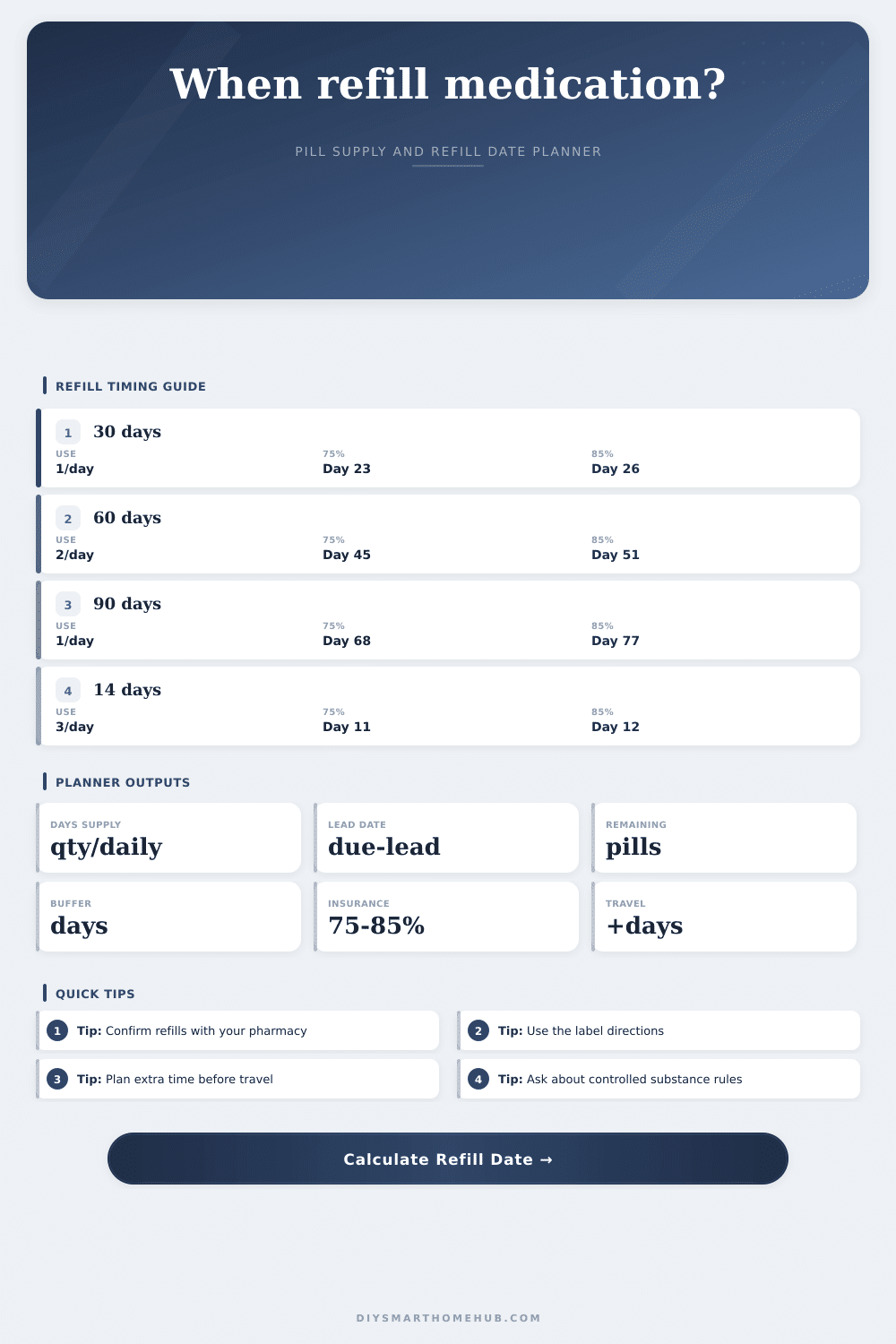
Medication Refill Reminder Calculator
Estimate days supply, reminder timing, current remaining pills, adherence buffer, and the earliest refill date based on the percent of the prescription used.
days supply = pills dispensed / dose per day
base refill date = fill date + days supply - refill lead days
remaining pills today = quantity - elapsed days x dose per day + missed doses x dose amount - extra doses x dose amount
adherence buffer = actual remaining pills - expected remaining pills
insurance earliest refill date = fill date + days supply x earliest refill percent used
| Supply | Daily use | Days supply | 75% used | 80% used | 85% used |
|---|---|---|---|---|---|
| 30 tablets | 1 per day | 30 days | Day 23 | Day 24 | Day 26 |
| 60 tablets | 2 per day | 30 days | Day 23 | Day 24 | Day 26 |
| 90 tablets | 1 per day | 90 days | Day 68 | Day 72 | Day 77 |
| 15 tablets | 0.5 per day | 30 days | Day 23 | Day 24 | Day 26 |
| 21 tablets | 3 per day | 7 days | Day 6 | Day 6 | Day 6 |
| Preset | Quantity | Dose/day | Days supply | Lead | Early % | Reminder | Remaining now |
|---|
Refill reminders remove any guesswork about whether or not it’s time to call the pharmacy. That happens a lot. “I wonder how many more I have left. Maybe I should call my pharmacy now…” It’s a balancing act between pissing off the billing system because you’re refilling too early vs. Running out. The tool will figure out right answer for you.
There’s no such thing as a pill that vanishes on a set date. You need to know when (and how) you’re taking your pills. If you’re popping one pill in the morning: That’s easy math. Taking two per day? Or do you take half of a pill twice daily? Different story.
How the Tool Helps You Refill Your Medicine
Enter your fill date plus number of pills dispensed. Then enter your dose amount and frequency to get a breakdown of how you took your pills. Guess what? Everyone messes up this step. They look at the label and think, “Oh, it’s supposed to last me thirty days… It must be gone by now.”
But then there were those couple extra ones you popped when your back hurt. But what about when you take additional pill, or skip taking your dose? A missed pill is different than an added pill. Two missed pills over the past week would mean that even though the calendar shows you running low, you actualy have more pills in stock. Taking one pill for a headache (i.e. You didn’t miss it, but you still has fewer pills available.
To account for this, the calculator will adjust based off any deviation from normal so that you know exactly how many pills you’ll have as of now. It will do this so that there is always an adherence buffer. A positive buffer mean you are ahead, and a negative buffer means you have fallen behind. That little adjustment makes all the difference when you are trying to time your refill request perfectly.
Typically insurance plans only allow you to refill after some minimum number of days/percentage of supply is exhausted (for example 80 percent). Your earliest refill date will be determined by how long your supply lasts. For example, if you take a maintenance medicine every day and get a three month supply, on what day are you allowed to refill? The answer: not until you’ve gone past a certain number of days. The tool calculates your earliest refill date using those numbers.
With a three-month supply of a maintenance med, you are not permitted to refill on day 50, not legally, and certainly not financially. You must wait until you’ve used enough for the system to acknowledge it. The page has reference tables showing the refill percentages for some common examples such as a thirty-day and sixty-day supply, so you can visualize how the rules affect your particular size bottle.
The other variable most folks don’t think about is processing time: pharmacies aren’t instant vending machines. Insurance has to be processed, checked, and verified; some plans require prior authorization, etc. And so you have to factor in lead time (i.e. This is how many days ahead of when you’ll actualy need the drug. The calculator also adds a processing buffer to your timeline.
Not only does it tell you when you can refill, it tells you when you should of order it so that it arrives before you’re out. If you’re travelling, you could also add additional buffer days so that you won’t get stranded at the airport because the pharmacy wasn’t open on Sunday.
That’s how it becomes easy. It eliminates the stress. It goes from abstract fear to real action. You can see your remaining pill count and your estimated refill date. Instead of guessing how many pills is left in your bottle, you know. There’s no more “oh my god do I have any” because there’s only one thing to figure out: Do I still have a buffer? Do I need to refill? Are there enough? When does it run out?
And then after you understand your insurance limits and your depletion rate, it’s all just math. It becomes a matter of logistics. Medication management is less about the pills and more about the schedule. The tool tells you when.
But preparing ahead of time gives you peace of mind. Knowing you’ve done the math and done it before it was an emergency; that’s the part where it stops being stressful. That’s when you can go to the pharmacy with confidence. You can make the phone call with ease because you know you did everything ahead of time. That’s the difference between planning and scrambling.