Emergency Lighting Duration Calculator
Estimate emergency battery runtime, required capacity for a 90-minute egress target, fixture count, floor illumination, and recharge margin from real load and lumen inputs.
Calculation breakdown
| Battery pack | Nominal Wh | Usable assumption | Runtime at 10 W |
|---|---|---|---|
| Small emergency pack | 24 Wh | 80% DoD, 88% efficiency | 1.69 hours |
| Dual-head unit | 60 Wh | 80% DoD, 88% efficiency | 4.22 hours |
| Remote head supply | 120 Wh | 80% DoD, 88% efficiency | 8.45 hours |
| Central battery segment | 300 Wh | 80% DoD, 90% efficiency | 21.60 hours |
| Egress zone | Typical target | Example area | Raw lumens at floor |
|---|---|---|---|
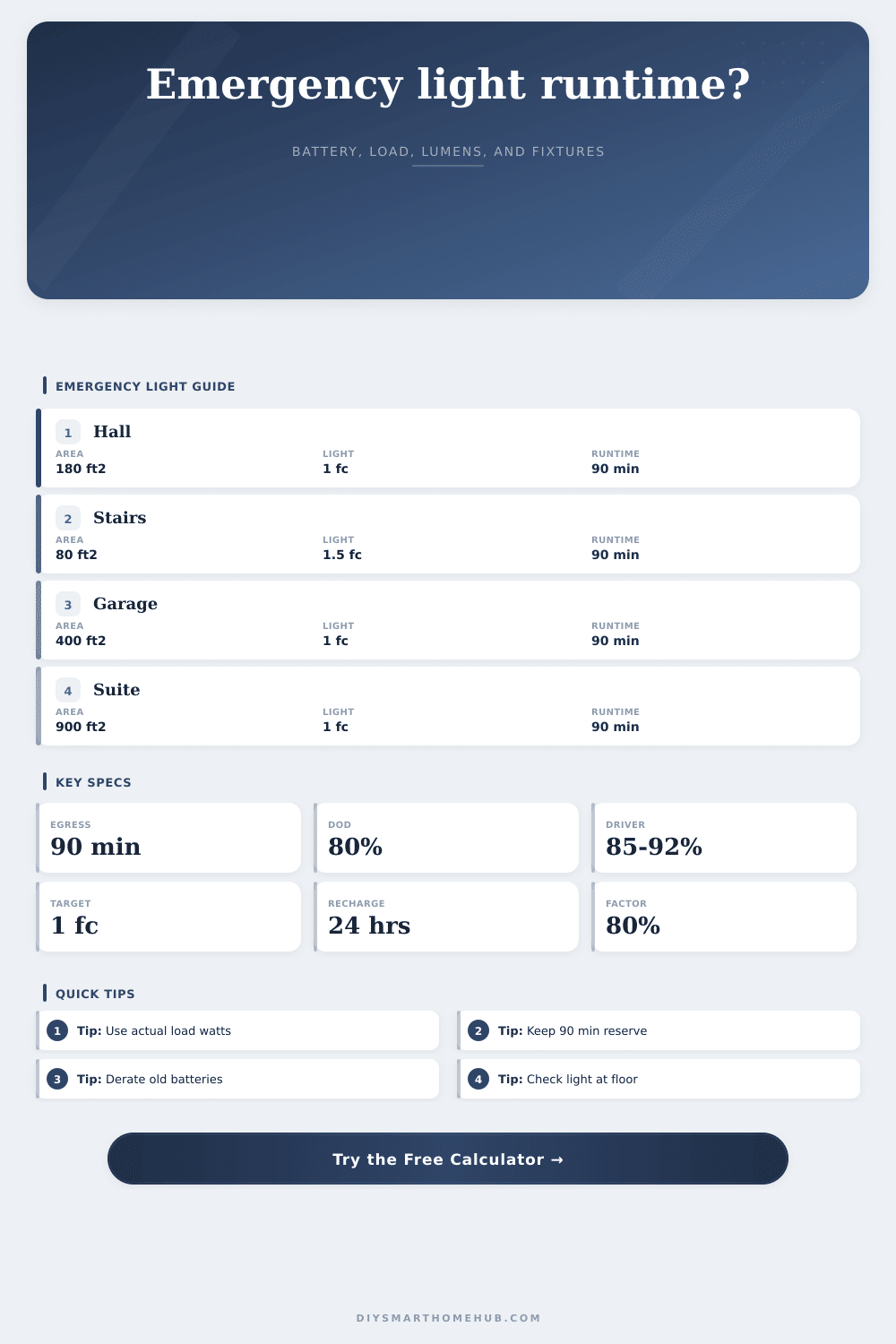
| Exit access corridor | 1 foot-candle / 10.8 lux | 180 sq ft / 16.7 sq m | 180 lumens |
| Stair or level change | 1.5 foot-candles / 16.1 lux | 80 sq ft / 7.4 sq m | 120 lumens |
| Garage exit route | 1 foot-candle / 10.8 lux | 400 sq ft / 37.2 sq m | 400 lumens |
| Small suite path | 1 foot-candle / 10.8 lux | 900 sq ft / 83.6 sq m | 900 lumens |
| Fixture output | Load per fixture | Fixtures for 500 lm | 90-min battery at 88% and 80% DoD |
|---|---|---|---|
| 120 emergency lumens | 1.5 W | 5 fixtures | 15.9 Wh plus control load |
| 250 emergency lumens | 3 W | 2 fixtures | 12.8 Wh plus control load |
| 400 emergency lumens | 5 W | 2 fixtures | 23.4 Wh plus control load |
| 700 emergency lumens | 8 W | 1 fixture | 19.2 Wh plus control load |
| Used emergency energy | Recharge window | Margin | Minimum charging watts |
|---|---|---|---|
| 12 Wh | 24 hours | 20% | 0.6 W |
| 30 Wh | 24 hours | 20% | 1.5 W |
| 60 Wh | 12 hours | 25% | 6.3 W |
| 120 Wh | 24 hours | 30% | 6.5 W |
Until you lose power, you don’t know what an emergency lighting system does for you. When lights go out, it’s so dark you can feel it; and then you know what the code means when it says they must run for at least 90 minutes. That’s the difference between scrambling out in a panic or getting out safe.
What most folks don’t know: A battery isn’t simply a battery. How much do you want it to carry? That’s based off the load you put on it. Also, how efficient are drivers that convert it to usable power? And finally, how deeply will cells be discharged during use? Plug your space size into calculator (above) with your desired foot-candle target and let it figure out the rest. No need to guess at conversions and coefficients.
How to Choose the Right Emergency Lighting System
What’s the actual light level needed on the floor? That’s what comes first. Code frequently say it should be one foot-candle (it’s a minimum; it doesn’t say “suggest”). But then factor in real-world losses: paint darkens walls, dust accumulates on lenses… the older the LED drivers get, the less they puts out. (In a stairwell, where consequences if someone trips are serious, you may wish to go above code minimum.) Here’s how it all breaks down into illuminance zones. This chart on the page makes it clear why a modest bump up from the bare minimum light level on your target can quickly multiply number of fixtures you need to install.
The reason that many of these plans don’t work out is in batteries themselves. In a stock light, there may be a tiny sealed lead acid (SLA) battery. On paper, that seem fine. But when put under heavy loads, the battery does not do well. The key number here isn’t just the battery’s rated capacity, but how many watt-hours you can actualy use. Here’s why: How deep do you want to pull the battery down? Pulling down to eighty percent of the battery preserves it more than pulling it down to fifty percent. But you’re shrinking the run time of the lights accordingly. It’s a balance between getting them up now and making the battery last longer.
The other important bit is how efficient the driver draws power. Does it has an eighty-eight percent efficient driver? Twelve percent is lost as heat. That’s no good. It all translates into less time with your lights on. Twelve percent is lost as heat. That’s no good. It all translates into less time with your lights on.
The recharge cycle is something folks tend to forget about. You have to allow time for batteries to recover after a long discharge. The more powerful your charger, the tighter the recharge window can be specified. It is more complicated than it is more expensive. Standard recharge window is twenty-four hours. Shorter recharges may be appropriate if your building has many short outages. The system include a margin for the recharge time and will be ready for next event.
Control load is also something easy to overlook. Even with main emergency heads dimmed, exit signs, monitoring circuits, etc., all draws power. One or two watts added to cover these types of extras can make the difference between meeting the ninety-minute mark vs not quite making it.
All batteries deteriorate with age. A unit installed five years ago won’t perform like a new one. You can adjust the usable capacity on the calculator to make up for it, but you should of actualy inspect the batteries. Are the cases swollen? Do the terminals shows corrosion? Those are red flags. In practice, run a monthly visual check and do an annual thirty minute discharge test to confirm that it’s still working. When the lights blink out, or go out prematurely, the battery has gone bad.
You don’t need to be an electrical engineer to get it right, but you do need to respect the numbers. This is all about confidence. It is about knowing that in the worst case scenario, you’ll be able to see your way out. You don’t have to be an electrical engineer to get it right. But you do have to respect those numbers. Those inputs are physical constraints. And those outputs is safety margins. Balance one against the other and you aren’t simply meeting code. You’re making sure that the way out is still going to be lit when lights go out. That’s what matters most when the rest of the building goes dark.