Radon Mitigation Fan Sizing Calculator
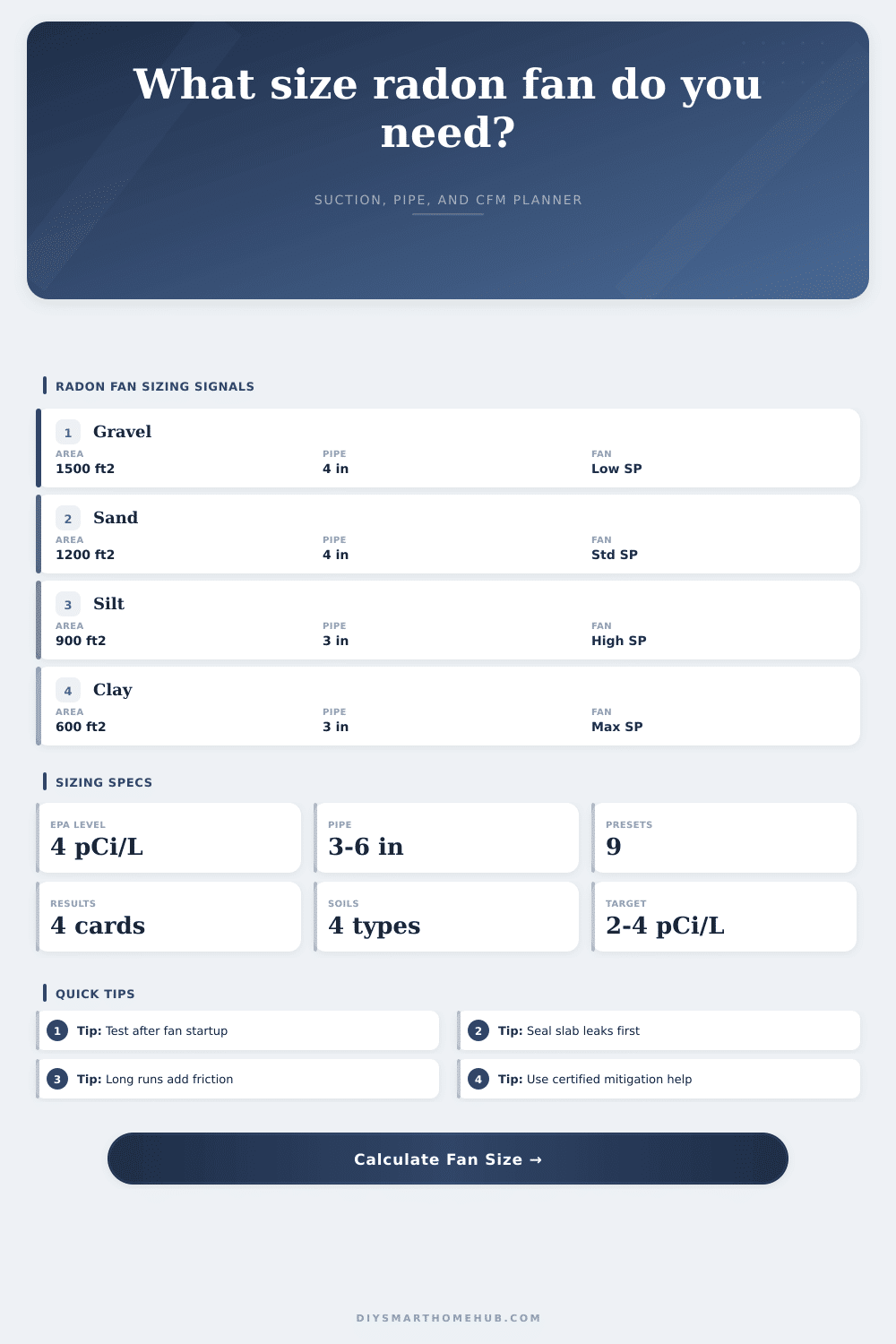
Estimate suction point count, sub-slab CFM, static pressure, pipe friction, fan class, and EPA 4 pCi/L target margin for an active sub-slab depressurization layout.
Homes at or above this level are generally targeted for mitigation.
Typical radon fans are selected by airflow at static pressure.
Four inch pipe cuts friction on longer or higher-flow layouts.
Count rises as area grows or sub-slab communication gets worse.
Fan class table
| Class | Typical CFM | Static pressure | Best use |
|---|---|---|---|
| Low pressure | 80-180 CFM | 0.5-1.2 in WC | Gravel, open fill, big pipe |
| Standard | 50-120 CFM | 1.2-2.0 in WC | Typical slab, mixed soil |
| High suction | 35-90 CFM | 2.0-3.0 in WC | Silt, clay, tight slab |
| Max suction | 25-70 CFM | 3.0+ in WC | Poor communication zones |
Pipe friction table
| Pipe | Area | Long-run signal | Use when |
|---|---|---|---|
| 3 in / 75 mm | 7.1 in² | Higher friction | Short runs, lower CFM |
| 4 in / 100 mm | 12.6 in² | Balanced | Most new layouts |
| 6 in / 150 mm | 28.3 in² | Low friction | High flow or trunk line |
| Each 90° elbow | 5-14 ft equiv | Adds loss | Reduce elbows when possible |
Radon target table
| Measured radon | Planning target | Reduction needed | Sizing response |
|---|---|---|---|
| 2 to 4 pCi/L | Consider reducing | Moderate | Good sealing may be enough with standard draw |
| 4 to 8 pCi/L | At or below 4 pCi/L | 50% typical | Standard fan with verified pressure field |
| 8 to 20 pCi/L | At or below 4 pCi/L | 50-80% | Add suction reach, margin, and sealing quality |
| 20+ pCi/L | Professional design | High | Confirm diagnostics and post-mitigation test |
Negative pressure makes radon mitigation work, but the idea isn’t to suck all air out of the house! Rather, use a vacuum seal beneath foundation, allowing soil gas to flow through a pipe different than through the flooring. Knowing how to understand your reading will guide you in selecting the proper tool.
The calculator do the math for your slab dimensions and soil conditions. No more conversions or coefficient guessing games.
How to Set Up a Radon System
When most homeowners purchase a vacuum cleaner they seek out big airflow numbers. This is not what you want. If you were purchasing a vacuum cleaner, you would expect it to be able to hold up to static pressure. The same are true here. Airflow is measured in cubic feet per minute (CFM). Unless the fan have sufficient static pressure to overcome soil resistance, CFM doesn’t matter.
A standard fan will have no problem pulling down radon levels from gravel. Why? Because gravel let air flow freely. Clay, on the other hand, is like a cork. You can starve a fan by trying to pull volume through clay using a small pipe.
Power isn’t as critical as length and pipe diameter. Mitigation systems only function at full capacity if they is not blocked by friction losses. Pipe resists air flow. Each foot and each elbow increase that resistance. Three inch pipe in a long run will create drag, Drag chokes off the air flow before it arrives at the suction point.
The size of the pipe affect friction and velocity as shown on the table. For new construction four inch pipe is often the best solution. It reduces friction but doesn’t break the bank. Then you can use a smaller, less noisy fan to do the job.
A good slab seal is almost as important as a fan. Without it, air escapes through an unsealed sump pit or crack in the foundation. Pressure field collapse. You have installed a high-capacity fan, but air escapes through walls of your basement. Radon levels are high in the corners and low near the pipe. With sealed entry points, pressure distribute evenly. Then a modest fan can create a uniform vacuum.
Systems is sized with safety margins. There is no such thing as one size fits all. Weather (wind, barometric pressure, etc.) affect radon levels. What works on a calm day may not work during a storm. Windy conditions reverse the stack effect. Go conservative. It pays dividends down the road.
Add an extra 20 or 30 percent to the needed air flow rate and you give the system some wiggle room when it’s under a peak load. You shouldn’t of wanted your system to be searching for its comfort zone.
Don’t buy a larger fan, just add additional suction points. On a big slab, one central pipe doesn’t provides even pressure. Distance cause pressure drop. Add another suction point. Or two. Bring your vacuum nearer the radon source. The calculator calculates how many points are required, depending on slab size, plus how well ground communicates beneath. Bypass earth’s resistance by adding more points.
Don’t overpower the earth. We want to work with the soil, not against it. A correctly sized system is able to turn the tables on the gas, reversing the gas flow. This means there are no loud noises and it also saves energy. The system understands physics of the foundation… It doesn’t attempt to brute force its way through.
Inputs makes sense because they understand how pressure distributes. You’re creating a pressure field that protects your home. The numbers shows you the way.