Mulch Volume Calculator
Estimate cubic feet, cubic yards, bags, top-up depth, settling buffer, material weight, and delivery rounding for landscape beds and paths.
Mulch volume results
Shredded Hardwood
Good all-purpose bed coverage, usually settles moderately, and knits together on slopes better than larger nuggets.
Pine Bark Nuggets
Coarser and lighter per cubic yard, useful where a chunky decorative layer is wanted with slower visual breakdown.
Compost Mulch
Heavier and finer than bark mulches, so delivery weight matters more and shallow layers are usually easier to manage.
Straw Mulch
Very light and fluffy for vegetable beds, with a larger settling allowance because loose straw compresses quickly.
| Area | 2 in depth | 3 in depth | 4 in depth | 2 cu ft bags at 3 in |
|---|---|---|---|---|
| 50 sq ft | 8.3 cu ft / 0.31 cu yd | 12.5 cu ft / 0.46 cu yd | 16.7 cu ft / 0.62 cu yd | 7 bags |
| 100 sq ft | 16.7 cu ft / 0.62 cu yd | 25.0 cu ft / 0.93 cu yd | 33.3 cu ft / 1.23 cu yd | 13 bags |
| 250 sq ft | 41.7 cu ft / 1.54 cu yd | 62.5 cu ft / 2.31 cu yd | 83.3 cu ft / 3.09 cu yd | 32 bags |
| 500 sq ft | 83.3 cu ft / 3.09 cu yd | 125.0 cu ft / 4.63 cu yd | 166.7 cu ft / 6.17 cu yd | 63 bags |
| 1000 sq ft | 166.7 cu ft / 6.17 cu yd | 250.0 cu ft / 9.26 cu yd | 333.3 cu ft / 12.35 cu yd | 125 bags |
| Material | Typical dry weight | Settling allowance | Planning note |
|---|---|---|---|
| Shredded hardwood | 600-800 lb/cu yd | 10-15% | Use 2-4 in for most shrub beds. |
| Cedar mulch | 450-650 lb/cu yd | 8-12% | Lighter bark mulch with moderate compression. |
| Pine bark nuggets | 350-550 lb/cu yd | 5-10% | Large nuggets cover loosely and can roll on slopes. |
| Compost mulch | 900-1200 lb/cu yd | 10-18% | Fine, heavy material; avoid overly deep layers. |
| Straw mulch | 120-250 lb/cu yd | 20-30% | Very fluffy; plan for fast settling. |
| Container | Cubic feet | Cubic yards | Bags per cubic yard |
|---|---|---|---|
| 1.5 cu ft bag | 1.5 cu ft | 0.056 cu yd | 18 bags |
| 2 cu ft bag | 2.0 cu ft | 0.074 cu yd | 14 bags |
| 2.5 cu ft bag | 2.5 cu ft | 0.093 cu yd | 11 bags |
| 3 cu ft bag | 3.0 cu ft | 0.111 cu yd | 9 bags |
| Bulk delivery | 27 cu ft | 1.000 cu yd | Often rounded to 0.25 yd |
| Project | Typical area | Recommended depth | Base volume | Planning note |
|---|---|---|---|---|
| Foundation bed strip | 80-160 sq ft | 2-3 in | 0.5-1.5 cu yd | Average the width if the bed flares near corners. |
| Single tree ring | 25-80 sq ft | 2-3 in | 0.2-0.8 cu yd | Keep mulch several inches away from the trunk. |
| Shrub island | 150-350 sq ft | 3 in | 1.4-3.2 cu yd | Add overage for curved edges and plant gaps. |
| Walk path | 120-400 sq ft | 3-4 in | 1.1-4.9 cu yd | Coarse mulch compresses under foot traffic. |
| Vegetable garden | 100-300 sq ft | 1-3 in | 0.3-2.8 cu yd | Straw needs a larger settling allowance. |
MULCH isn’t dirt; most homeowners think of it as such, brown stuff to cover up weeds. That “dirt” thinking waste money and makes your beds messy. Mulch is an insulating blanket, not a structural fill. Too much suffocates the roots. Too little lets sun burn through and then the weeds comes back.
Calculating the correct amount is basic math; guessing from the driveway how much there should of be on an irregular bed leads you wrong. First: What’s the shape? Most garden beds aren’t straight lines, there are islands of shrubs, or they curve alongside house, but that doesn’t mean it’s impossible to figure out what area is covered by any particular bed. The calculator on this page does all the conversion work after you select the correct shape. Then you can focus on actualy measuring what you’re working with instead of staring at a calculator screen and trying to do mental geometry.
How to Measure Mulch for Your Garden
Circles: All you need is the diameter for circles like those around tree trunks. For rectangles, width and length are enough. Weirdly shaped polygons (a.k.a., beds): Use the custom area option to bypass all shape calculation and simply input the square footage you’ve already measured.
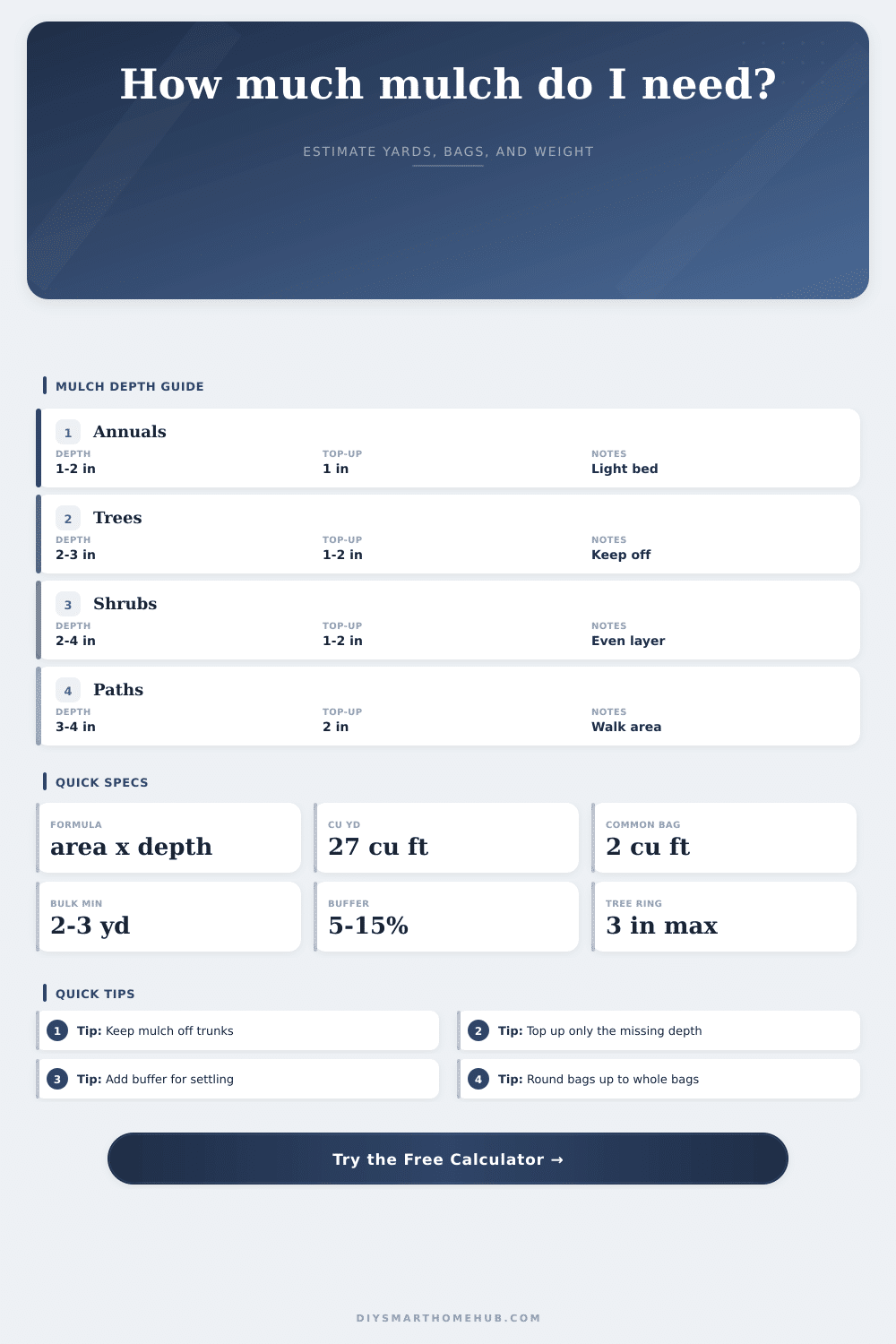
The other variable that trips folks up is depth. Because you may think more is better (more coverage must mean better weed control), there’s a strong temptation to go thick. But mulch doesn’t work that way: Two to three inches is all most landscape bed require to block out light and hold in moisture. More than four inches can actualy be too much because oxygen can’t reaches the soil beneath, which smothers shallow roots or rots tree trunks.
To help prevent overthinking what’s right, the calculator offers presets for popular scenarios such as a heavy-duty path or a lighter-weight annual bed. If you’re topping off an existing bed, factor in any current mulch before starting; adding another layer on top of a compacted old one will raise the grade and potentially create a dam that hold water next to your foundation.
The tool also prompts you for your material, because different materials varies widely in their volume and hence their weight. Compost, for instance, is very dense; cedar mulch, not so much. Shredded hardwood mulch doesn’t break down as fast than cedar, but is heavier. For delivery purposes: A truckload of straw may hold three cubic yards; but wet bark, or even stone, would amount to just a fraction of that. That’s why most bulk suppliers sells by the yard, equivalent to twenty-seven cubic feet. That number helps convert things if you are used to buying by volume versus weight, which makes a difference when you realize that there may be a minimum delivery charge, even though your little bed only requires a fraction of yard. The density differences is shown in the reference table on the page where you can get an idea of how to think about buying by volume or by weight.
The math starts being annoying in the bag-shopping phase: Retail bags are small, and the piles don’t look heavy enough (until I realized that you need nearly fifteen of those two cubic foot bags to fill a single cubic yard). Because you can’t purchase half-a-bag from the hardware store, the calculator rounds up to full bags. And it also accounts for some wiggle room for cuttings and settling. New mulch is fluffy but will compress after a few rainstorms. Adding a little bit for settling means you won’t be left with a skim job a couple weeks down the road.
That last one? That’s not a number; it’s a plan. The final number is the answer to questions like: Do I need a wheelbarrow or a small truck? How much will the delivery be? How often do I have to go to the store? A full bed of mulch won’t break your budget; it won’t smother the plants, and it won’t go bad if you get the volume correct. Don’t hoard brown flakes, but provide exactly what each plant need to grow happy, without drowning it in its own mulch.