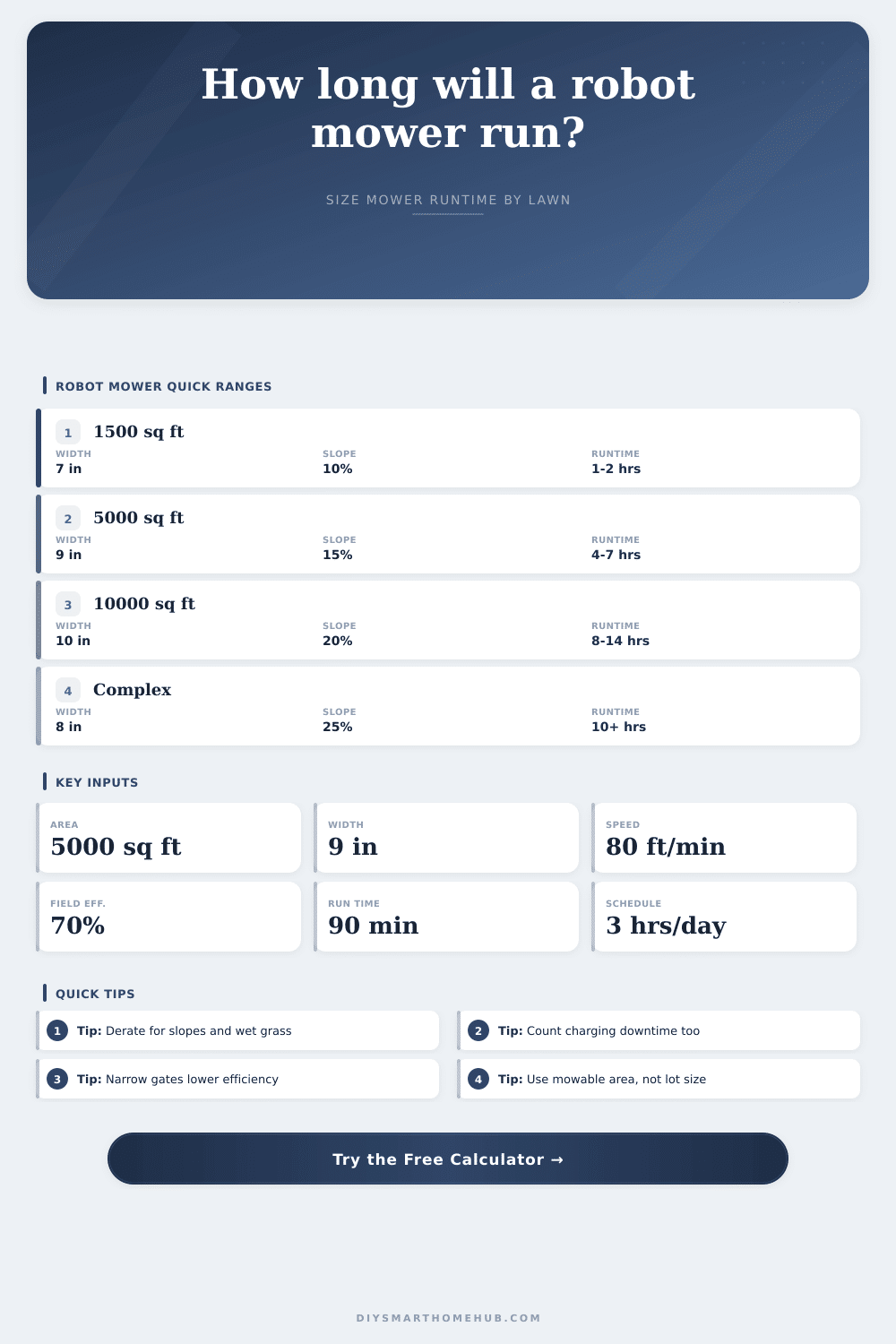
Robot Mower Runtime by Lawn Size Calculator
Estimate effective mowing capacity, required mowing hours, weekly completion time, battery sessions, charging downtime, and derates for slopes, wet turf, obstacles, and tight layouts.
Calculation breakdown
| Mower class | Cut width | Speed range | Field efficiency | Practical capacity |
|---|---|---|---|---|
| Compact townhome robot | 6-7 in | 55-75 ft/min | 55-70% | 1,100-1,800 sq ft/hr before site derates |
| Standard residential robot | 8-9 in | 70-95 ft/min | 60-78% | 2,000-3,900 sq ft/hr before site derates |
| Large-lawn residential robot | 9-11 in | 85-115 ft/min | 65-82% | 3,400-5,700 sq ft/hr before site derates |
| Commercial courtyard robot | 10-14 in | 95-140 ft/min | 60-80% | 4,700-10,900 sq ft/hr before site derates |
| Working slope | Runtime effect used here | Common mower fit | Planning note |
|---|---|---|---|
| 0-10% | 0% derate | Most models | Normal turning and traction assumptions usually work. |
| 11-20% | 5% derate | Most residential models | Expect extra wheel correction and slower climbing. |
| 21-30% | 14% derate | Slope-capable models | Check manufacturer slope rating and boundary placement. |
| 31-40% | 25% derate | High-traction models | Wet grass and tight turns can sharply reduce runtime. |
| Over 40% | 35% derate | Specialty only | Do not assume safe or reliable mowing without model specs. |
| Battery class | Runtime per charge | Charge time | Duty cycle | Best use |
|---|---|---|---|---|
| Small pack | 45-70 min | 45-75 min | 38-61% | Small lawns and short daily windows |
| Standard pack | 70-110 min | 60-100 min | 41-65% | Common suburban lawns |
| Extended pack | 110-180 min | 90-150 min | 42-67% | Large yards with open mowing areas |
| Commercial pack | 150-270 min | 120-240 min | 38-69% | Courtyards, campuses, and shared lawns |
| Complexity level | Multiplier | Typical signs | Runtime impact |
|---|---|---|---|
| Open lawn | 1.00 | Few edges, broad rectangles, no islands | No extra derate beyond field efficiency. |
| Light beds/edges | 0.92 | Fence edges, one bed, mild boundary work | Adds about 9% more mowing time. |
| Moderate trees/islands | 0.82 | Trees, play set, several no-mow zones | Adds about 22% more mowing time. |
| Complex maze/objects | 0.68 | Narrow strips, many objects, broken zones | Adds about 47% more mowing time. |
| Very complex courtyard | 0.58 | Courtyards, islands, gates, corridors | Adds about 72% more mowing time. |
| Scenario | Area | Width | Speed | Derate profile | Battery plan | Schedule risk |
|---|---|---|---|---|---|---|
| Small Townhome | 1,500 sq ft | 7 in | 65 ft/min | Light obstacles, low slope | 1-2 sessions | Low |
| Suburban 5,000 | 5,000 sq ft | 9 in | 80 ft/min | Normal yard, 12% slope | 2-4 sessions | Low to medium |
| Large Yard | 10,000 sq ft | 10 in | 95 ft/min | Open but more coverage | 4-7 sessions | Medium |
| Complex Trees/Islands | 7,500 sq ft | 8 in | 75 ft/min | Complex pathing | 5-8 sessions | High |
| Steep Slope Yard | 6,000 sq ft | 9 in | 70 ft/min | 30% slope derate | 4-7 sessions | High |
| Quiet Hours Restricted | 4,000 sq ft | 8 in | 70 ft/min | Normal derates | 2-4 sessions | Window limited |
| High Growth Rainy Week | 5,500 sq ft | 9 in | 75 ft/min | Wet plus growth | 4-7 sessions | High |
| Narrow Gate Layout | 3,200 sq ft | 7 in | 60 ft/min | Corridor losses | 3-5 sessions | Medium |
| Commercial Courtyard | 12,000 sq ft | 12 in | 110 ft/min | Many zones | 5-9 sessions | High |
The reason you bought the robot mower? To get back your weekends. The promise from the marketing: “Autonomous.” A nice, quiet hum while you’re away enjoying your life. Your lawn will be perfect. You’ll never has to touch a push mower again.
Reality check: It’s now the first week of spring, and growth has come. The unit docks prematurely. Half the day, it spin in circles near a tree. It struggles up a slope that seemed doable. Then it returns home, leaving half the yard still untouched. You stand on the patio watching it all happen.
How to Make Your Robot Mower Work Better
That’s the difference between the theoretical capacity of the thing and how it really works. This is where most people lose their patience as owners. They mistake the maximum runtime from the marketer for what the machine can actualy achieve in their own environment.
Once you input the details about your lawn, the calculator does all the math for you (above). You no longer have to guess at the conversions or coefficients. But where it really shines is helping you understand what each input mean.
Why are these numbers important? Where do we start? We start with the mowable area, which is doing some heavy lifting here. What exactly do we mean by “mowable”? A large number of folks say they have 5,000 square feet of lawn. Or 10 acres.
What does that mean? Does it include the driveway, or the vegetable garden, or the patio, or the flower beds? If yes, then that’s a recipe for disappointment. Because those things aren’t mowed. The robot can’t climb up a two-foot retaining wall. And it certainly won’t cut across the concrete of the driveway.
Measure just the turf you can actualy reach with the blades of the robot mower. Often this shrinks the target area by twenty to thirty percent, which right away alters the feasibility of the schedule.
But then there’s the whole geometry thing. Robots’ best friends is squares. Clusters of trees, narrow corridors, and islands will all reduce efficiency. The unit needs to stop, re-orient, re-find itself. These micro-delays add up fast over four hours.
The calculator uses derates for obstacle complexity to account for this. But visualize the path anyway. If your yard looks like a maze to a GPS free device, it’ll spend a lot more time thinking then cutting. This is not a flaw in the machine, but a limitation of the navigation method. Semi-random or random pathing works great on open space but struggle with broken up areas.
The other silent killers of runtime? Weather and slope. Fine with a gentle incline. Caution with a 20% grade: higher power consumption, lower travel speed. It will drain the battery faster and slow the travel speed even more. Throw in wet grass to the mix and you have compounded traction issues. So the mower has to go slower to avoid slipping. You get fewer passes per charge.
Small thing, but when you’re trying to get a full cycle done during a three-hour morning window before work, it matters. The page lays all this out in the form of a reference table, which shows how moisture and slope interact to reduce effective capacity. It’s not linear. A steep, wet day can see your effective mowing time cut in half versus a flat, dry afternoon.
The planning part of battery management, however, is the rub: the rubber meeting the road. Most mowers shut off automatically once their battery falls below a certain threshold. Even if they’re mid-job, they stop. That means you have to count charge time too.
For example, if your mower operates for an hour and a half but then needs seventy-five minutes to recharge, you aren’t getting much work time in a day. The calculator will tell you how many times you has to run it to get the job done. And it’ll tell you how long that will take.
If it tells you that to mow your lawn, it’s going to require six sessions, but that you’ve only got three hours a morning to do it, you have a problem. The solution is rarely to buy a bigger battery. You typically change the schedule, allowing for more days per week or a longer window each day during the peak growth period.
We aren’t trying to get the entire lawn mowed all at once. We’re simply trying to ensure it’s kept cut regularly. And that means allowing the robot to chew on the lawn for a few days here and there.
The key is understanding what’s actually being tracked. No, we aren’t tracking speed. We are tracking consistency. If you can match your expectations to how the world actualy works (battery cycles, slope, obstacles), then the robot becomes a trusted companion. It no longer becomes a cause for frustration.
Your weekend remains yours, the lawn continues to be green, and the machine returns to doing precisely what you purchased it to do.