DIYSmartHomeHub spa water planning tool
Hot Tub Water Change Interval Calculator
Estimate when spa water should be drained and refilled using the common gallons divided by three divided by bathers rule, then adjust for sanitizer, filter cycles, TDS rise, soak length, and shock frequency.
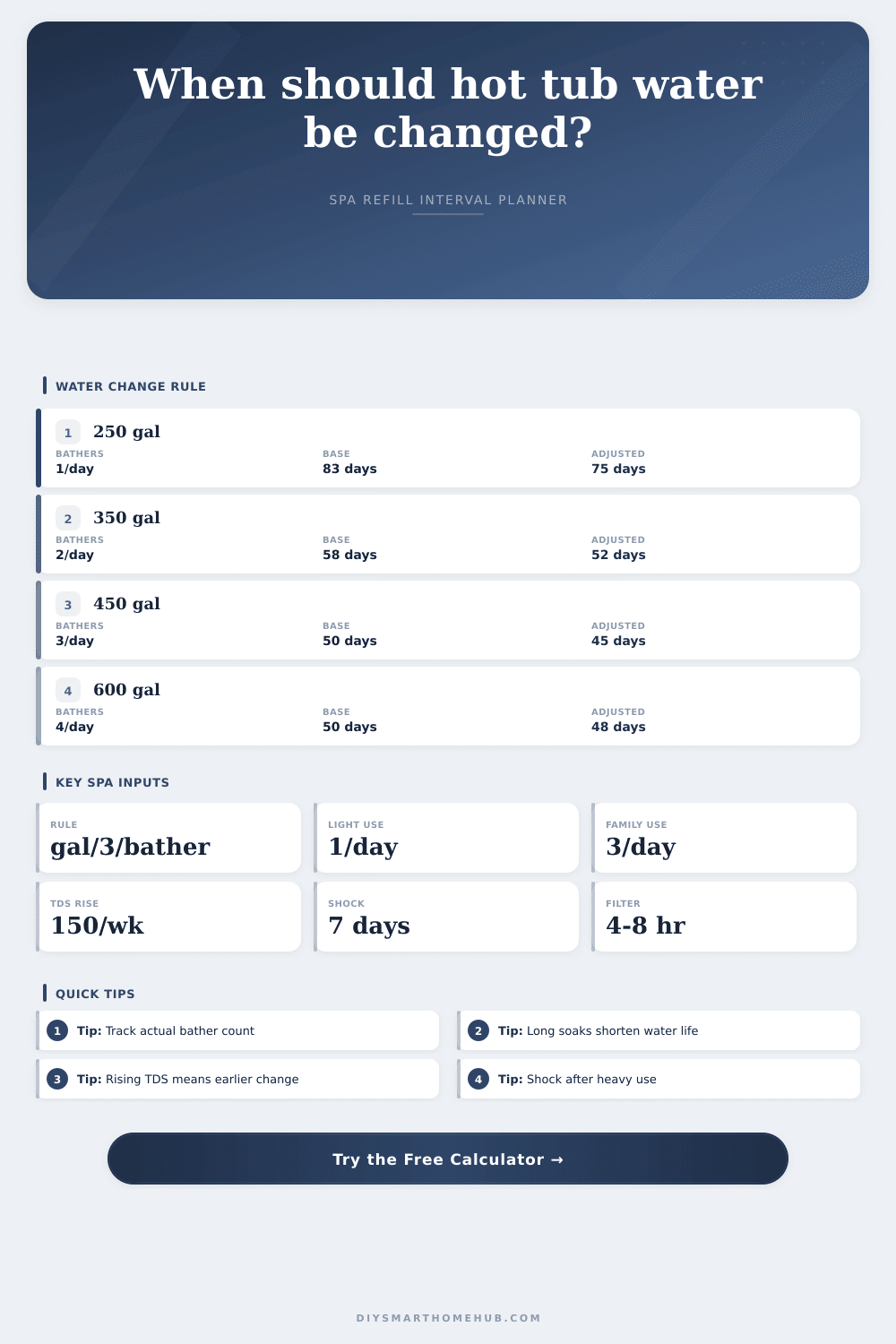
Divide spa gallons by 3, then by average bathers per day.
Soaks above 20 minutes per bather shorten the adjusted interval.
The calculator treats 150 ppm per week as a normal dissolved-solids rise.
Weekly shock is the neutral setting for the oxidizer adjustment.
Light Private Use
One or two regular users, short soaks, predictable sanitizer, and slow TDS rise.
70-120 daysTypical Family Use
Two to four bathers most days, weekly shock, and moderate filtration.
40-75 daysHeavy Weekend Use
Long social soaks or many guests compress the interval even when gallons are high.
20-45 daysHigh TDS Water
Fast dissolved-solids buildup points to earlier replacement before the base rule expires.
15-40 days| Spa volume | 1 bather/day base | 2 bathers/day base | 4 bathers/day base |
|---|---|---|---|
| 250 gallons | 83 days | 42 days | 21 days |
| 350 gallons | 117 days | 58 days | 29 days |
| 450 gallons | 150 days | 75 days | 38 days |
| 600 gallons | 200 days | 100 days | 50 days |
| Sanitizer system | Adjustment used | Calculator effect | Best input note |
|---|---|---|---|
| Chlorine granules or tabs | 1.00x | Neutral baseline | Use measured free chlorine habits. |
| Bromine floater or feeder | 1.05x | Slightly longer | Stable residual gets modest credit. |
| Salt chlorine generator | 1.08x | Longer if output is steady | Assumes the cell maintains residual. |
| Mineral cartridge plus sanitizer | 1.10x | Longer under light load | Still needs normal sanitizer residual. |
| Ozone or UV assist plus sanitizer | 1.12x | Longest assist factor | Useful only while circulation is active. |
| Biguanide system | 0.92x | Earlier change | Accounts for system-specific buildup. |
| Daily bather-minutes | Load label | Interval pressure | Example pattern |
|---|---|---|---|
| Under 30 | Light | Low | One short evening soak. |
| 30 to 75 | Moderate | Normal | Two bathers for 20 to 35 minutes. |
| 75 to 150 | Heavy | High | Family use or repeated sessions. |
| Over 150 | Very heavy | Very high | Guests, rentals, or long social soaking. |
| Care input | Low setting | Neutral setting | High setting |
|---|---|---|---|
| Filter cycle | 1 to 3 hours/day shortens interval | 4 to 8 hours/day is neutral to helpful | 9+ hours/day receives limited extra credit |
| TDS rise | 75 ppm/week extends interval | 150 ppm/week is baseline | 300+ ppm/week shortens interval sharply |
| Shock frequency | Every 10 to 14 days shortens interval | Every 7 days is neutral | Every 3 to 5 days modestly extends interval |
| Conservative buffer | 0% leaves calculated interval intact | 10% changes water earlier | 20% is cautious for uncertain inputs |
That’s why, when you step into your hot tub and the water doesn’t feel right, you might realize something. There’s nothing wrong that you can see; just no crisp feeling on your skin. It could be slightly slick… or maybe even thicker.
Owners tend to think they’re unlucky or that their pump is failing, but most of the time you won’t see it: It’s invisible dissolved solids that degrade your hot tub water over time.
How Often Should You Change Your Hot Tub Water
And while there are ways to guess what’s happening inside your hot tub and when to change out the water, doing so tends to cost you comfort (and money).
Drainage is easy math. The conventional wisdom is: divide the size of your spa in gallons by three, then divide by average number of bathers per day. That gives you a starting point. For example, a 450 gallon tub with an average of two people per day equals roughly seventy-five days.
Sounds like science right? But it isn’t.
The equation rely on ideal circumstances, such as found in a showroom. It doesn’t include the effect of your water chemistry. Salt chlorine generators create their own residual on demand; therefore the water might last slightly longer. Biguanide systems is easy but generate waste products more rapidly and shorten the usable life.
Here is where people gets tricked. They assume that because the sanitizer kills germs, it eliminates the need to empty the tub. Not so. It merely postpones it.
But what do you throw in there? It contains dead skin cells, oils and lotions from every bather. Shock oxidizers burns off the organic matter, leaving behind inorganic salts. They build up, unnoticeably.
For that reason, the tool asks how much TDS you think you’ll raise each week with bathing. If your tap water is hard, that number goes up quickly.
It’s possible you balance pH exactly right and even add shock every week. But if you’re raising two hundred parts per million of TDS per week, the water will tire out before the bather math says you should of drain. You’ll taste it, or see it: continuous foaming.
Filtration plays a supporting role. A long list of factors can affect how those solids build up in your water. If you run the pump for 12 hrs/day then solids will still accumulate even though they’re kept off the filter element longer. That is all the calculator accounts for, but it does not guarantee indefinite use. Eventually the extra circulation will just warm up the air in your yard. There’s a point of diminishing returns.
Baseline soak length used by the calculator is 20 min/bather. If your family soaks for an hour straight then the pressure multiplies accordingly. Think about it like this: you’ve doubled the load but not the bather count.
Consider the output a maintenance horizon, not a hard deadline. So if the calculator says 60 days and it’s still crystal-clear by then… cool, leave it an extra week. Day 40 rolls around and the water’s looking cloudy? Well, you probably got a little too optimistic with your inputs there.
Got a houseful of guests/kids who don’t rinse off first? Turn up the safe buffer setting. It doesn’t take much, but when it comes to avoiding that last-second panic drain on holidays, every little bit helps.
Spa ownership isn’t about rescue. It’s about rhythm. Failing to plan on a regular change schedule equals waiting until the water turns green. Running fresh water every two weeks whether needed or not equals wasted resources. The key is to hit that sweet spot between the two, and that means monitoring your water, not just the calendar.
Monitor the water for that slippery feel, and be honest with your inputs. When the chemistry gets beyond what you can figure out, change the water. That fresh water will give you that crisp snap you had on day one.