Pool Alkalinity Adjustment Calculator
Estimate total alkalinity adjustment doses for sodium bicarbonate raising or acid lowering, including dose splits, pH cautions, and a clear formula breakdown.
Calculation breakdown
| Adjustment | Base constant | Formula use | Best use note |
|---|---|---|---|
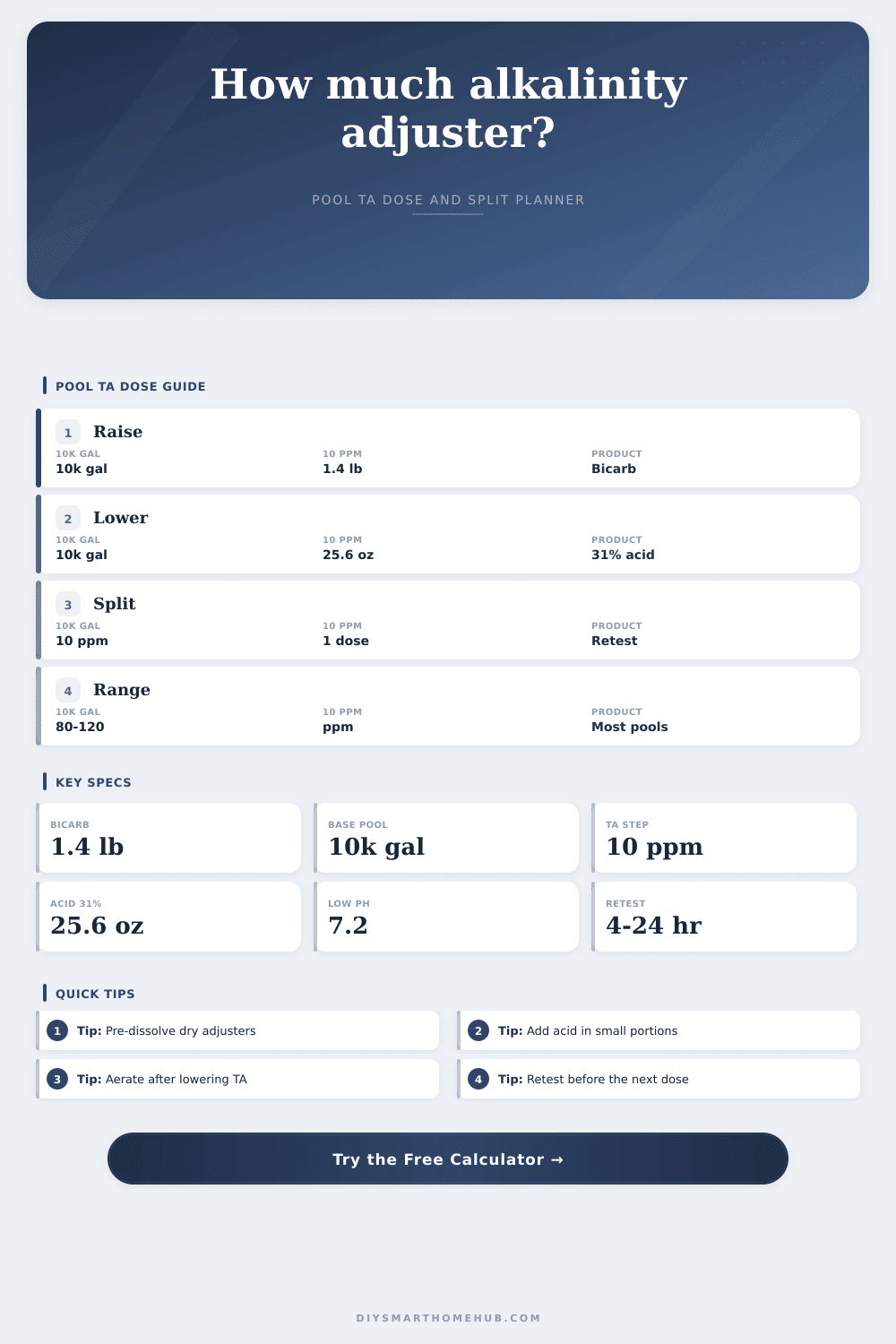
| Raise with sodium bicarbonate | 1.4 lb per 10 ppm per 10,000 gal | 1.4 x volume factor x ppm factor | Best for raising TA with modest pH effect. |
| Raise with alkalinity increaser | 98% bicarbonate equivalent | Bicarbonate dose divided by 0.98 | Use when label confirms sodium bicarbonate base. |
| Raise with soda ash | 1.65 bicarbonate equivalent | Bicarbonate dose divided by 1.65 | Raises pH strongly; use only when pH is also low. |
| Lower with acid | ppm x liters / 50,000 = acid equivalents | Equivalents divided by acid normality | Approximate only; lower in stages and aerate. |
| Acid product | Strength model | 10 ppm in 10,000 gal | Handling note for calculation |
|---|---|---|---|
| Muriatic acid 31.45% | About 10.0 normal | 25.6 fl oz | Strongest liquid option in this calculator. |
| Muriatic acid 29% | About 9.2 normal | 27.8 fl oz | Similar dosing, slightly more liquid. |
| Low-fume acid 15% | About 4.55 normal | 56.3 fl oz | Requires larger volume for the same TA change. |
| Dry acid 93% | Sodium bisulfate equivalent | 2.15 lb | Dry dose estimate from acid equivalents. |
| Pool situation | Typical TA range | pH tendency | Calculator note |
|---|---|---|---|
| Plaster or aggregate surface | 80 to 120 ppm | Needs stable saturation balance | Avoid large one-day swings. |
| Vinyl or fiberglass pool | 70 to 110 ppm | Often tolerates lower TA | Watch pH drift before chasing TA. |
| Saltwater chlorine generator | 60 to 90 ppm | Often pH rises over time | Lower TA targets may slow pH climb. |
| Trichlor tablet pool | 90 to 120 ppm | Acidic sanitizer trend | Higher TA can buffer pH decline. |
| Example pool | Pool volume | TA change | Estimated dose |
|---|---|---|---|
| Small spa raise | 500 gal | +30 ppm | 0.21 lb sodium bicarbonate |
| Above-ground pool raise | 7,500 gal | +20 ppm | 2.10 lb sodium bicarbonate |
| Family pool raise | 18,000 gal | +25 ppm | 6.30 lb sodium bicarbonate |
| High TA acid plan | 20,000 gal | -40 ppm | 205 fl oz of 31.45% acid |
Sodium bicarbonate
Primary choice for raising total alkalinity because it changes TA predictably with only a modest pH rise.
Soda ash
Useful only when both pH and TA are low. It can overshoot pH faster than bicarbonate.
Muriatic acid
Used for high TA plans, but it lowers pH first and should be split into controlled additions.
Aeration cycle
After acid lowers pH and TA, aeration raises pH back without adding more alkalinity.
Your pool water doesn’t look cloudy and it smells okay, so you think it’s just fine. But when you check the water, total alkalinity is slowly shifting. And that shift throw off the pH. And an unstable pH makes everything else unstabel. That’s why most pool owners are only concerned about their chlorine level; they don’t realize that what protects all of those other chemical is a buffer called total alkalinity.
If there isn’t any, then every time you dose your sanitizer, splash in the pool, or get rained on, the pH will change. You’ll add some acid and the pH goes up…add some base and now the pH is down. It swings right back into the opposite number again, usualy within a day. It’s tiring and costly.
How to Keep Your Pool Water Balanced
While the calculator does it for you (see above), knowing what goes in makes all difference. First, there’s volume. Most folks rely on their pool size as stated by manufacturer, which can be incorrect. They include air space, coping and equipment pad. That’s not your water volume. Input a conservative figure into the calculator. The dosage are adjusted for when you are around the ten-thousand-gallon level.
Why is accuracy important? Overdosing will cause more issue.
Alkalinity is simple. How do you raise it? You use sodium bicarbonate (a.k.a. Baking soda). It dissolves. It bumps the pH up a bit. It buffers. The calculator figure out exactly how many pounds are required to get you from where you are to where you want to be. Generally, most pools does best with between eighty and one hundred twenty parts per million. Below that number, pH gets unstable. Above that number, pH settles and won’t come down.
The calculator divides the total into multiple doses. That’s the safety part. A large dose all at once cause localized “hot spots” of high pH. Those hot spots will irritate people and/or damage surfaces. So add half the dose. Let it circulate for four hours. Test it again. Then add the remaining portion. Patience protect your plumbing.
It’s harder to reduce alkalinity. There isn’t an ingredient you can add which just soaks up extra buffer. To lower alk you need some kind of acid. And a lot of folks freak out if they see the pH drop before the alkalinity do. Remember muriatic acid reduces pH and it may go below 7. Don’t counteract it by adding base. Allow the acid to affect alkalinity.
Next step is air. Turn on all your jets and set return jets to high. Turn on your fountains or run your waterfall on high. Aeration brings in oxygen which removes carbon dioxide from water. That in turn will raise pH right back into range but leave the alkalinity lowered.
The calculator assumes the acid volume is based off both concentration and strength. It factors that liquid acid is diluted while dry acid is concentrated. On that page there is a reference table that clearly indicates what ranges are best depending on the type of pool you have. For example, plaster pools require more alkalinity as it helps shield the plaster from etching. Fiberglass and vinyl pools can handles lower levels. Alkalinity kept toward the low end may be better for saltwater pools. In those, the saltwater has a tendency to push the pH upward over time. Adjust your target according to your pool surface material. Don’t just go by some generic number.
Before adjusting anything, check your pH. Adding more acid can be dangerous if your pH is already low. You’ll burn swimmers and it can even corrode metal components. First raise the pH and then address the alkalinity. Which chemical to add doesn’t matter more than this sequence. That’s why the tool flags it. It warns you when chemistry might go unstable.
Think about it as a living system, not a static tank. Bather load varies. Weather shifts. Water change. Test weekly. Adjust gradually. Use the calculator as the roadmap but you’re still driving the car. Large, chaotic corrections are worse then small, frequent adjustments. As long as the buffer is right, the rest of the chemistry will fall into place. You’ll stop chasing numbers and just enjoy the water. That’s stability.