Pool pH Adjustment Calculator
Estimate pool volume, acid or base demand, alkalinity buffering, product-strength adjustment, aeration effect, and safer split-dose size before retesting.
Calculation breakdown
| Product | Use direction | Strength model | Split-dose maximum |
|---|---|---|---|
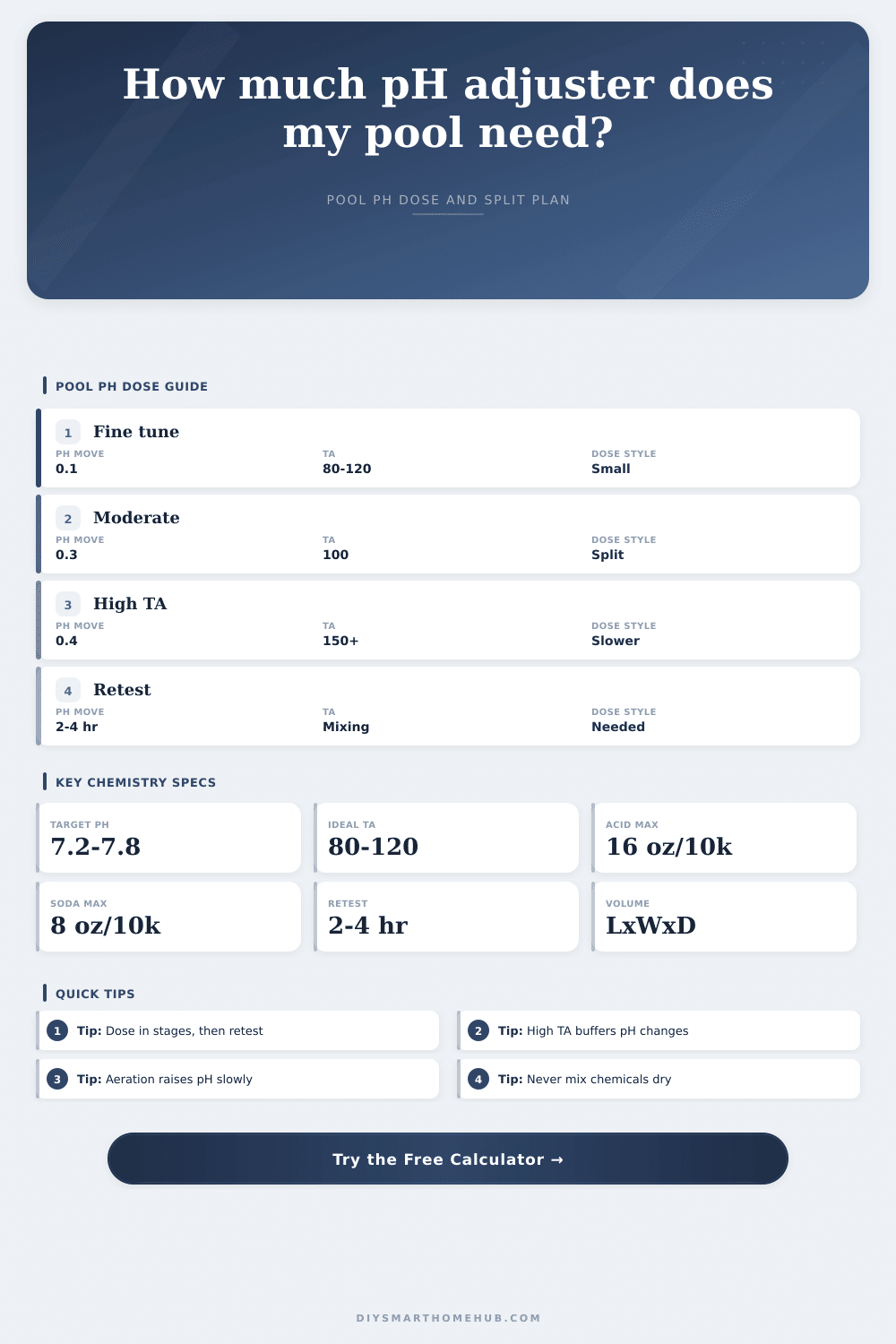
| Muriatic acid 31.45% | Lower pH | 1.00x liquid acid baseline | 16 fl oz per 10,000 gal per pass |
| Muriatic acid 20% | Lower pH | 0.64x of 31.45% baseline | 24 fl oz per 10,000 gal per pass |
| Dry acid 93.2% | Lower pH | 0.72x acid equivalent by dry ounce | 24 dry oz per 10,000 gal per pass |
| Soda ash 99% | Raise pH | 1.00x base baseline by dry ounce | 8 dry oz per 10,000 gal per pass |
| Formula part | Calculation | Why it matters | Calculator use |
|---|---|---|---|
| Rectangular volume | Length × width × depth × 7.48052 | Sets the gallons that scale every chemical dose. | Best for straight-sided pools. |
| Round volume | pi × radius² × depth × 7.48052 | Diameter errors grow because radius is squared. | Best for round above-ground pools. |
| pH step count | Absolute pH change / 0.1 | Larger pH moves are intentionally split. | Controls acid demand or base demand. |
| TA buffer | Total alkalinity / 100 with a pH-curve adjustment | High alkalinity resists pH movement. | Multiplies the estimated dose. |
| Total alkalinity | Buffer factor | Typical effect | Dosing note |
|---|---|---|---|
| 50 ppm | 0.55x to 0.70x | pH moves easily | Use smaller corrections and retest carefully. |
| 80 to 120 ppm | 0.85x to 1.25x | balanced buffer | Normal staged dosing model applies. |
| 150 ppm | 1.45x to 1.70x | pH resists change | Expect more acid and slower response. |
| 200 ppm | 1.90x to 2.20x | strong buffering | Split doses become especially important. |
| Pool and goal | Common product | First dose cap | Retest plan |
|---|---|---|---|
| 10,000 gal, lower 0.2 pH | 31.45% muriatic acid | Up to 16 fl oz | Circulate 2 to 4 hours, then retest. |
| 20,000 gal, lower 0.5 pH | Dry acid | Up to 48 dry oz | Use several passes if demand is high. |
| 15,000 gal, raise 0.2 pH | Soda ash | Up to 12 dry oz | Add gradually to avoid overshooting. |
| Salt pool pH drift | Acid plus aeration control | Match calculated cap | Aeration and spillovers can raise pH again. |
Strong liquid acid
Most compact dose for lowering pH. The calculator caps each pass because it can move pH quickly.
Reduced acid
Needs more liquid for the same acid demand. It can be useful when gentler handling is preferred.
Dry acid
Measured by dry weight. The calculator converts acid demand into a dry-ounce estimate.
Base or aeration
Soda ash and borax raise pH with chemical dose; aeration raises pH slowly without adding base.
Here’s what happens: You’re at side of the pool holding a jug of muriatic acid in one hand and a test kit in the other. Your pH is high according to the strip, but you remember adjusting it yesterday. What do you do? Most people fail right here. They guess how much to add, throw it into their pool, and cross there fingers. Sorry…guessing isn’t a great strategy when dealing with water chemistry.
Chemistry is never intuitive; it’s all about how chemical strength, buffering capacity, and volume works together. The calculator above eliminates guesswork and calculates the tricky math based off simple inputs (like the stuff you’ve got).
How to Use the Pool Calculator
First thing: What is existing water amount in your pool? Most people pull out manufacturer’s sticker here. It typically states max capacity, not current level. Your pool is probably down a foot or two at this point…especially in the summer. Once you’ve entered your pool’s average depth and dimensions, it will provide an accurate gallon count based on that. This is your base for all other calculations; without it, any other number you use would of been a wild guess at the wrong scale.
After that it’s how much total alkalinity you have versus what your current pH is. That’s where newbies can trip up. What alkalinity does are resist a change in pH. It resists a change in pH. So if you’ve got a lot of alkalinity (above 150 parts per million), it’s going to fight you if you want to drop the pH. The tool takes that into consideration and adjust the dosage to match. That’s why it isn’t simply dosing with acid. It’s fighting the buffer too. People miss that one. When they don’t take their alkalinity into account, they’ll under-dose, test an hour later and see no difference at all. That’s what folks don’t understand about treating pH and alkalinity separately. They’re very much related.
Which type of acid? While there are many acids available, you really only have three choices: dry acid, reduced strength liquid, and full strength liquid muriatic acid. These each requires a different dose. How much depends on how concentrated they are. To make that clear, I put together a reference table on the page. Basically, a weaker acid require more volume to get the same amount of correction. Soda ash works opposite way when raising pH, it also increases alkalinity. This can cause a vicious cycle as your pH continues to increase. Knowing this allow you to select the proper tool for the job instead of picking up whatever’s in garage.
Pool maintenance requires pacing and safety. Pool chemistry isn’t something you want to mess with. For this reason, the calculator offer a split-dose plan. Dumping a huge volume of acid all at once runs the risk of localized low-pH spots that will eat away at your pool’s equipment or surface. Breaking the dose into multiple parts allow the chemical to mix and spread throughout the water. Add the first portion, let the pump run for several hours, and then retest. A little slow is better than too fast. You can’t easily back up if you overshoot; undershooting is easy to correct. Slower is OK, and it will save you having to start over.
And then there is also aeration, how that slightly help in keeping things in check. Your pool wants to self-balance naturaly, but if you are only treating with chemicals, you may not realize what nature is doing for you. For example, wind, splashes and other water features release CO2 that can lower your pH over time. Saltwater pools tend to move towards higher pH due to electrolysis depleting acid. Understanding those environmental conditions will help you see why your pH might creep back up a few days after you adjust it. It is not necessarily a chemical mishap, but just physics at play.
So in conclusion, maintaining proper pool pH isn’t necessarily about being precise; it’s about consistency. Don’t fret over achieving a perfectly accurate 7.5 each and every time. That said, aim to keep it between 7.2 and 7.8, a safe zone where water feel good on swimmers’ bodies and sanitizer works best. Follow the tool to determine your initial dose, watch your water’s buffering power, and always wait before applying additional product. When you allow the math to dictate your hand, the guesswork goes away and management take over. You’ll eventually be able to ditch the test kit and simply enjoy the swim, all while seeing clearer water and getting longer life out of your equipement.