Rain Barrel Fill Rate Calculator
Estimate runoff from roof catchment area, rainfall intensity, downspout share, screen loss, barrel capacity, and the time until overflow starts.
| Rain pattern | Intensity | 300 sq ft gross flow | Best use in calculator |
|---|---|---|---|
| Light steady rain | 0.10 in/hr | 18.7 gal/hr before share | Long-duration drizzle or gentle fronts. |
| Moderate rain | 0.25 in/hr | 46.7 gal/hr before share | Common planning value for small barrels. |
| Strong rain band | 0.50 in/hr | 93.5 gal/hr before share | Short storms where overflow may start fast. |
| Heavy downpour | 1.00 in/hr | 186.9 gal/hr before share | Overflow and drain-path stress checks. |
| Cloudburst segment | 1.50 in/hr | 280.4 gal/hr before share | Conservative sizing for intense bursts. |
| Surface or inlet condition | Typical loss | What it represents | Calculator setting |
|---|---|---|---|
| Clean metal roof | 5% | Smooth runoff with a clear inlet screen. | Use when gutters are clean and direct. |
| Covered patio roof | 8% | Small splash and edge losses. | Good for compact roof sections. |
| Asphalt shingle roof | 12% | Texture, grit, and screen restriction. | Useful default for many homes. |
| Tile roof | 15% | Profile channels and splash losses. | Use when runoff is not perfectly smooth. |
| First-flush diverter | 18% | Intentional bypass before storage. | Use when first runoff is diverted. |
| Leafy gutter or screen | 25% | Debris, overflow at screen, and splash. | Use before maintenance or cleaning. |
| Setup | Usable capacity | Good catchment range | Overflow note |
|---|---|---|---|
| Decorative 40 gallon barrel | 35-40 gal | 80-180 sq ft | Can fill within one moderate storm hour. |
| Standard 55 gallon barrel | 50-55 gal | 120-300 sq ft | Needs clear overflow routing in downpours. |
| Twin linked barrels | 100-110 gal | 250-600 sq ft | Link pipe size can become the bottleneck. |
| Slim wall tank | 65-90 gal | 150-450 sq ft | Useful where footprint is limited. |
| IBC tote | 250-275 gal | 600-1200 sq ft | Overflow may be delayed but still planned. |
| Scenario | Catchment | Assumed rain | Approximate net fill |
|---|---|---|---|
| Small shed roof | 96 sq ft, 100% share | 0.25 in/hr, 8% loss | 13.8 gal/hr |
| Townhouse downspout | 220 sq ft, 50% share | 0.50 in/hr, 12% loss | 30.1 gal/hr |
| Garage corner | 360 sq ft, 40% share | 0.60 in/hr, 12% loss | 47.4 gal/hr |
| Half suburban roof | 650 sq ft, 50% share | 0.40 in/hr, 12% loss | 71.3 gal/hr |
| IBC tote capture | 900 sq ft, 75% share | 0.35 in/hr, 15% loss | 125.1 gal/hr |
Frustration is when your rain barrel overflows in a storm, yet your lawn is bone-dry and you have lost the potential for that water to flush the toilet or grow your tomatoes. Always it’s due to a gap between expectation and reality, how does water behave? The shape of your roof and gravity alter what most folks expect will happen (the barrel fills in a straight line). Water-catchment math is simple, but simple enough to guess wrong.
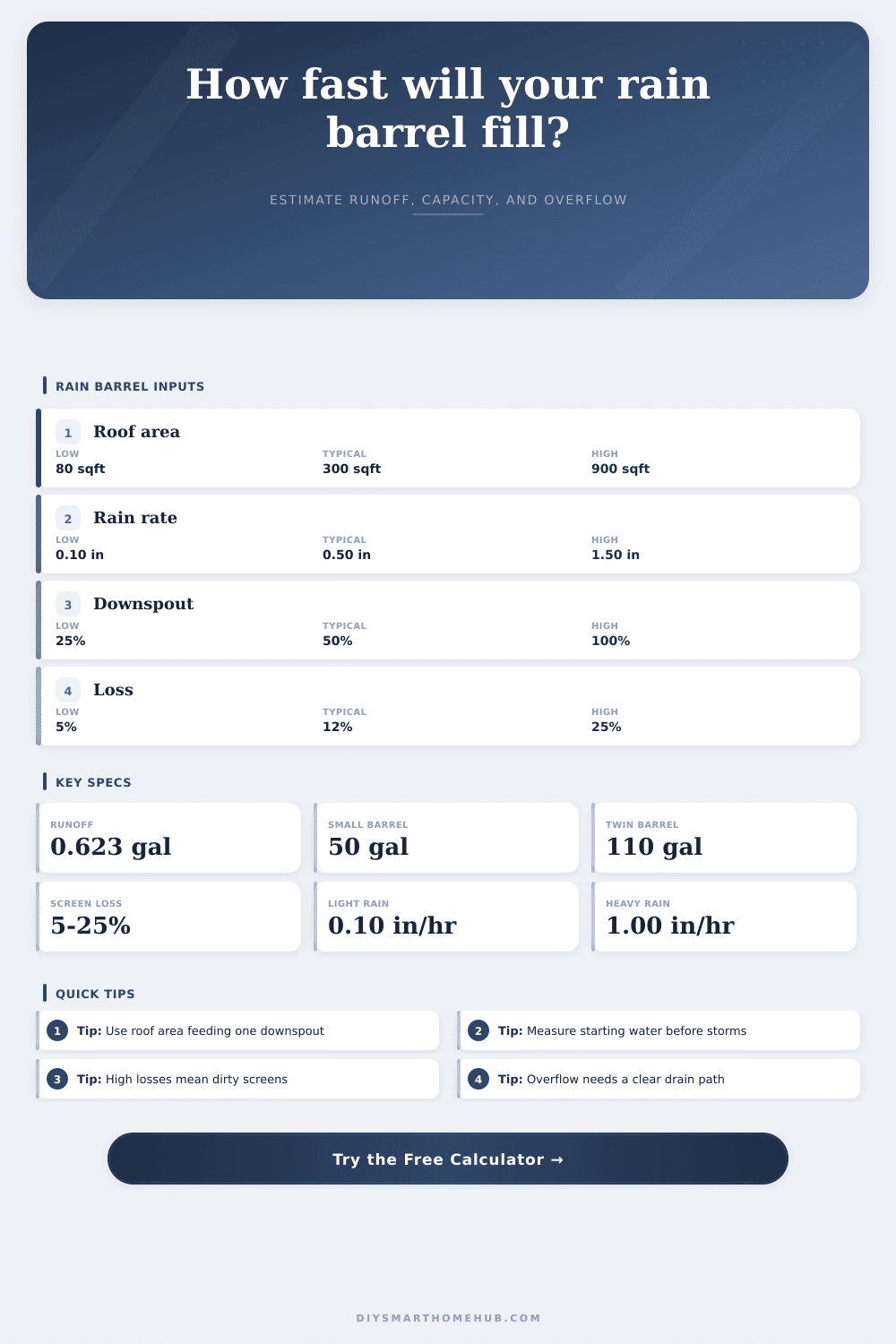
For example: Each inch of rain falling onto each square foot of roof captures roughly six-tenths of a gallon. There’s no need to whip out the calculator mid-storm to work out such figures in your mind. To spare yourself, just input the information (roof area draining into each downspout; intensity of the storm; barrel size) and let the calculator do the conversion work for you. The result? The result show how quickly the barrel will fill and at what point the overflowing starts.
How to Calculate Rain Barrel Water
This brings us back to the main problem: knowing how much area you’re measuring. A lot of people just put in square footage of their entire house’s roof. That doesn’t work. Unless all of that water flows into one cistern (via one big downspout), it isn’t relevant. Think about isolating the area feeding your particular barrel or barrels.
Do you have a two-downspout house? Then unless you’re collecting the water from both downspouts, you’re only catching water from half the roof area if you have a barrel beneath just one downspout. Uneven water flow caused by roof pitch will reduce your collection even further. So right there, when you get the input wrong, you double your margin for error.
The second factor is loss, which also reduces yield. No roof is 100% efficient at capturing water. Some will splash off surface. Some will evaporate before reaching the ground. Some will be caught by debris. Depending on what type of roof you have, you’ll lose some water due to splashing and evaporation, with a clean metal roof losing only about five percent. Asphalt shingles are rougher than metal and they hold onto moisture longer so they lose more (see the reference table below). If you have a clogged up screen or leaves in your gutter, that loss percentage will jump to twenty-five percent or more.
Bottom line: you’re likely only getting three-quarters of the water you thought you were getting; a quarter goes up in smoke thanks to physics and lack of care. The other hidden variable is storm intensity. A barrel will fill at a different rate from a gentle rain that lasts 4 hours compared with a hard rain that lasts only half an hour.
With a gentle rain, the barrel fills gradually over several hours. You have plenty of time to see that it is full and take action by opening a tap or diverting the excess. With a quick burst, however, it will be full within minutes. That means that the overflow volume is what really matters here.
Do you need to know how much before you start seeing overflow if you’re storing water in the barrel as an emergency? Then you’d like to know how much you get before spilling. Or do you wish to keep your basement dry? Then you’ll want to know how much you should of plan on overflowing, which will guide you in lengthening your downspout or grading your yard accordingly.
And then there’s barrel size. Luckily, a typical fifty-five gallon drum is available off-the-shelf. But it is tiny. In a moderate rain, on a big roof section, it will fill in under an hour. To solve that problem many gardeners connect two drums. You double the capacity, slow the rate of fill and provide yourself with some buffer against sudden downpours.
The tool shows you that instant trade-off. Change the input for capacity; watch how the overflow time changes. Plan instead of guessing. Manage expectations. Because we don’t manage the weather, we manage our expectations through collecting rainwater.
Understanding your storm patterns, your roof surface, and your catchment area allows you to plan instead of guess. When the clouds roll in, you’ll know what your barrel is doing next time. How much water did you save? Will it fill? Will it overflow? Knowing that makes a simple plastic container a trusted component of your homes infrastructure.