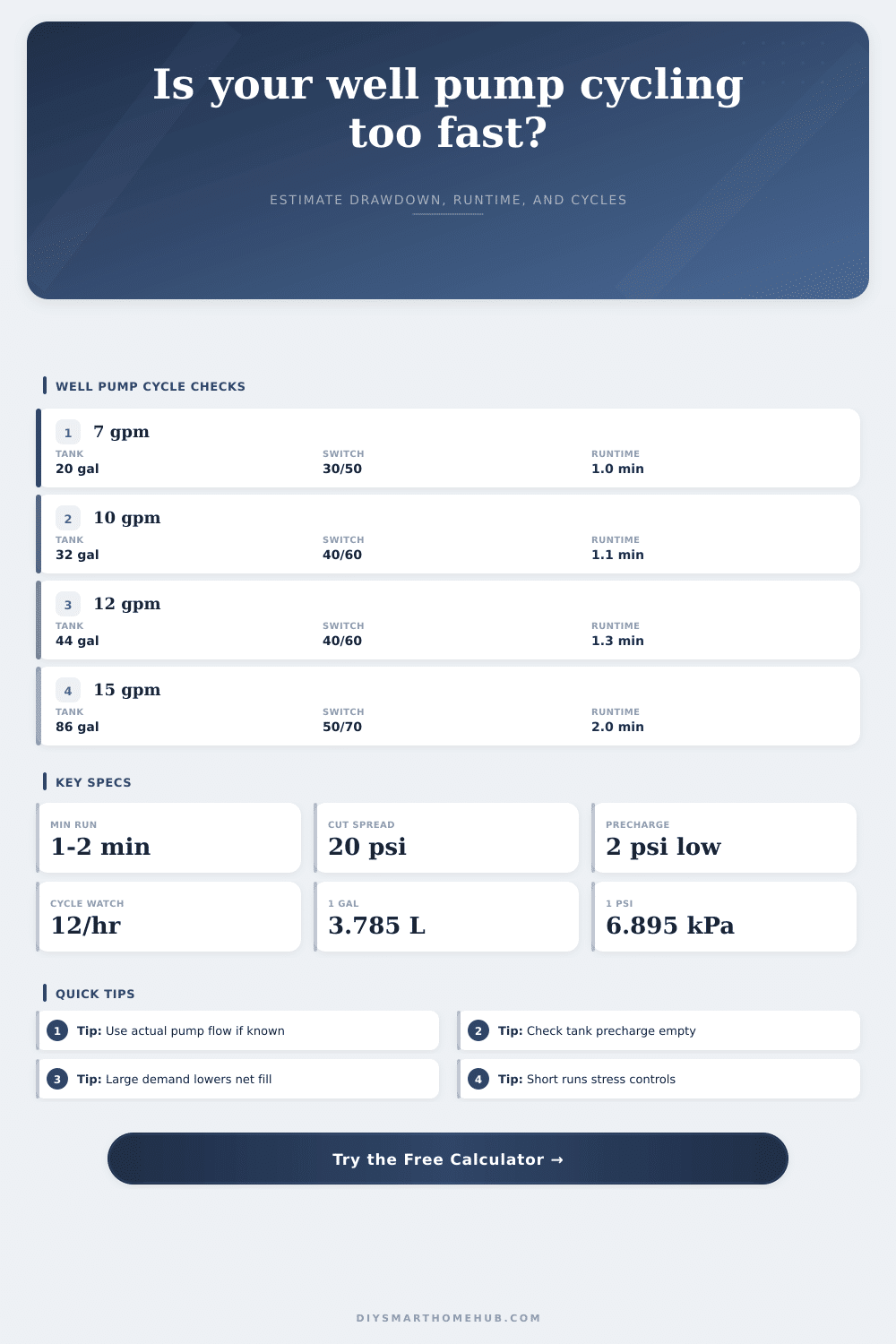
Well Pump Cycle Calculator
Estimate pressure tank drawdown, pump runtime, cycles per hour, and minimum tank size from pump flow, fixture demand, pressure switch settings, and drawdown factor.
Well Pump Cycle Results
Calculation Breakdown
| Switch setting | Precharge model | Ideal drawdown | Drawdown share |
|---|---|---|---|
| 30/50 psi | 28 psi | 5.9 gal on 20 gal | 29% |
| 40/60 psi | 38 psi | 5.2 gal on 20 gal | 26% |
| 50/70 psi | 48 psi | 4.7 gal on 20 gal | 24% |
| 40/70 psi | 38 psi | 7.3 gal on 20 gal | 36% |
| Demand case | Typical flow | Metric flow | Cycle effect |
|---|---|---|---|
| Lavatory faucet | 0.8 to 1.5 gpm | 3 to 6 L/min | Longer off time |
| Shower valve | 1.8 to 2.5 gpm | 7 to 9 L/min | Normal cycling |
| Washer fill | 2.5 to 4 gpm | 9 to 15 L/min | Faster drawdown |
| Irrigation zone | 6 to 12 gpm | 23 to 45 L/min | May run steady |
| Pump flow | Net refill | Target run | Needed drawdown |
|---|---|---|---|
| 7 gpm | 5 gpm | 1.0 min | 5 gal |
| 10 gpm | 8 gpm | 1.5 min | 12 gal |
| 12 gpm | 9 gpm | 2.0 min | 18 gal |
| 15 gpm | 12 gpm | 2.0 min | 24 gal |
| Factor | Model value | What it means | Use when |
|---|---|---|---|
| Correct precharge | 1.00x | Ideal model | Tank is checked empty |
| Typical bladder | 0.95x | Small real loss | Nameplate is optimistic |
| Precharge off | 0.85x | Less usable water | Air charge is uncertain |
| Aged tank | 0.72x | Possible waterlogging | Cycles are unusually fast |
Now listen closely. When the pump comes on the first time, do you hear it make a noticeable thump? Then maybe just a minute later there’s another one. That’s not just irritating; it’s the sound of a system fighting physics.
These is burned-out pump motors, chewed-up pressure switches, and confused customers wondering why their water pressure seem low. The pump isn’t the problem most times. It’s a matter of how much pressure your pump pushes, how much your tank holds, and how you’ve got your pressure switch adjust. Once you understand that relationship, it become an engineering problem; not a guessing game.
Understanding How Your Water Pump and Tank Work
Drawdown is the key variable. Drawdown refers to how much water you have inside the tank when it’s at the point where it cuts on and off. For example, most residential tanks is 40 gallons. But that doesn’t mean they’re full of 40 gallons of usable water. With a normal thirty-to-fifty pound pressure switch, there’s probably maybe ten to a dozen gallons of water that’s realy useable. What’s left is just compressed air. And that air creates a spring effect. Pushing water outward as the pressure decrease. If you don’t include that in the calculation, you’ll think you have more reserve then you actualy do.
Tank Condition allows you to adjust the “ideal” drawdown with the calculator above. It also help you visualize how an old bladder or bad precharge can cut up to twenty percent (or more!) of your usable capacity and narrow your runtime window considerabley.
The money will be in runtime. Any residential system should target a pump cycle duration of at least one or two minutes. You save nothing by stopping short; you use more electricity starting the motor than you gain by not having it run longer. Repeated starts stresses the mechanical seals and electrical contacts.
The net fill rate is what the tool calculates based off your fixture demand input. Say you have a 10 gallon per minute pump feeding a shower and a faucet with combined flow of four gallons per minute; the tank will only refill at the rate of six gallons per minute. Less time means more cycles per hour. More than twelve cycles per hour should be considered a warning sign of an undersize or failing system.
Which brings us naturaly to tank size. Want a one-minute minimum of safety? A small pump demand a bigger tank to stretch that runtime. A good-sized pump can probably gets by in a smaller tank as long as the pressure switch range meets the demand. That’s where the chart on the page comes into play. That says at moderate demand, a 10 gpm pump wants X amount of drawdown to achieve that one minute minimum of safety. And no, it’s not “get the biggest tank off the shelf”. It’s “how do I make sure my tank has enough air cushion to match the delivery rate of the pump and the consumption pattern of house”?
Also inspect the precharge pressure on an empty tank. It should of been set exactly two pounds shy of the cut-in of the pump. Too high and the tank has no useful drawdown and just gets water logged like a brick. Too low and the tank will fill too easy and the pump will cycle way too fast. To measure it you have to drain the water side totally, a chore most people leave until the system starts acting funny. The drawdown factor in the calculator takes into account these real world flaws and lets you see what effect a slightly off precharge has on your results.
A new pump isn’t necessary for most cases of short cycling; more often than not it’s a matter of adding a little bladder tank, changing to a pressure switch with a wider spread, or building up the air charge in your tank.
Stripping away all the confusing math leaves us with: how much time do you need the pump to run? Answer that question with how much time do I need the pump to be doing useful work, not just flipping a switch. If the pressure stabilizes and the thumping cease, then you’ve got a good handle on the balance between them. It is nothing but air, water, and timing working together rather than against one another.