Low Flow Showerhead Savings Calculator
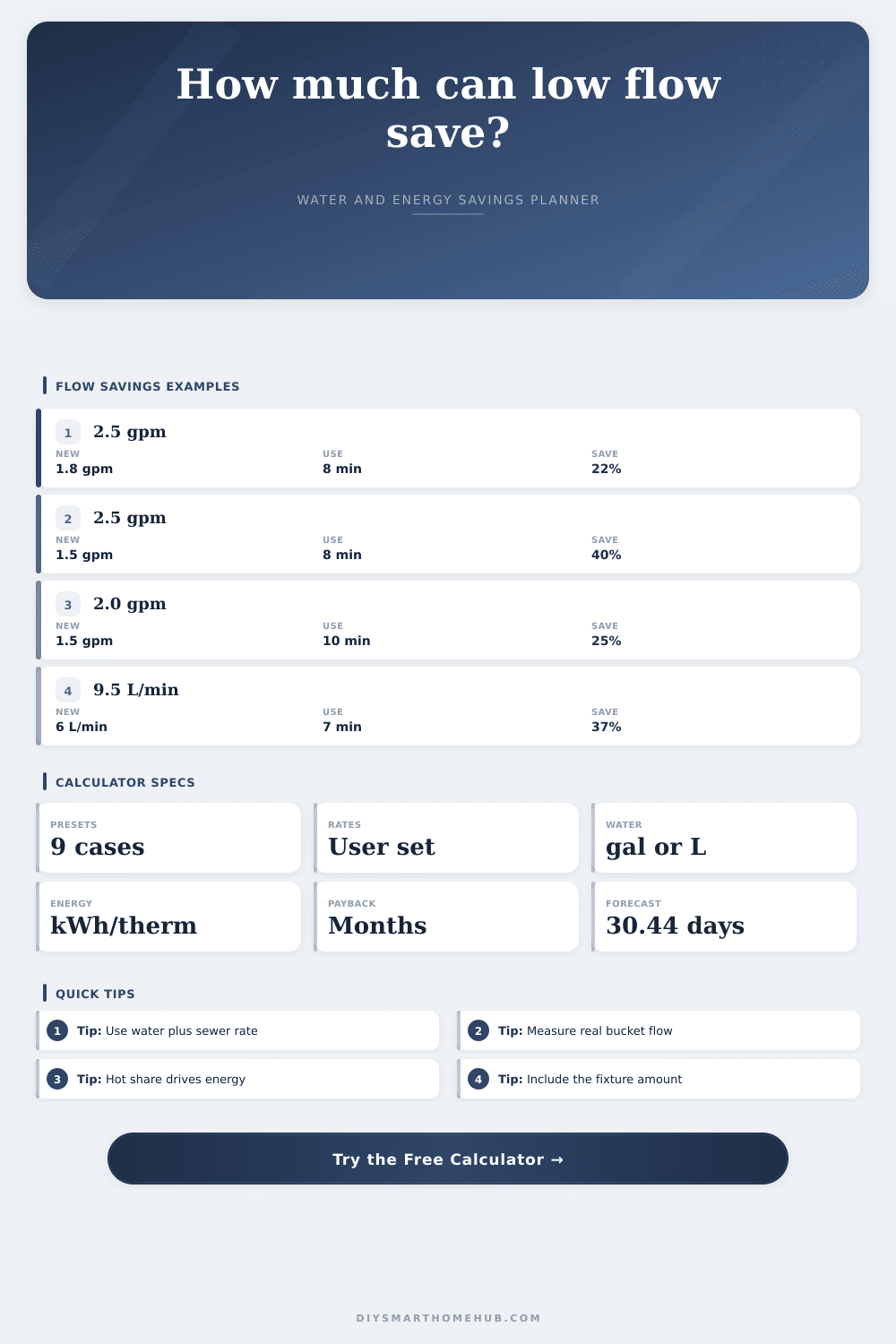
Compare your current showerhead with a low-flow replacement using old and new flow rates, shower length, weekly use, hot-water share, utility rates, heater efficiency, and fixture amount.
🚿Household Presets
⚙Calculator Inputs
📊Comparison Grid
💧Flow And Savings Specs
📋Reference Tables
| Type | Flow | Metric | Use note |
|---|---|---|---|
| Older high-flow head | 3.0 gpm | 11.4 L/min | Large savings potential |
| Standard maximum | 2.5 gpm | 9.5 L/min | Common comparison baseline |
| Moderate efficient | 2.0 gpm | 7.6 L/min | Smaller but useful drop |
| Low-flow model | 1.8 gpm | 6.8 L/min | Balanced savings target |
| High saver model | 1.5 gpm | 5.7 L/min | Higher volume reduction |
| Shower feel | Hot share | Energy effect | Best use |
|---|---|---|---|
| Cool rinse | 40% | Low | Summer or quick rinse |
| Mild shower | 55% | Moderate | Lower heat setting |
| Warm shower | 65% | Typical | Common default estimate |
| Hot shower | 75% | High | Cold rooms or winter |
| Very hot use | 85% | Very high | Use with caution |
| Household | Showers/week | Minutes | Monthly showers |
|---|---|---|---|
| Single adult | 7 | 8 | 30.3 |
| Couple | 14 | 8 | 60.7 |
| Family of three | 21 | 9 | 91.0 |
| Family of four | 28 | 8 | 121.3 |
| Athletic household | 35 | 7 | 151.7 |
| Step | Formula | Output | Why it matters |
|---|---|---|---|
| Water saved | (Old - new) x min | gal/shower | Core flow reduction |
| Hot saved | Saved x hot % | hot gal | Energy volume |
| Heat energy | L x 4.186 x C / 3600 | kWh | Useful heat saved |
| Purchased heat | kWh / eff. | kWh input | Heater losses included |
| Payback | Amount / monthly save | months | Simple recovery time |
ℹPractical Notes
How much do you think you use when you take a shower? If most of us guessed, which we usually do by basing our answers on how long we shower, then we would figure that a 10-minute shower cost twice as much as a five-minute one. This make sense: longer = more expensive. But here’s the thing: Time has nothing to do with it. Your bill isn’t driven by time at all. It’s driven by flow.
An old-school ’90s-era shower head can spit out almost three gallons a minute, while an efficient new one use roughly half as much and still manages to provide same pressure. And that’s not just about water; it’s about the incredable amount of energy it takes to warm that water up in the first place.
Why Saving Water Saves You Money
Use the calculator on this page; it’ll do the work for you. Pay attention to what you’re putting into equation. Your habits matter more then the fixture’s sticker price. Be sure to input your previous and new flow rate; this is a great moment to assess exactly how much water you’re using now. Don’t know? Time yourself filling up a gallon bucket. It’s easier than reading through specification sheets from manufacturers, and it reflect your home’s water pressure plus any mineral buildup in your plumbing.
This is the point at which most calculation fall short. It’s when people calculate water savings and then cease. They neglect the fact that heated water costs money. The calculator considers how much of your water usage are hot, what your heater is set at, and what the temperature of your cold inlet water is. That last part can be near freezing in the dead of winter. To get it up to a decent one hundred twenty degrees require a substantial amount of energy.
Also consider that if you’re on gas, you need to know the efficiency rating of your heater. Standard tanks lose heat both up their flues and out the sides. Tankless units is different as are heat pump water heaters. Adjusting this number will greatly impact your energy savings.
And this is where the nuance comes into play: It’s all about the trade-offs, and the reference table on the page show it. Some people adjust down to a one-point-five-gallon-per-minute head, complaining of low pressure. Other people are happy with a well-designed aerated one-point-eight model that seem just as strong. You want the lowest flow that feels good. The sooner you get used to a lower water flow (without feeling rushed in the shower), the faster your savings grow.
The last part of the puzzle? Payback period. Low-flow fixture heads cost between twenty and fifty dollars. If your monthly savings are fifteen dollars, then the fixture would of pay for itself in three to four months. Every dollar after that is gravy.
Because you’re using less water, you’re putting less strain on your water heater, which could mean extending its life. The savings add up to money saved on your water bill. Also, using less water reduce stress on your water heater. Keep it all in perspective. It’s not just the arid parts of the country where water might be scarce. In fact, water scarcity is becoming a common reality in many regions, not just the dry west. Less volume means less water pumped and treated by municipal systems. Cut back your flow and you’re helping contribute to a measurable conservation step, however small. Plus, you’re lowering that system’s carbon footprint when it comes to producing energy.
Whether it is about money or the health of the planet, the math work in your favor. The key here is not to think of this showerhead upgrade as swapping out hardware but rather changing the whole system. First measure your flow. Look at your utility rate, specifically the portion for sewer which is often tied to how much water you use. Plug that into an equation. It may surprise you. More often than not, it’s not about making drastic life changes. It’s about using smarter equipment that works harder with less.
You come in saying that you want to save money, and then you leave having a smarter home. And that is what everyone misses. They look at a little plastic nozzle and fail to grasp the bigger engineering shift it creates. The water still gets hot. The shower still feels great. But the waste dissapears.