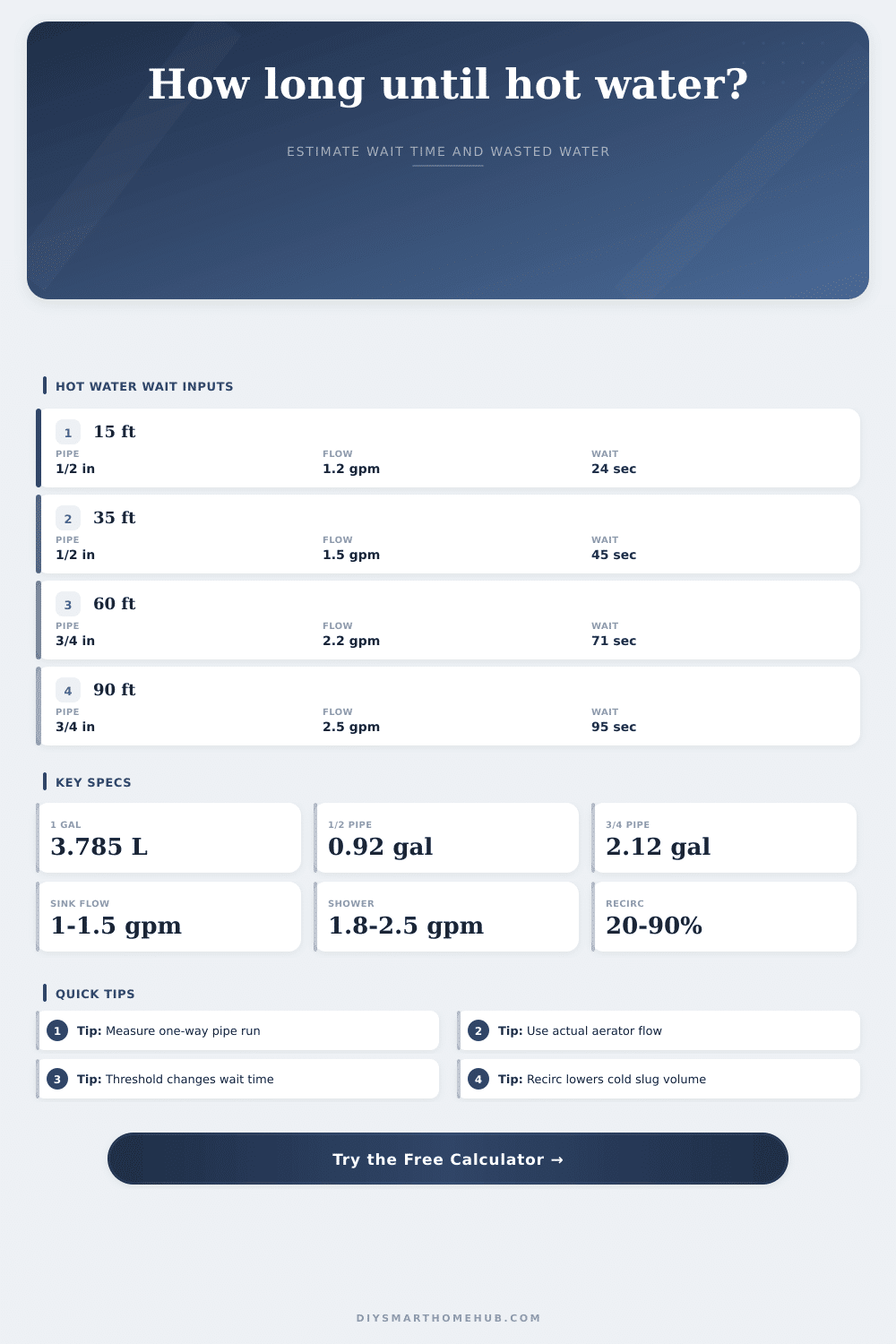
Hot Water Wait Time Calculator
Estimate how long a fixture waits for hot water from pipe run length, inside diameter, flow rate, target temperature, starting line temperature, and recirculation effectiveness.
Hot Water Wait Results
Calculation Breakdown
| Pipe profile | Inside diameter | Gal per 100 ft | L per 30 m |
|---|---|---|---|
| 1/2 in PEX | 0.485 in / 12.3 mm | 0.97 gal | 11.0 L |
| 1/2 in copper | 0.545 in / 13.8 mm | 1.21 gal | 13.8 L |
| 3/4 in PEX | 0.681 in / 17.3 mm | 1.89 gal | 21.5 L |
| 3/4 in copper | 0.785 in / 19.9 mm | 2.50 gal | 28.4 L |
| Pipe run | Pipe ID | Flow rate | Base wait |
|---|---|---|---|
| 20 ft branch | 0.545 in | 1.2 gpm | 12 sec |
| 45 ft branch | 0.545 in | 1.5 gpm | 22 sec |
| 70 ft trunk | 0.785 in | 2.0 gpm | 53 sec |
| 100 ft trunk | 0.785 in | 2.5 gpm | 60 sec |
| Start temp | Threshold | Heater outlet | Volume factor |
|---|---|---|---|
| 70 F idle line | 100 F | 120 F | 0.60x |
| 70 F idle line | 105 F | 120 F | 0.70x |
| 65 F cool line | 110 F | 125 F | 0.75x |
| 80 F warm line | 105 F | 120 F | 0.50x |
| Loop condition | Model factor | Volume cleared | Planning use |
|---|---|---|---|
| No recirculation | 1.00x | 100% | Full cooled run |
| Weak demand pump | 0.85x | 85% | Partial warm start |
| Good demand recirc | 0.45x | 45% | Reduced cold slug |
| Near-instant loop | 0.10x | 10% | Short branch only |
How long will it take to get hot water? This is one of the most common questions and it’s all about how much water there is in your pipes. Before doing any renovations, find out how long it will be and plan accordingly. It’s based off flow rate, pipe size and length from heater.
Water volume is the primary consideration here: How much water is in the tube? To get hot water flowing at the tap, first all the cold water in the pipe has to exit. Wider tubes contains more water; longer ones contain even more. For example, a three-quarter-inch pipe contains more water then a half-inch copper pipe. Therefore, despite their tight feeling, smaller pipes is actualy more efficient at saving water. According to the reference table, see how many inches of water occupy various pipe lengths.
How to Get Hot Water Faster
It’s also believed by some that turning on the faucet at higher flows will do the trick, it won’t. While a high-flow faucet does remove the cold water quicker, it still wastes as much total water. So you’re just trading time for volume, but wasting same number of gallons. That’s why lower-flow fixtures can feel like they takes longer to heat up. They move the water slower so there’s less flow going in the same amount of cold water. That’s why the calculator does that math for you. Plug in your flow rate and length of your pipes and find out if a new aerator would make a difference.
The other factor is that the temperature makes a difference on the waiting time. Your cold water will cool down from hot water and will lose heat to its environment (the concrete or surrounding air). If you have an unconditioned crawlspace or attic, then the water might cool all the way down to the surrounding temperature. So you’ll need to flush even more water until it’s comfortabley.
The hotter you set your water heater, the quicker hot water gets to you. The smaller the temperature gradient, which means the more work the mixing valve has to do. Although this is a very small difference, it impact your comfort. In hot water loops, hot water are pumped around in a loop to stay warm. These require energy (a cost that’s factored into the calculator). It shows you just how much time you save with a demand pump compared to a full-time loop. Usually it’s a matter of time/water vs. Electricity. With a timed loop, your water will be warm in the morning but might have cooled down while you slept. That saves energy, at the cost of waiting a bit longer when you get up.
The thing about measuring a pipe run is it’s not a straight line. It goes up in the ceiling, it goes down through the floor, around a beam. Every foot of distance it travels matter. Tracing out the twists and turns could make a fifty foot straight line an eighty foot run of pipe. Underestimating the distance mean underestimating the wait time. Knowing exactly what you are measuring is key.
On new construction or remodeling: Place the water heater as close as possible to every fixture, that way less cold water has to be pumped around. If running long lengths of pipe, use small diameter pipe (so it doesn’t holds as much cold water). Insulate your hot-water plumbing, particularly if it’s in unheated areas (this slows down heat loss). That means fewer expensive recirculation systems down the road.
Not only do we wait for warm water but we wait for a certain amount of water to reach a certain distance in the pipe. If you understand that relationship then you are in control. You can decide to live with it, or you can add insulation, improve the flow, add a pump etc. And you can make your decision based on numbers. It is not just feelings of frustration. Think about it different than and there is hope that you can solve the problem of the cold shower.