Household Water Bill Calculator
Estimate fixture use, irrigation, leaks, CCF billing tiers, sewer charges, fixed fees, daily cost, and low-flow savings in one water bill breakdown.
Water bill estimate
Full calculation breakdown
| Billing unit | Equivalent gallons | Equivalent cubic feet | Where it appears |
|---|---|---|---|
| 1 gallon | 1 gal | 0.1337 ft³ | Fixtures, leaks, and irrigation estimates |
| 1 cubic foot | 7.48 gal | 1 ft³ | Meter math behind CCF billing |
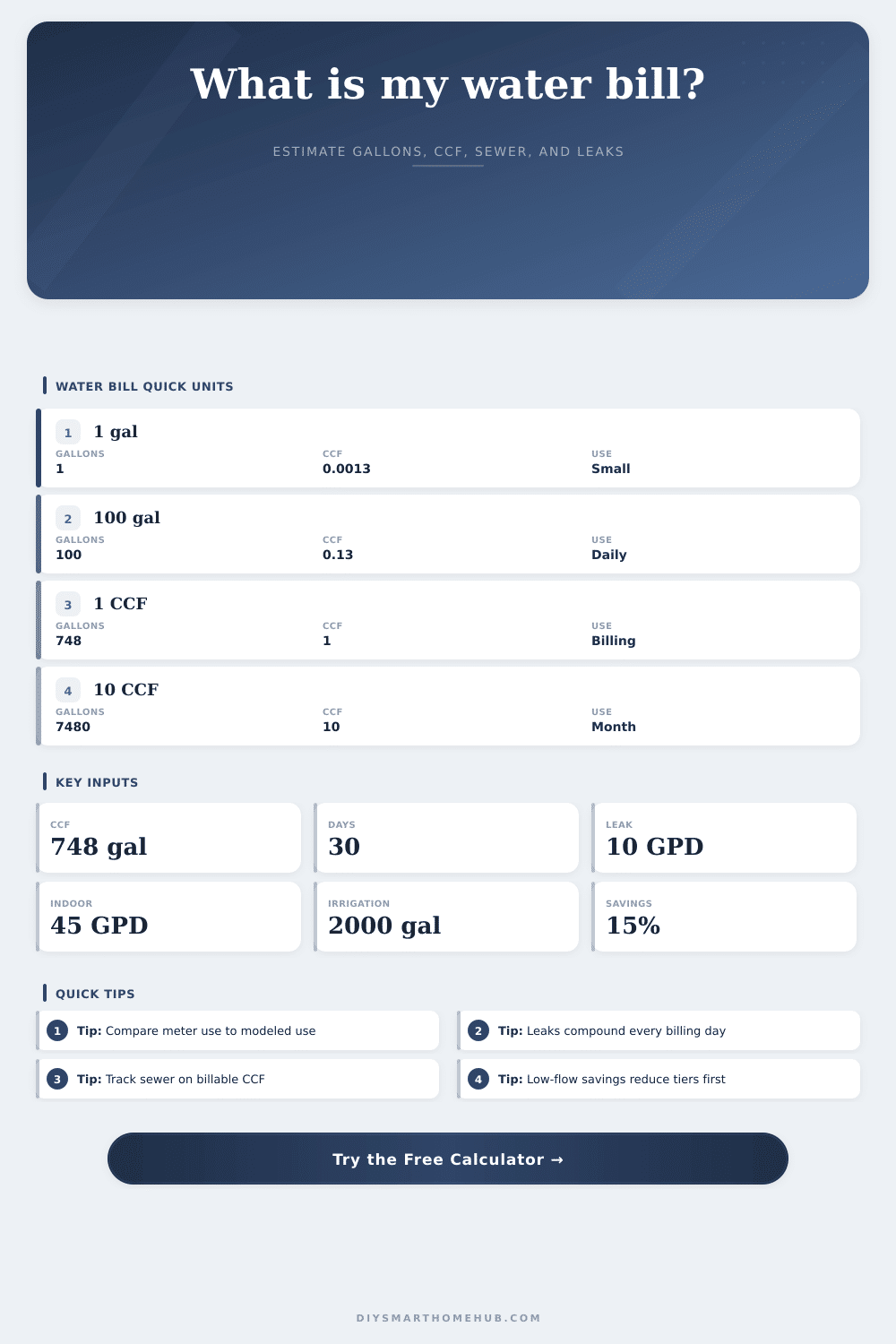
| 1 CCF | 748 gal | 100 ft³ | Most tiered water and sewer rate sheets |
| 10 CCF | 7,480 gal | 1,000 ft³ | Typical monthly single-family bill range |
| Fixture profile | Indoor GPD per person | Typical drivers | Calculator input to adjust |
|---|---|---|---|
| Very efficient home | 30-38 GPD | Low-flow toilets, efficient washers, short showers | Indoor fixture use and savings percent |
| Average newer home | 40-55 GPD | Mixed fixtures and normal laundry cycles | Indoor fixture use per person |
| Older fixtures | 60-80 GPD | Older toilets, long showers, older clothes washer | Indoor GPD before conservation savings |
| High-use pattern | 85+ GPD | Frequent baths, extra laundry, guests, unnoticed leaks | Indoor GPD and leak gallons per day |
| Tier structure | Use block | Formula | Practical meaning |
|---|---|---|---|
| Tier 1 | 0 to Tier 1 limit | Tier 1 CCF × Tier 1 rate | Essential or baseline water use |
| Tier 2 | Tier 1 to Tier 2 limit | Tier 2 CCF × Tier 2 rate | Moderate use above baseline |
| Tier 3 | Above Tier 2 limit | Remaining CCF × Tier 3 rate | Irrigation, leaks, or heavy use usually land here |
| Fixed fee | Whole bill | Added after water and sewer | Base service cost independent of gallons |
| Leak source | Common flow | 30-day gallons | Added CCF |
|---|---|---|---|
| Slow faucet drip | 3 GPD | 90 gal | 0.12 CCF |
| Small toilet leak | 30 GPD | 900 gal | 1.20 CCF |
| Running toilet | 120 GPD | 3,600 gal | 4.81 CCF |
| Irrigation valve leak | 300 GPD | 9,000 gal | 12.03 CCF |
Your water bill went up, but it might just be because of increased outdoor use. Your faucet might be leaking, or even your toilet. There’s nothing wrong with the hose. But there might be something wrong with how your outdoor water consumption is pushing you into higher tiered pricing structures used by the city.
To fix it, you must forget about that bottom line number and focus on units behind it. Enter your home’s usage estimate and your local water rate into calculator above, and it’ll do all the tricky math for you. That way, you don’t have to guess what each of those mysterious utility unit means in terms of gallons.
How to Understand Your Water Bill
Most water utilities don’t charge by the gallon. Instead, they give you tiers (or “blocks”) to reward conservation. Tier 1 is your first block of water and is usualy for things we need, like drinking, cooking, and bathing. It’s cheap; the cheapest water you’ll ever purchase.
After that, you move on to the next tier. The price per unit go up. If you’re family, if you irrigate, if you have leaks, you may reach second tier pretty darn fast. And then the third. Each time, the expensive rate applies to the marginal gallons… Not to the average gallons.
This is what most people fail to grasp. They assume that their rate remains constant. But instead, it’s a ladder, and as you rise up this ladder, it gets steeper.
And then there’s the unit of measurement. Your typical residential bill will show your usage in something called CCF. That’s short for hundred cubic feet. Sounds like some engineering term, doesn’t it? But really, it’s nothing more than a conversion. A CCF is equivalent to about seven hundred forty-eight gallons.
Knowing that figure helps you see how your usage compares to others. A single CCF can seem pretty insignificant. However, one CCF are a fair amount of water. If you’re seeing a ten CCF charge, then you’re looking at almost seven and a half thousand gallons. This is where the reference table on the page does its job by connecting abstract units to the real world volume.
Leaks are silent budget killers. Leaks such as a dripping faucet or running toilet may sound like nothing more than a soft hum, yet they can be wasting more than a hundred gallon a day. In a month, that’s almost five CCF. At peak rates, a single leaking toilet can cost you as much as all of your indoor use.
Enter an estimate of how many gallons a day this leak wastes and the tool will model it for you. See exactly what a slow drip means in terms of both water and dollars. Now, it’s not just an annoyance, it’s also a money problem. Half the battle is estimating the leak; what you don’t know, you can’t fix.
There is also more: sewer fees. Utilities often bill you based off how much water flows into your home, under the assumption that most of it ends up going down the drain. But water used outdoors doesn’t enter the sewer system. Some utilities will credit you for outdoor water; others charge you on all water delivered. If you have a big lawn, you may be paying sewer fees for water that has never passed through your pipes.
To match your utility’s sewer billing policy, you can change the sewer billing basis in the calculator. You can see the impact of charging by all water different than just indoor use. The difference can be substantial during the summer months.
The low-flow equation helps, though: because you have lower indoor usage as your base, you stay on the lower (cheaper) rate for longer. Efficient toilets and showerheads pays for themselves, since you won’t spend as much money at the higher tier prices. In the calculator, we multiply your modeled indoor use by a % of conservation, and you can see what effect even a small change, like fifteen percent less, has on the bottom line. It’s not just about conserving water; it’s about not being in the expensive price bracket.
First step to fixing the bill: separate the facts from the assumptions. Don’t guesstimate how much you use. Pull up the meter reading and look at history. Factor in seasonal fluctuations. That’s where the tool helps, it gives you a structure for running through what-if scenarios.
Run the “what if I had a leak” scenario? Or maybe it is a vacation month. What about a retrofit? Understanding what drives things up (or down) isn’t the number itself. It’s knowing what will make a difference, which allows you to control the cost.
Break the water bill down into pieces and it’s no longer a mystery. You should of seen it was math waiting to be solved.