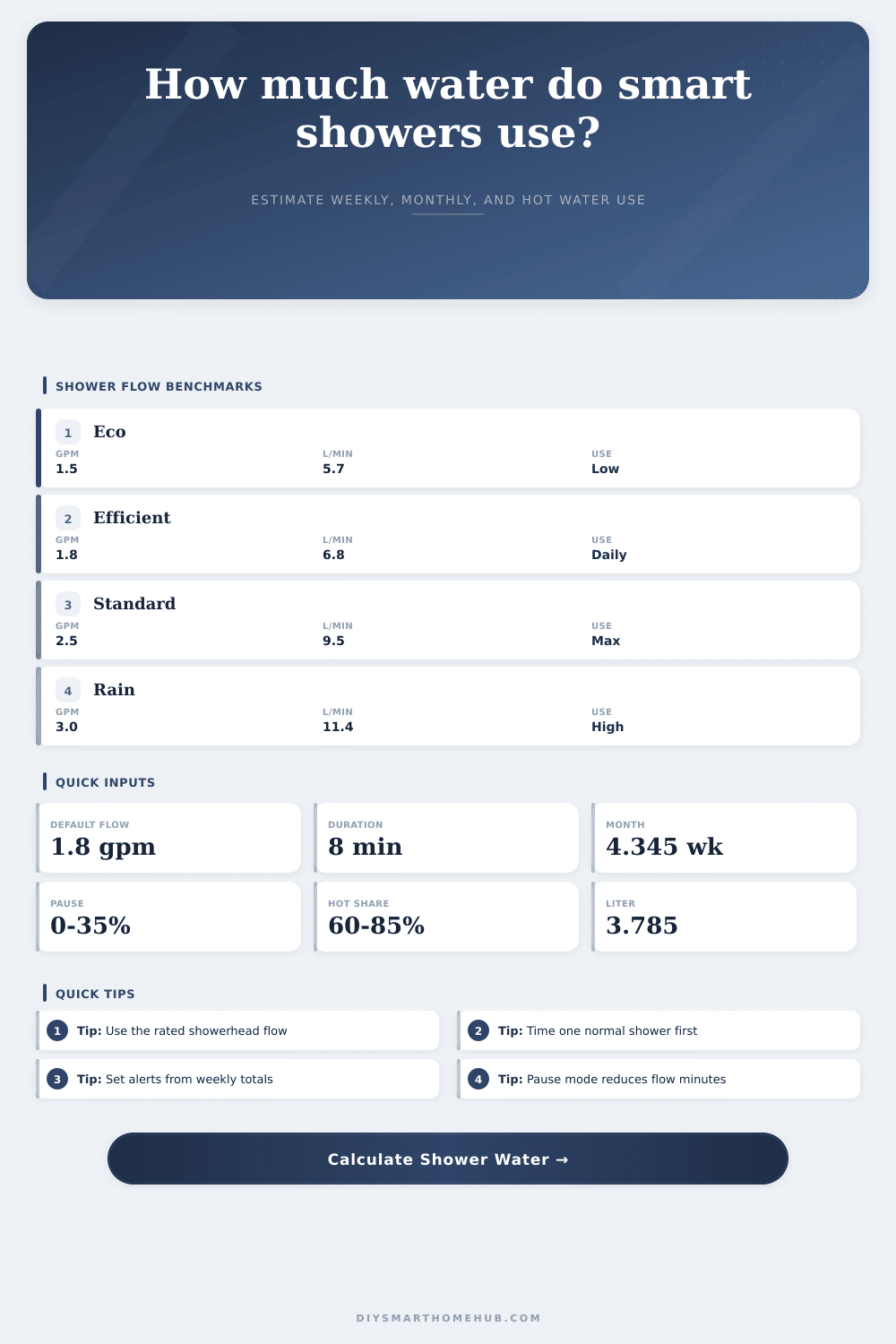
Smart Shower Water Usage Calculator
Estimate shower flow, timed duration, household weekly use, monthly gallons and liters, pause-mode savings, hot water volume, and smart alert thresholds.
Calculation breakdown
| Showerhead pattern | Planning flow | Metric equivalent | 8 minute shower |
|---|---|---|---|
| Eco low-flow head | 1.5 gpm | 5.7 L/min | 12.0 gal / 45 L |
| Efficient smart shower | 1.8 gpm | 6.8 L/min | 14.4 gal / 55 L |
| Federal standard head | 2.5 gpm | 9.5 L/min | 20.0 gal / 76 L |
| High-flow rain head | 3.0 gpm | 11.4 L/min | 24.0 gal / 91 L |
| Dual outlet shower | 4.0 gpm | 15.1 L/min | 32.0 gal / 121 L |
| Scenario | Raw volume | Pause setting | Effective volume |
|---|---|---|---|
| 1.8 gpm for 6 minutes | 10.8 gal | 0% | 10.8 gal / 41 L |
| 1.8 gpm for 8 minutes | 14.4 gal | 15% | 12.2 gal / 46 L |
| 2.5 gpm for 10 minutes | 25.0 gal | 20% | 20.0 gal / 76 L |
| 3.0 gpm for 12 minutes | 36.0 gal | 30% | 25.2 gal / 95 L |
| Household pattern | Showers/week | Per shower volume | Weekly total |
|---|---|---|---|
| Solo efficient routine | 7 | 10.8 gal | 75.6 gal / 286 L |
| Two users daily | 14 | 14.4 gal | 201.6 gal / 763 L |
| Family of four daily | 28 | 20.0 gal | 560 gal / 2,120 L |
| Long shower heavy week | 21 | 30.8 gal | 647 gal / 2,449 L |
| Weekly water | Monthly gallons | Monthly liters | 70% hot share |
|---|---|---|---|
| 100 gal/week | 435 gal | 1,645 L | 304 gal hot |
| 200 gal/week | 869 gal | 3,290 L | 608 gal hot |
| 350 gal/week | 1,521 gal | 5,758 L | 1,064 gal hot |
| 550 gal/week | 2,390 gal | 9,047 L | 1,673 gal hot |
You hum to yourself while waiting for the water to warm up and stand under running water until you feel refreshed. It is a little private ritual, but the amount of water flowing through that pipe isn’t small. Everyone knows that showers use a lot of water, vaguely, but few know how much there particular shower uses each week.
Once you enter in the duration and flow rate (the water volume coming out), the calculator do all the work. It converts those abstract plumbing numbers into something concrete, something you can understand and plan for in your budget.
How to Save Water and Money in Your Shower
The flow rate, typically measured in gallons per minute, is the first concept to understand. A typical older shower head blast out three gallons a minute or more. Sounds great; but do the math: a ten minute soak = thirty gallons of clean water into the ether.
The new efficient heads throttle down the flow to 1.8 gallons per minute. That’s the moddern sweet spot for comfort without waste. If your showerhead is over a decade old, then it’s probably dumping hundreds of gallon every month. Why? Because its internal restrictor are either gone or worn out. With a stop watch and a bucket, you can test it for yourself. It’s a fun weekend project that will ground your understanding of how much stuff your house consume.
The second variable is duration. And this one’s got nothing to do with hardware; it’s all about behavior. We all believe we’re fast, but how long does it take you to wash yourself thoroughy? If you’re lucky, it’s eight minutes.
Smart showers has that awesome feature called “pause” where the water turns off as soon as you want to lather soap into your hair. You can cut your effective water use by twenty to thirty percent. And that saves water without making you feel like you’ve been camping out in a freezing stream. It’s a little interaction, but after weeks/months of daily usage, it’ll add up bigtime.
The math gets crazy fast when you start throwing other people into the equation. If you’re alone at home, and take a shower daily, that’s maybe seventy-five gallons a week. If you have a family of four who each take a shower every day, you will use well over five hundred gallons pretty quick. Three-thousand plus gallons per month is a huge strain on your water heater, and it’s a big demand on the local city system. You can see this all spelled out in reference table on the page. Your personal behavior add up as your household grows. Not only does an individual save water by doing this, but the cumulative effect for the entire family is what matters.
The real money-leaker… Where it all comes out of your pocket… Is with hot water. In most households, heating water make up most of the home’s energy cost. If your shower is drawing half of your household’s total volume of water use, and if seven-tenths of that water is hot, then yes, you’re running your heater a lot…hard. Knowing how much of your family’s water use are going into the shower lets you know what percentage of that water can be saved by lowering flow or duration. That translates into financial savings on gas or electric bill. And it saves money on your water bill too. It shifts the motivation… From abstract conservation, to direct financial saving.
Finally, you can use all that data to create smart alerts based off your own needs. How much water do you want to use each week? Set that as your threshold. Then, if there’s a spike, get a notification. Catching a leak would of been good. Seeing if someone was under the spray a little too long would be nice, too. It turns passive consumption into active management. No policing is necessary. You are just seeing the trend.
Water is an invisibility cloak, until it’s not. Then it’s on demand; it comes from a tap. And it’s plentiful and warm. But behind that tap lies a system: pipes, pumps, and heaters. These cost resources and money to maintain and run. When you know exactly how much water your shower uses, you stop guessing and start managing. Not livig in some sort of fast-shower, cold-purgatory is not the goal. It’s to enjoy your bath while knowing exactly what it costs you, or the planet. You can have the savings and the hot water. You just need to pay attention to the numbers.