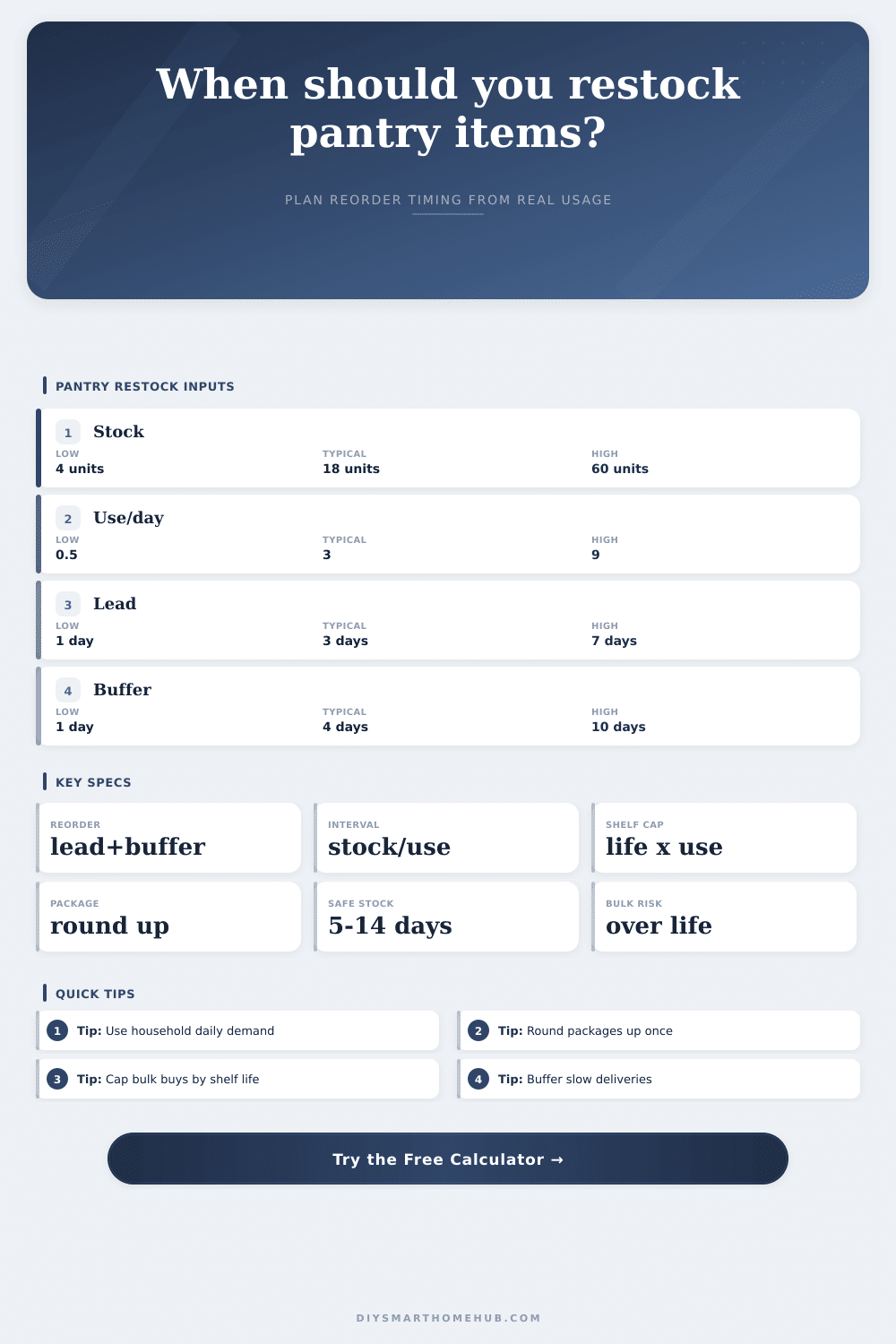
Pantry Restock Interval Calculator
Estimate when a pantry item should be reordered from current stock, household usage, delivery lead time, buffer days, shelf-life limits, and rounded package size.
Pantry Restock Results
Calculation Breakdown
| Metric | Formula | Meaning | Planning use |
|---|---|---|---|
| Household demand | Use rate x people | Units consumed per day | All interval math |
| Reorder point | Demand x lead+buffer | Minimum stock before order | Smart reminder trigger |
| Restock interval | Stock - point / demand | Days before ordering | Calendar spacing |
| Package rounding | Ceiling gap / package | Whole packages to add | Quantity selection |
| Need before rounding | Pack size | Rounded packs | Units added |
|---|---|---|---|
| 7 units | 6 per pack | 2 packs | 12 units |
| 18 units | 12 per pack | 2 packs | 24 units |
| 42 units | 20 per pack | 3 packs | 60 units |
| 96 units | 48 per pack | 2 packs | 96 units |
| Supply type | Lead time range | Buffer range | Automation trigger |
|---|---|---|---|
| Local pickup staple | 0-2 days | 2-4 days | Low stock reminder |
| Scheduled delivery | 2-5 days | 4-7 days | Reorder point alert |
| Subscription item | 3-7 days | 5-10 days | Skip or advance check |
| Essential supply | 5-10 days | 10-21 days | High-priority alert |
| Pantry item | Freshness window | Stock strategy | Watch for |
|---|---|---|---|
| Coffee, oils, nuts | 30-90 days | Short intervals | Flavor decline |
| Cereal, snacks | 60-180 days | Moderate stock | Stale opened packs |
| Rice, pasta, cans | 180-730 days | Longer cycle | Hidden old stock |
| Paper goods | No food limit | Space-limited | Package bulk |
The Bottom of Beans It’s not a disaster. It’s a Tuesday. But it feels like a crisis. Your routine just collided with reality, and you reach for the coffee. There are no beans left, but there’s a dusty bottom of them anyway.
Most of you treats your pantry as if it were a magic storage unit that replenishes itself according to its own schedule. But how many of you has ever actualy calculated how much of each item should be in there? Because while the difference between chaos and calm isn’t usually a matter of willpower, it’s mostly just math.
How to Stop Worrying About Running Out of Food
But here’s the thing: Your estimation of how fast you go through things isn’t based off measurement, it’s based on memory. You think you use a bag of rice every month, but in fact your eating habits might have changed. Maybe you’re cooking more often then usual? In that case, you’ll burn through a bag of rice in three weeks instead.
The calculator above does all the hard work for you; you simply input your actual rate of consumption without wondering if you have enough. You convert vague anxiety into something tangible: the number of days until you run out.
Step 1: Look around at what you have on the shelf right now. This is your starting point. Step 2: Estimate, per-person, how much of this thing you go through each day. It sounds like a drag, but it’s the only way to break the pattern of buying too much and then letting it rot.
Then we get into logistics. How long will it take that thing to get from manufacturer to my front door once I click that button? That’s called lead time. People totally ignore this and think everything is instant with the internet. It isn’t. There’s shipping time, processing time, the occasional missed delivery window, etc. So you want to include a buffer in this amount. What’s a buffer? It’s protection against supply chain hiccups and human error. If you’re buying baby formula or pet food, you want a bigger buffer. No margin for error there.
The math part of the calculator account for this stuff and spits out an exact reorder point. What’s that? When do you know you’ve got exactly enough to cross the finish line till next delivery? Not when the box runs dry. Exactly one unit past when the box runs dry.
There is another restriction beyond simple inventory math: shelf life. It may tells you to purchase a giant jumbo bag of almonds because it’s cost-effective, but unless your family actualy eats through those almonds in less than two months, you’re not saving; you’re composting. To avoid this, the tool compares what’s on your shelves with each item’s freshness window, so you won’t end up buying more of something that’ll go bad by the time you eat it. This is especially true with nuts, oils, and opened grains. Age happens, whether or not you reach into it.
The last bit of friction is package rounding. You rarely buy exactly seven units of anything. Most stores sells by the dozen, two dozens, even fifty count packages. Your math might come out to a perfect number when you plan, but in the real world, you have to round up. That means you have more food than you need, which lengthens your time between orders but increases the risk that some will go bad before it is used. The graph on the page do a good job illustrating where this forces bigger jumps in package size because you’re trying to close little gaps in planning. These are small things, but they impact both the cost and what your food tastes like.
It’s not about becoming a warehouse manager. It’s about getting rid of the mental weight of “Do I have enough stuff?” Because once you know your reorder point, you stop checking the pantry out of anxiety and start checking it out of habit. You should of known that. You check because it’s a habit. And then you order. You don’t react to emptiness, you respond to data.
Next time you grab that cup of coffee? You’ll also know right when it got restocked. That’s what they misunderstand. This isn’t about hoarding. This is about rhythm.