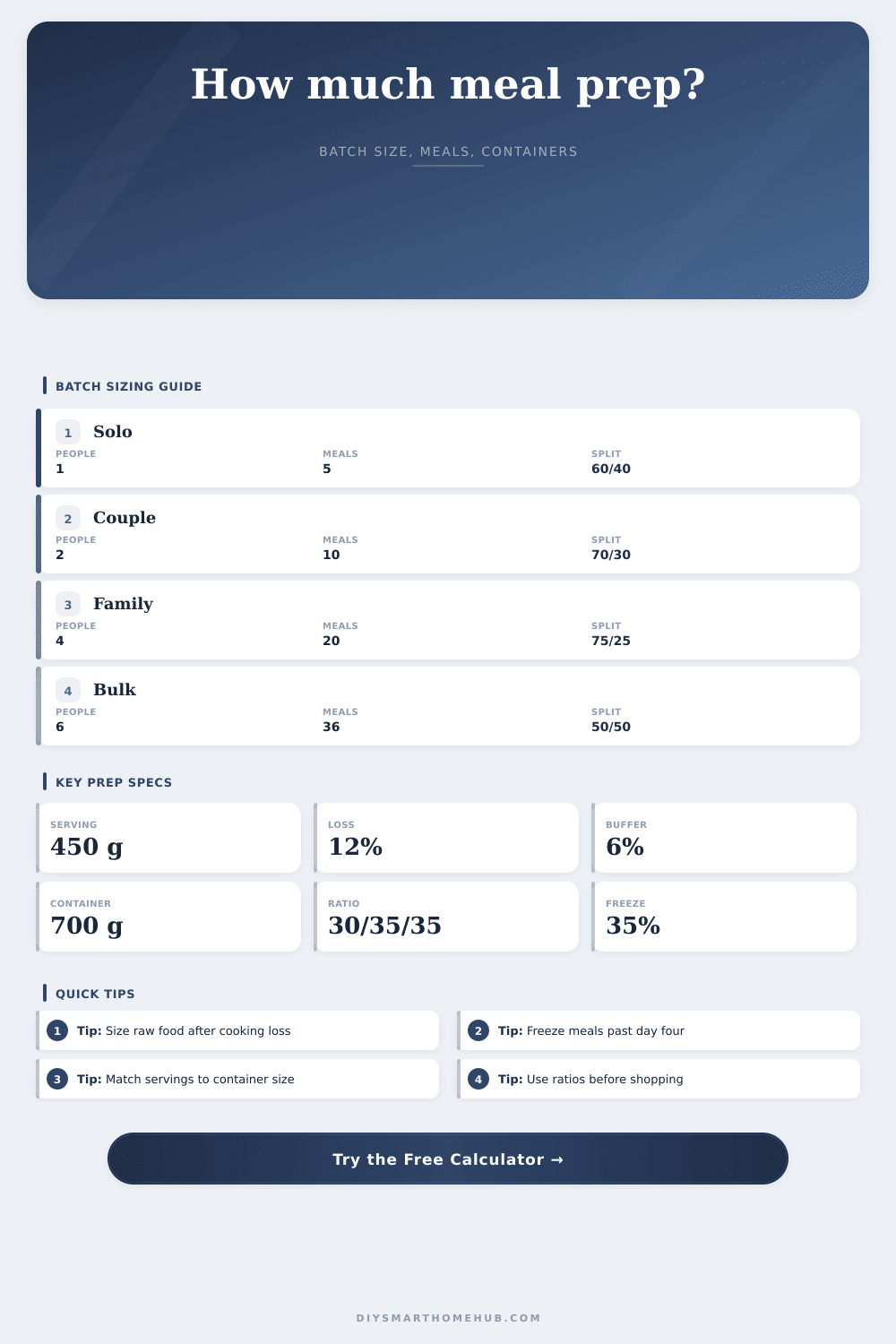
Meal Prep Batch Size Calculator
Plan batch yield from people, meals per day, serving size, food ratios, container capacity, cooking loss, spoilage buffer, and freezer split.
Formula breakdown
| Ratio preset | Protein | Carb | Vegetable |
|---|---|---|---|
| Balanced bowls | 30% | 35% | 35% |
| High protein prep | 40% | 30% | 30% |
| Plant forward | 25% | 25% | 50% |
| Endurance carbs | 25% | 45% | 30% |
| Lower carb plates | 35% | 20% | 45% |
| Container size | Best serving | Headroom | Notes |
|---|---|---|---|
| 450 g capacity | 300-380 g | 70 g+ | Small lunches |
| 600 g capacity | 400-520 g | 80 g+ | Most bowls |
| 750 g capacity | 500-650 g | 100 g+ | Dinner prep |
| 1000 g capacity | 700-850 g | 150 g+ | Shared trays |
| Storage plan | Buffer | Freeze split | Use when |
|---|---|---|---|
| Fresh first | 8% | 10% | Short weeks |
| Steady fridge | 6% | 20% | Normal prep |
| Mixed week | 6% | 35% | Busy weeks |
| Freezer heavy | 4% | 55% | Bulk cooking |
| Long horizon | 10% | 60% | 7+ days |
| Scenario | Meals | Cooked yield | Containers |
|---|---|---|---|
| Solo workweek | 5 | 2.39 kg | 5 |
| Couple lunches | 10 | 5.30 kg | 10 |
| Family dinners | 12 | 7.20 kg | 12 |
| Freezer stock up | 28 | 14.56 kg | 28 |
One source of wasted food is the fridge. It’s full of half eaten meals, fast-spoiling veggies. People try to remedy this with meal prepping, but there’s a catch: how do you plan? How much should you cook so you don’t run out of something but also not have leftovers that spoil?
Enter the calculator below: After you type in size of your family and what you want to store, it does math for you. You won’t have to guess in the middle of a bare pantry anymore.
How to Plan Your Meals with a Calculator
What anchors meal prep is not time; it’s not recipes. It’s weight. If you start with just one variable, it should of be this: how much food will this serve? Once you’ve defined what your lunchbox contains, you have defined its physical reality, the serving size.
And if you shoot for a four hundred and fifty gram serving, you leave yourself some wiggle room for steam and sauces without having the lid warp when you extract your piping-hot meal from the bag. That’s around seven hundred grams per standard container.
Raw ingredients goes down when they’re prepared. Five pounds of raw ingredients don’t turn into five pounds of cooked food. Grains soak up water, vegetables give off moisture, and raw chicken goes down in size. Your food shrinks. You’ll probably end up hungry on Thursday if you forgets about this.
The second step in the calculator requests the cooking loss percentage, typically twelve percent for a mixed plate. That’s how much less food you wind up with after cooking. You want to make sure you has enough cooked food to account for the loss.
How much extra are you willing to cook? Your answer here is determined by your storage strategy. How long will it take you to eat what you make? 4 days). In that case, you want to account for a little spoilage. But if you freeze half of it, you can relax the safety margin for those meals, since freezing basically freezes the clock.
And the freezer-heavy version in the chart above need less extra since we are freezing so much. We don’t need to eat all our food fresh; instead, you can enjoy some of the texture tradeoffs that come from freezing stuff to eat later.
Consistency is key, rather than the portion ratio, which is why the calculator divide the overall weight by whatever proportions you prefer. For example, maybe a healthy meal include 30% protein, 35% veggies and 35% carbs. You don’t have to weigh all the carrots, just get an idea of what the grand total should be for this entire batch. That makes the grocery list easy, and you’ll purchase bulk items based off the total weight instead of exact grams per ingredient.
The last restriction here is containers. What if you calculated that you need 600 grams, but all of your container hold just 500? It is time for bigger boxes or smaller servings. The tool lets you see the size gap before you reach for a knife and start dicing. Revising a digit on a computer screen beats juggling too-full bowls in a warm kitchen.
Meal prep isn’t about being perfect. It’s about being consistent. If meal prep seems like a chore, that means it failed. Meal prep succeeds if it feels like a system. If you size your batch properly to eliminate the struggle of having to second-guess yourself, it works. You cook once, you pack efficiently, and you eat.
The refrigerator becomes a place where you can depend on something rather than regret something. Meal prep gets you your time back. And your lunch still tastes good on Monday more then it does on Friday.