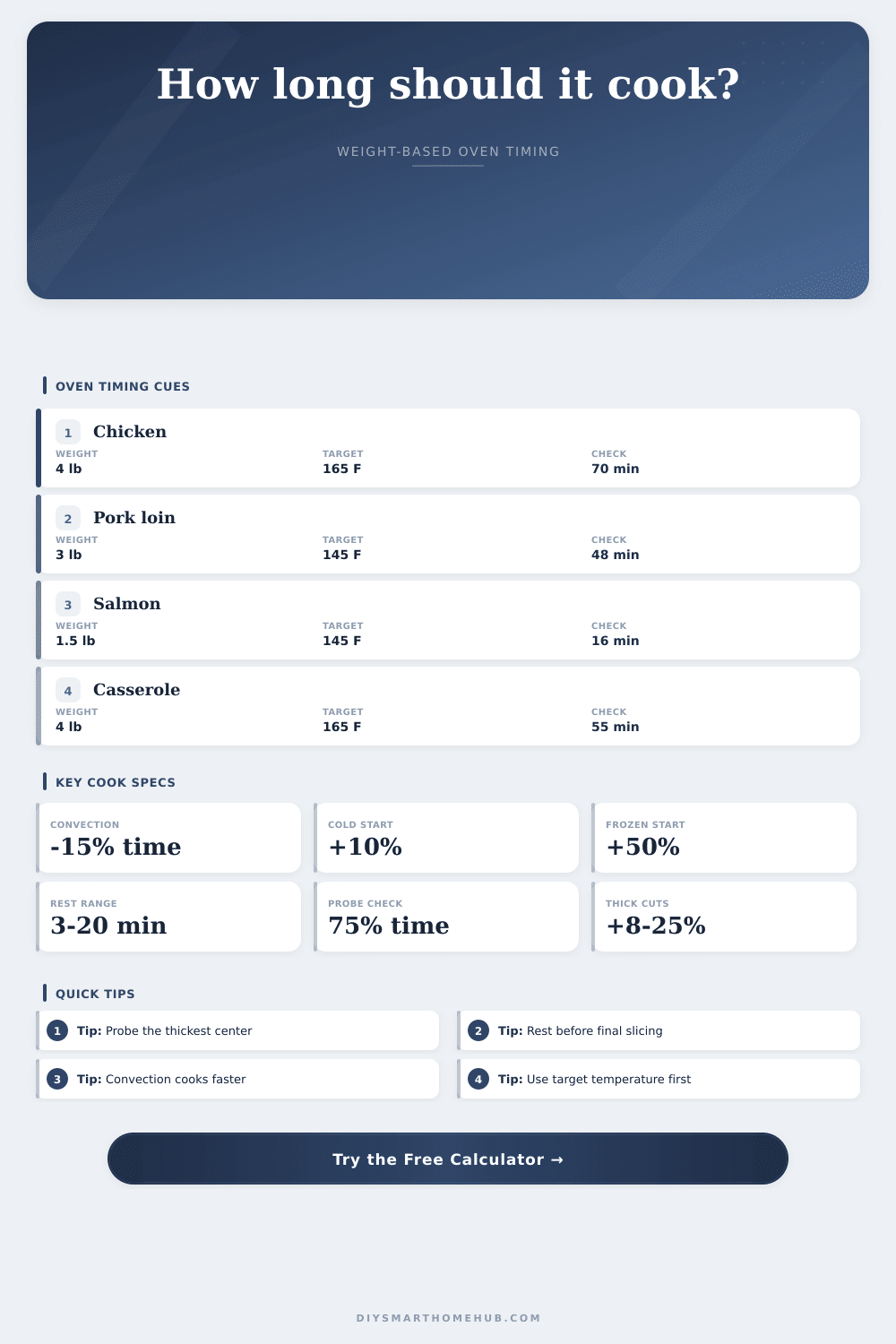
Smart Oven Cook Time by Weight Calculator
Estimate oven time from food type, weight, thickness, oven mode, starting temperature, target internal temperature, convection speed, and rest carryover.
Detailed timing breakdown
| Food category | Minimum internal temperature | Rest note | Calculator use |
|---|---|---|---|
| Chicken, turkey, and poultry | 165°F / 74°C | No timed rest required for the minimum | Use for whole birds, parts, and stuffing cooked inside poultry |
| Beef, pork, veal, lamb steaks or roasts | 145°F / 63°C | Rest 3 minutes | Use for intact roasts, chops, and steaks |
| Ground meat and meatloaf | 160°F / 71°C | Probe the center | Use for ground beef, pork, veal, lamb, and sausage mixtures |
| Fish and seafood fillets | 145°F / 63°C | Or opaque and separating easily | Use for salmon, cod, trout, tuna, and similar fillets |
| Casseroles and leftovers | 165°F / 74°C | Heat through the center | Use for baked dishes, reheats, stuffing, and mixed leftovers |
| Food type | Baseline oven | Base minutes per lb | Built-in shape allowance |
|---|---|---|---|
| Whole chicken | 350°F / 177°C | 18 to 22 min/lb plus setup time | Rounded bird shape, bones, and cavity slow the center |
| Boneless chicken breast | 375°F / 191°C | 18 to 24 min/lb | Thickness matters more than total tray weight |
| Pork loin roast | 350°F / 177°C | 16 to 22 min/lb | Lean dense roast with moderate carryover |
| Beef roast | 325°F / 163°C | 20 to 28 min/lb | Large dense roasts rely on rest carryover |
| Fish fillet | 400°F / 204°C | 8 to 12 min/lb | Thin fillets are thickness-limited and finish quickly |
| Casserole or lasagna | 350°F / 177°C | 10 to 15 min/lb plus center-heat time | Pan depth and starting temperature dominate timing |
| Oven mode | Time factor | Temperature behavior | Best timing habit |
|---|---|---|---|
| Standard bake | 1.00x | Baseline dry oven heat | Start probe checks near 75% of predicted time |
| Convection bake | 0.85x | Fan heat speeds surface transfer | Check early and watch browning |
| Air fry / fast fan | 0.78x | Stronger airflow cooks small items quickly | Use for thinner cuts and trays, not huge roasts |
| Steam assist | 0.92x | Moist heat improves heat transfer | Good for dense bakes and poultry skin finishing |
| Covered dish | 0.95x | Moist enclosed heat reduces drying | Uncover at the end only if browning is needed |
| Deep glass or dense pan | 1.12x | Container delays center heating | Add time and probe the center carefully |
| Scenario | Weight and thickness | Mode | Approximate check window |
|---|---|---|---|
| Whole chicken dinner | 4 lb, 3.2 in thick | 350°F standard bake | Probe around 55 to 65 minutes |
| Family pork loin | 3 lb, 2.8 in thick | 350°F convection | Probe around 38 to 45 minutes |
| Weeknight salmon tray | 1.5 lb, 1.1 in thick | 400°F convection | Probe around 11 to 15 minutes |
| Meatloaf pan | 2.5 lb, 2.5 in thick | 350°F standard bake | Probe around 45 to 55 minutes |
| Deep chilled casserole | 4 lb, 2.8 in thick | 350°F covered dish | Probe around 45 to 60 minutes |
Weight estimate
Weight gives a useful planning baseline for roasts, birds, and baked dishes because larger mass needs more energy before the center reaches target temperature.
Thickness adjustment
Thickness changes how far heat must travel to the center. Thin salmon and thick meatloaf can have similar weights but very different finish times.
Probe confirmation
A smart oven estimate should trigger checks, not replace the thermometer. Pull temperature accounts for expected carryover during the rest period.
We have entered the era of data-based kitchens. Instead of doing what comes naturaly, you face a screen on your smart oven telling you it knows exactly how long things will take, yet you still fret over whether that roast is cooked through.
Weight is part of the answer, but not the entire answer. While two pounds of protein may be evenly distributed in the pan, a four-pound pork loin is not remotely the same thermal puzzle as a four-pound chicken. Though the two might sit side-by-side on the rack, the former is much more likely to dry out if pulled too soon or too late.
How This Cooking Calculator Works
The calculator above runs those numbers for you, taking all three factors, weight, thickness, and starting temperature, and spitting back an estimate of how much time everything should take. It removes the guesswork (but never replaces the thermometer).
That’s where many home cooks fail. The gadget tells you when to begin checking… It doesn’t tell you when to remove the food. For that, you’ll want some confirmation of that yourself.
The most obvious place to start is with weight. Mass determine how much energy must flow through the meat. A bigger piece of meat (a roast) has more mass, so it will take more time to heat the core. And it’s also an insulator, retaining heat longer in its center compared to a smaller roast.
Thickness, however, is what trips people up more often then not and ruins their dinner. Two slab of fish might weigh the exact same amount. But one may be a thick fillet while the other is sliced very thinly. They’re going to cook wildly differently. Why? The heat flows from the outside in.
To account for this, the calculator allows you to enter thickness of the thickest part, which is essential. If you don’t pay attention to thickness, you’ll effectively be cooking based off volume rather than geometry. It typically leads to a raw middle and dry edges.
The other problem is carryover cooking. When food comes off the heat source, it keeps warming up. Beef roasts, being large and dense, may gain another ten degrees as they rest. Chicken breasts barely budge.
You might pull a huge roast off at precisely its target temp. That thing’s going to keep rising as it rests on your cutting board. How much, exactly? That’s what the tool tries to predict, using both weight and type of food.
You pull it earlier than seems reasonable which feels backwards, but then again, it’s heating up from inside. You don’t want it to be done, do you? No. But heat takes time to transfer. The outside catches up with the interior, and letting the meat rest gives that core time to reach balance. Not only does it redistribute juices (which certainly helps), but it also lets thermodynamics finish its work.
And then there’s oven mode. It speeds things up by moving air around with convection fans (shaving maybe fifteen percent off cook time), or pushes that even further with an air fry setting. But those modes can be aggressive; they’ll get the outside browner in no time flat, yet leave the inside not quite ready. The calculator factors all of them in, but keep your eye on the color. When the outside looks cooked but the probe’s still calling “wait,” believe the probe. Your eyes will fool you. A golden crust can hide a cold center.
Smart ovens try to help you out with sensors and cameras, but they are only so accurate. How many people forget starting temp? If you pull out a cold roast and throw it right into the oven, it’s going to take longer to cook through compared to one that sat on your counter and came up to room temp first. Then there’s frozen, a whole other kettle of fish. Sometimes they’ll need half again as long. This thing figures all of that in. No more pulling it out at 30min just to discover it’s still like ice in the center. It figures the work into defrosting it while cooking it.
On the page there’s a table of reference, a reminder that some foods require a certain temperature at which they’re safe to eat, and this isn’t open to negotiation. One hundred sixty-five degrees, for poultry. Rest your beef after cooking and you can bring it down to one hundred forty-five. What about ground meats? Because they’ve got bacteria inside the meat in addition to any on the surface, go higher. Know those numbers. Then use the calculator to get there and not overcook. That’s how it turns all that information into an actual dinner.
Cooking is part science and part art. It’s one thing for the science to tell us how long it takes for heat to arrive. Then the art comes in to know when to call it done. It is part science and part art. It’s one thing for the science to tell us how long it takes heat to reach. Then the art comes in to know when to call it done.
The math portion comes with the calculator. It crunches the numbers for the carryover, weight, and mode. The human portion comes from your hand on the pot. Checking the thickest part. Your hand allows the meat to rest. Your eye trusts what the probe says more than the clock.
The tool will get you ahead of the game. The tool will eliminate the fear of the unknown. Ultimately the choice is still yours. It is not because you’re reading a cookbook, but because you’re directing a thermal process. Once you understand how that heat travels through the meat, you don’t worry so much about what time it reaches the right temp. You learn to trust the temp. You follow the screen as a guide. The probe tells the truth. Patience is the rest of it.