Air Purifier CADR Match to Room Calculator
Match purifier CADR to room volume, target air changes per hour, pollutant type, open-plan leakage, filter age, and quiet-speed derating.
Detailed CADR breakdown
| Target use | Typical ACH target | Formula at 8 ft ceiling | When to choose it |
|---|---|---|---|
| AHAM baseline | 4.8 ACH | CADR about area / 1.55 | Balanced everyday particle reduction in a closed room |
| Dust control | 4.0 ACH | CADR about area / 1.88 | General dust reduction with moderate fan noise |
| Pollen and allergy | 4.5 ACH | CADR about area / 1.67 | Seasonal pollen or bedroom allergy support |
| Smoke and fine particles | 5.0 ACH | CADR about area / 1.50 | Wildfire smoke, cooking particles, or PM2.5 events |
| Heavy smoke event | 6.0 ACH | CADR about area / 1.25 | Higher reserve for severe outdoor particle episodes |
| Pet dander | 5.5 ACH | CADR about area / 1.36 | Rooms with shedding pets or fabric surfaces |
| Rated CADR | AHAM area at 8 ft | Metric area | Best-fit room example |
|---|---|---|---|
| 100 cfm | About 155 sq ft | 14.4 m2 | Small bedroom, nursery, compact office |
| 150 cfm | About 233 sq ft | 21.6 m2 | Bedroom suite or medium office |
| 200 cfm | About 310 sq ft | 28.8 m2 | Living room or large bedroom |
| 300 cfm | About 465 sq ft | 43.2 m2 | Open living room or studio zone |
| 400 cfm | About 620 sq ft | 57.6 m2 | Large open-plan area with good circulation |
| Derating factor | Low impact | Moderate impact | High impact |
|---|---|---|---|
| Fan speed | High speed: 100% | Medium: 65% to 80% | Sleep mode: 35% to 50% |
| Filter condition | New filter: 0% | Mid-life: 8% to 15% | Overdue filter: 25% |
| Open-room mixing | Door shut: 0% | Open doorway: 20% | Connected rooms: 35% to 50% |
| Ceiling height | 8 ft baseline | 9 to 10 ft needs more | Vaulted rooms need volume math |
| Room scenario | Room volume | Particle target | Base CADR need |
|---|---|---|---|
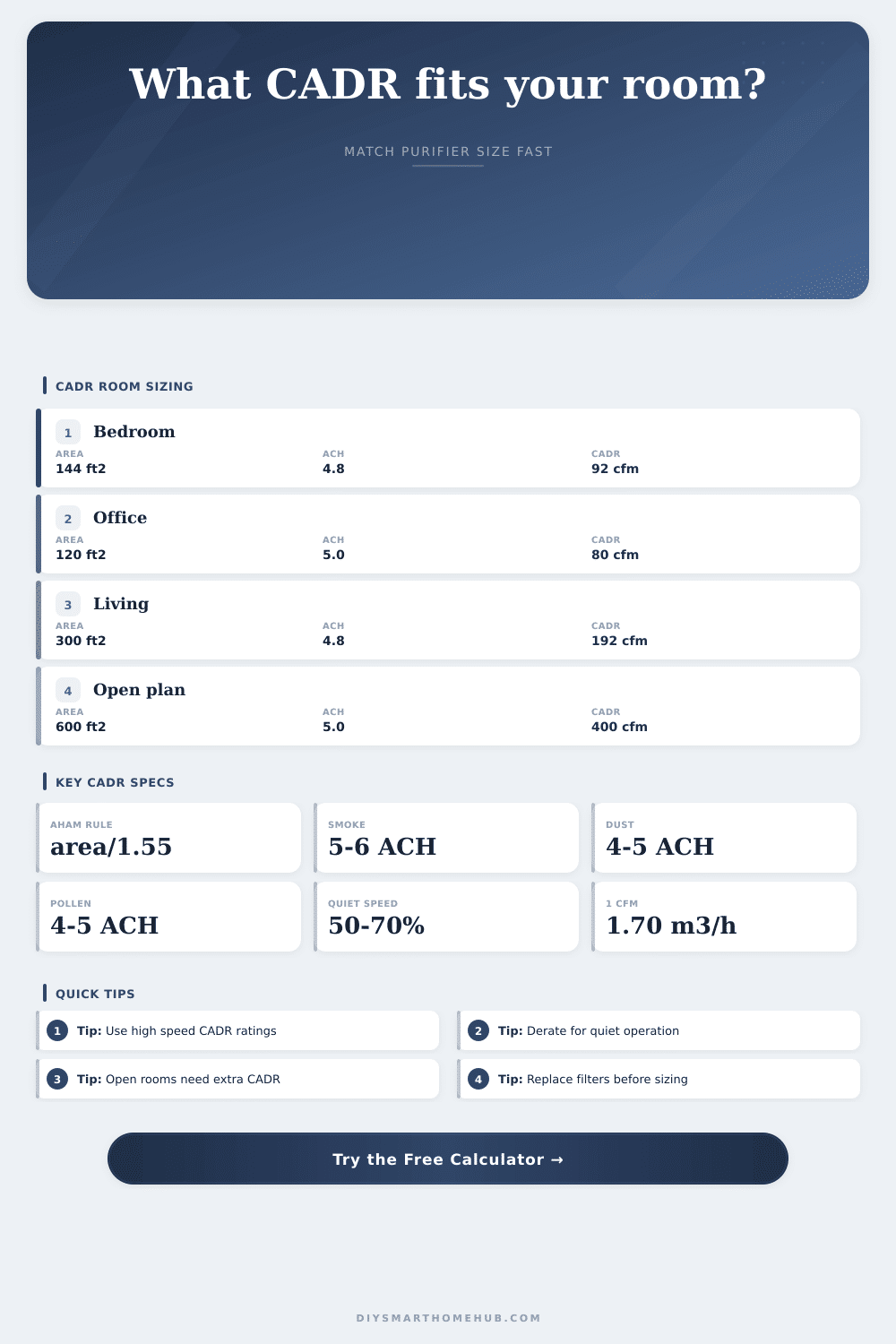
| 12 x 12 bedroom, 8 ft ceiling | 1,152 cu ft | 4.8 ACH baseline | About 92 cfm before derating |
| 10 x 12 home office, 8 ft ceiling | 960 cu ft | 5.0 ACH smoke | About 80 cfm before derating |
| 15 x 20 living room, 9 ft ceiling | 2,700 cu ft | 4.5 ACH pollen | About 203 cfm before derating |
| 24 x 25 open-plan zone, 8 ft ceiling | 4,800 cu ft | 5.0 ACH smoke | About 400 cfm before derating |
| 500 sq ft studio, 9 ft ceiling | 4,500 cu ft | 4.8 ACH baseline | About 360 cfm before derating |
Volume-based sizing
Room volume times target ACH gives the actual clean-air delivery needed per minute. This captures tall ceilings and unusual room sizes better than area alone.
AHAM shortcut
The common room-area shortcut assumes an 8 ft ceiling and about 4.8 air changes per hour, so CADR is roughly floor area divided by 1.55.
Real-use derating
Quiet fan speeds, older filters, and connected rooms lower effective delivery, so a purifier that looks large enough on high speed may undershoot in daily use.
You paid good money for the thing. And you’ve got an air purifier that… On paper, sounds like a good deal. It’s sleek. It’ll make the air clean. You plug it in. Maybe you even turn it up as high as possible because the thing is LOUD. It is loud enough that you can hardly hear yourself think. You lower the fan until it’s not too bad anymore. Then you start wondering if all those square feet they claim to cover are really true. That’s the difference between the box and the reality in your home.
The CADR match calculator closes that gap. It goes beyond just square footage which is about all we get from a box. It makes you face facts: how big is my room? How tall is the ceiling? What’s the noise level going to be? No one wants a loud machine screaming away all night.
Why This Calculator Helps You Choose
The most critical measurement here is Clean Air Delivery Rate (CADR) which tell you how many cubic feet of air per minute a device can deliver free of particles. Higher numbers mean more rapid removal of pollutants. But the manufacturers like to talk about their max CADR. This figure typically apply to high fan speed. In practice, who runs it like that? At those levels, the noise is unbearable. And so the calculator takes that into account. It lets you lower the actual performance depending on the fan speed that you would realistically use. So if you’re planning to run it at a medium quiet level, then effective CADR will be lower. The tool accounts for that reality and makes an adjustment to the math. You get your actual coverage area instead of theoretical maximum.
Another variable is ceiling height. Sizing rules don’t take into consideration ceiling height. Most sizing guidelines assumes an eight-foot ceiling. What about taller? Taller homes mean a lot more air. More air means you need more cleaning power to achieve the same air changes per hour. That means you need proportionally more cleaning power for the same ACH. How does it know what your ceilings are? Because you tell it. Enter the actual dimensions of your room into the calculator. It won’t simply count the floor area. Instead, it’ll calculate the volume. That way, you won’t fall into the trap of buying a unit that’s too small for your high ceilings.
And if you have open plan living spaces, it can handle those too because they’re very hard to size. Open doorways leak air from one room to the next, diluting the impact of your purifier. For this case, there’s a leakage factor. So you won’t underestimate amount of power required for an open-concept apartment or a studio.
Second: People underestimate the impact of filter condition. When you have a new filter, it’s clean and air flows through easily. If your filter is dirty, however, it will block airflow, reducing the effective CADR from what’s printed on the box. The calculator considers the “derating” factor caused by filter age. It recognizes that while a brand-new filter can do its job, a three-month old filter won’t quite reach the same level. That’s realistic, it’s something a lot of consumer miss. They’ll purchase the purifier, then wait six months until the filter gets loaded up with junk. At that point, they’re wondering why their air doesn’t seem any fresher. The math proves you want some reserve capacity to make up for this decline with time.
Performance is based on size of the problem. Because airborne pollutants vary by size, different levels of air changes per hour are necessary to properly filter them out. For example, smaller smoke particles requires more air changes per hour to remove effectively because they’re so tiny. The tool will adjust the needed air changes based off the pollution source you choose (e.g., dust, pollen, etc.). That way, you know that what you’ve built is sized to fit your needs to solve whatever issue you have. You don’t need as high a CADR rating, for instance, when faced with seasonal pollen versus wildfire smoke.
At the end of the day, buying an air purifier is about managing expectations. Those specs on the packaging are meant to be optimistic. They’re telling you what’s possible in perfect circumstances. And those aren’t the circumstances of your home. Your home has high ceilings and drafty spots and open doors and quiet requirements. If you have a tool that takes all that into account; well, then you’ve got more than a number to go off of, haven’t you? It’s less of a guess based off square footage and more of a calculation of what will actualy work. You get the one you want because it meets both your needs and your space.
For something as important as clean air, that’s some additional math well spent. It would of been worth the extra effort, especially if it gets you back to sleep without having to listen to a turbine.