HEPA Filter Life by Runtime Calculator
Estimate filter replacement timing from rated hours, daily runtime, fan speed loading, particle levels, pets or smoke, prefilter care, and your selected CADR drop threshold.
Detailed filter-life breakdown
| Filter class | Reference efficiency | Particle basis | Life note |
|---|---|---|---|
| HEPA H13 | 99.95% minimum efficiency | MPPS under EN1822 class testing | Common purifier grade with moderate pressure rise |
| HEPA H14 | 99.995% minimum efficiency | MPPS under EN1822 class testing | Finer media may show airflow loss earlier |
| True HEPA | 99.97% at 0.3 micron | US consumer purifier claim basis | Use stated hour rating from the exact model |
| HEPA plus carbon | Particle HEPA plus gas adsorber | Two-stage cartridge behavior | Odor saturation can require earlier replacement |
| Media rating | Typical use | Fine particle capture | Calculator adjustment |
|---|---|---|---|
| MERV 8 | Basic HVAC dust filter | Not HEPA-level fine particle control | Use only for coarse prefilter planning |
| MERV 11 | Better residential HVAC media | Captures more pollen and larger dust | Shorter interval in dusty return air |
| MERV 13 | High-efficiency HVAC filter | Improved PM2.5-range capture | Higher loading in continuous fan use |
| MERV 16 | Very high-efficiency media | Approaches HEPA-like performance bands | Watch static pressure and airflow drop |
| HEPA H13/H14 | Portable purifiers and clean air units | Tested at MPPS efficiency levels | Use CADR loss, runtime, and load factors |
| Condition | Low load | Typical load | Heavy load |
|---|---|---|---|
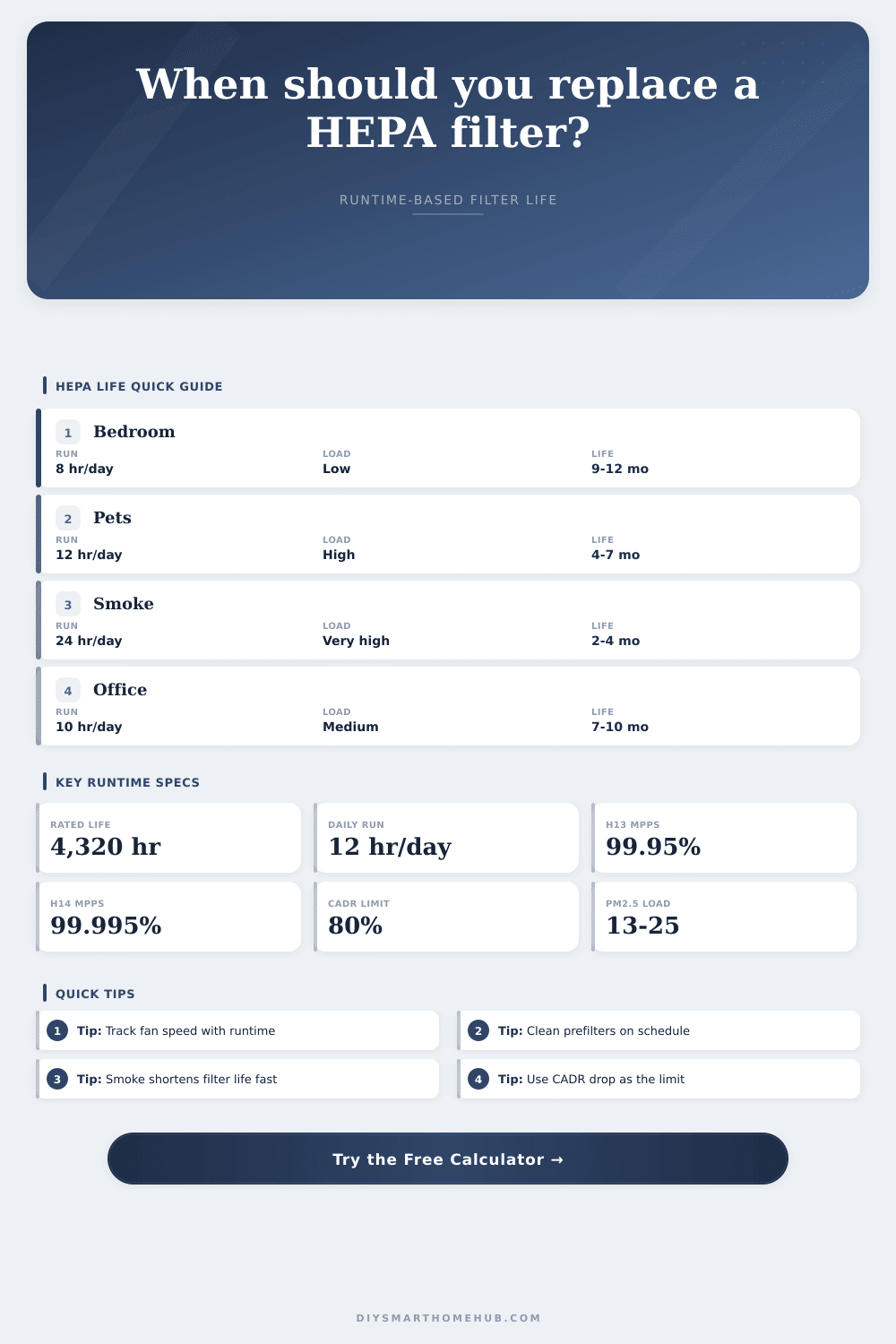
| Fan speed | Low speed, 0.55x | Medium, 1.00x | Turbo, 2.40x |
| PM2.5 level | 0 to 5, 0.75x | 6 to 12, 1.00x | Above 50, 2.50x |
| Particle source | Normal dust, 1.00x | Pets, 1.25x to 1.55x | Smoke or work dust, 2.10x to 2.60x |
| Prefilter care | Weekly, 0.88x | Every 2 weeks, 1.00x | Rare cleaning, 1.80x |
| Use case | Runtime pattern | Likely load factor | Replacement range |
|---|---|---|---|
| Bedroom purifier | 8 hours/night on low | 0.45x to 0.75x | 9 to 18 months for many filters |
| Living room with pets | 12 to 18 hours/day | 1.3x to 2.1x | 3 to 8 months depending on media area |
| Smoke or wildfire season | Continuous high speed | 3.0x to 5.0x | Weeks to a few months under severe loading |
| Home office | 8 to 10 hours/day on auto | 0.8x to 1.2x | 8 to 14 months for larger cartridges |
| Workshop cleanup | Short high-speed sessions | 2.0x to 4.0x | Track hours and inspect airflow often |
Runtime dominated
A filter in clean air can last close to its rated hours, so daily runtime is the main driver of calendar replacement timing.
Loading dominated
Pets, smoke, cooking aerosol, and high PM2.5 shorten life because particles fill media pores and raise resistance faster.
CADR threshold
A stricter CADR remaining target, such as 85% or 90%, intentionally replaces the filter before the end of the nominal rating.
Your air purifier was purchased to help you breathe better by capturing pet dander and pollen from the air. Over time, pores in filter become filled with dust and gunk. Airflow begins to decrease and performance suffer. Often unnoticed by your ears, it becomes less effective.
For most of us, we replace our filters when they “feel” like it’s time or based off calendar. This is both wasteful AND means you’re running your filter way too hard with a clogged up one.
How to Know When to Change Your Air Purifier Filter
How long will it last? It is not about when, but how much. If you use a filter with a four-thousand-hour rating and run it just five hours a day, then yes: a single unit will go eight years. Blast it at top speed through wildfire season, though, and it won’t even make it a few months. That’s where the math comes in. The calculator does it for you. It considers the fact that factory settings is adjusted based on typical use (how you actualy use your machine).
Why is this important? Because HEPA filters are active sieves, they age under pressure. Fine mesh lead to faster sieve-blocking. You control that tradeoff.
Think about what type of dust your house has. Is it all carpet? Or does it have a cat who sheds on the rug? That’s different than. Cat hair is sticky; there is lots of pet dander, which gets everywhere, including onto the prefilter and into the main HE media. To account for this, tool applies a factor to the dust loading. So having two pets are more than just double the dust of one; it’s a compounding factor that changes how the filter clogs.
Even worse, there is smoke. Air from wildfire smoke contain ultrafine particles that infiltrate deeply into the fibers, causing a quick rise in resistance. When you are exposed to a lot of smoke, the estimated life go down drastically. When the rest of the world is on fire, clean air doesn’t come cheap.
Another invisible factor is prefilter upkeep. Most units has a coarse mesh at the front to catch lint and hair. Weekly washing protects the costly HEPA core. Neglecting this allow the prefilter to become a mat, which puts excess strain on the primary filter. The calculator will pay you back for your hard work with a longer estimated life span. A little effort goes a long way. Diligence trumps intensity. Leaving the fan on for long stretches on low is usually beneficial to filter life. Higher speeds blast particles harder into media, compacting them and increasing static pressure more rapidly.
In the results, you’ll notice numbers that refer to CADR, or Clean Air Delivery Rate. That’s the flow rate of clean air the unit produces. When the filter gets loaded with dust, the fan struggle to push against the resistance. At some point, the CADR fall below where you can use it.
How long do you let it go? Some users wait till it’s just barely breathing. Others change it before it dips below ninety percent performance. It’s all about your budget and what level of allergy symptoms you’re willing to tolerate. There is no wrong answer, just one of diminishing returns.
These reference tables gives a basic guideline for some common situations. For example, they illustrate the difference between a bedroom and a workshop. But they are only beginning. Your house isn’t like anyone else’s. That is the point. You can break free of guessing. Use them as a starting point, then begin monitoring.
When does the unit seem to strain? What color is the filter (if you can see it)? Those are the qualitative indicators of whether the numbers check out.
If your filter is clogged, there has been a performance failure. You’re paying for air that doesn’t get filtered. And then comes the day. It is the day the estimate says it’s due. You go get it. You remove the old cartridge from unit. You look at the new filter and see it is open and white. The old one is dense and gray. Oh yeah. That. That’s good. It shows you that the machine did its work.
And now you have fresh capacity for the next round. So you set the timer and recalibrate your expectations. For a couple of days, the air seem crisper. But soon enough, the new filter starts its gradual path towards being full. And round and round we go. Only this time it’s on your terms. You know when it’s coming and what you’ll need to buy when it does.