Programmable Setback Savings by Hours Calculator
Estimate HVAC savings from thermostat setback hours using degree-hours, indoor-outdoor delta T, setback degrees, runtime reduction, recovery penalty, and energy in kWh or therms.
📌Quick setback schedules
⚙Schedule and HVAC inputs
💡Live formula checks
📊Setback savings results
📐Formula reference cards
📋Equipment energy conversion table
| Equipment profile | Energy output shown | Main conversion | Runtime note |
|---|---|---|---|
| Gas furnace | Therms plus blower kWh | Btu / efficiency / 100,000 | Capacity gives burner runtime estimate |
| Gas boiler | Therms plus pump kWh | Btu / efficiency / 100,000 | Output capacity limits pickup speed |
| Heat pump | Electric kWh | Btu / 3,412 / COP | Deep setback may raise recovery penalty |
| Cooling system | Electric kWh | Btu removed / 3,412 / COP | Runtime reduction is cooling output time |
🏠Common setback schedules table
| Schedule pattern | Typical hours | Setback degrees | Best formula signal |
|---|---|---|---|
| Overnight heating setback | 7 to 9 hr/day | 4 to 8 deg F | Avoided degree-hours |
| Workday away setback | 8 to 10 hr/day | 6 to 10 deg F | Runtime reduction |
| Cooling sleep setup | 6 to 8 hr/day | 3 to 6 deg F | Reduced cooling delta T |
| Weekend trip hold | 18 to 24 hr/day | 8 to 14 deg F | Gross minus recovery penalty |
📝Calculation notes
A programmable thermostat is usually viewed as a on/off knob with the power to save money by switching bills on and off whenever you’re home or away. It is actualy more complex than this simple switch suggests. Because a building isn’t a sealed box but a thermal sponge, what happens when you set heat down during the day or when you go to bed? You’re not just saving energy for that unoccupied period; you’re borrowing against yourself. You’ve created a debt that will have to be repaid later as your system scramble to warm you up again into your comfort zone.
The calculator (above) do all that math for you if you input the nitty gritty of your schedule, sparing you the guesswork about whether the initial investment is really worth the savings. It all hinges on something called degree hours, basically just a measure of how much weather is working against your insulation as time goes by. The colder it is outside, the longer you can keep temperature lower then you want (for example, twenty degrees cooler), and the more degree hours you accumulate in avoiding heat. Eventually you’re going to have to pay down that thermal debt. Sometimes this means spending more energy getting there fast when you could of kept things slow and held the line easly. That is the penalty that ultimately makes or breaks savings depending on what kind of equipment you use.
How Programmable Thermostats Really Save Money
More important than selecting a pre-set schedule is inputting true nature of your building. The envelope load rate is how quickly your home’s walls and windows gives up heat. Then there’s the thermal mass of any object within those walls. Does it hold on to that warmth, like a house with heavy masonry floors, or is it an airy condo made of thin drywall and air? You’d be surprised at how violent the recovery phase can spike if you don’t know, and thus whether a deep setback is even going to be worth the effort. You’ll have your furnace short cycling itself silly instead.
Heat pumps is bad at quick temp swings in really cold weather; gas furnaces aren’t, but they deal with it differently. The reference table at the bottom of the page explain this. In a deep setback situation, even if your gas unit is 90% efficient, it could still save more therms than an electric resistance heater. An electric heater will see a huge increase in energy cost with no mechanical advantage.
Comfort is only one side of the equation: there’s also physics to consider when it comes to recovering from a day at work with an eight-degree setback for nine hours. By the time you return home, you’re looking at bridging a bigger temperature difference in less time, asking your system to do more work. The calculator recognize this by taking into account thermal mass and a share of the recovery penalty. This acknowledges that rushing to reheat tends to be wasteful, either by overshooting to a higher temp or having auxiliary heating strips kick in when they shouldn’t.
Instead of thinking of setback as a sprint, think of it as a slow dance. You don’t want to run so hot that you waste energy and overshoot your target temperature. On the flipside, if your building lacks much thermal mass, setting back too much may cost you even more since your system has to work hard to play catch-up. So yes, knowing your buildings exact area and its UA value matters before assuming you can earn 1:1 savings for each hour you’re out of the building.
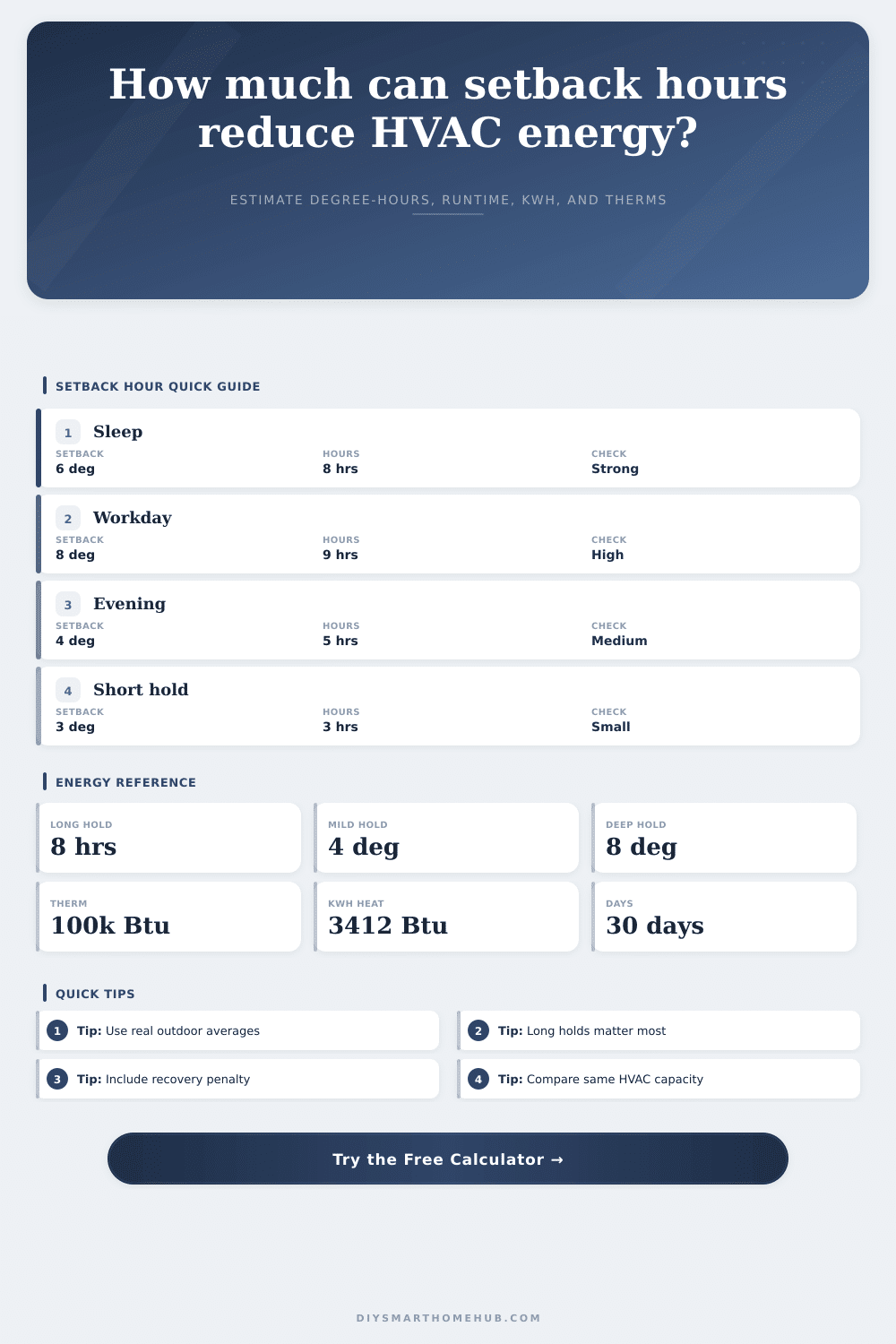
How long does it hold? An eight hour sleep schedule or a nine hour workday hold will accumulate degrees-hours, pushing the needle enough to make a real difference. But it takes longer then three hours in the evening when the house’s stored heat has not been lowered sufficiently. That said, if the thermostat is reset three hours at night, it barely impacts the overall month-long bill.
The bulk of the trick is understanding exactly what is measured. You must look at how insulation quality, equipment efficiency, and weather severity all works together. It’s what takes the numbers from abstraction into something actionable for your budget.
In the end, it’s about figuring out the tradeoff, what will I recover vs what can I save with my heat set back? Will a slight setback help most? Or should I keep it at a constant temp? This might be necessary if my heating system is really inefficient or my home has bad insulation. To use the tool is to be able to walk away knowing the answer. Instead of having to guess. You will know how much you are trading in kilowatt hours or therms for each degree you turn down the heat for a while, instead of just hoping your bill goes down. That’s what makes this a real money-saving tool. It turns the thermostat from a guessing game into an asset management tool.