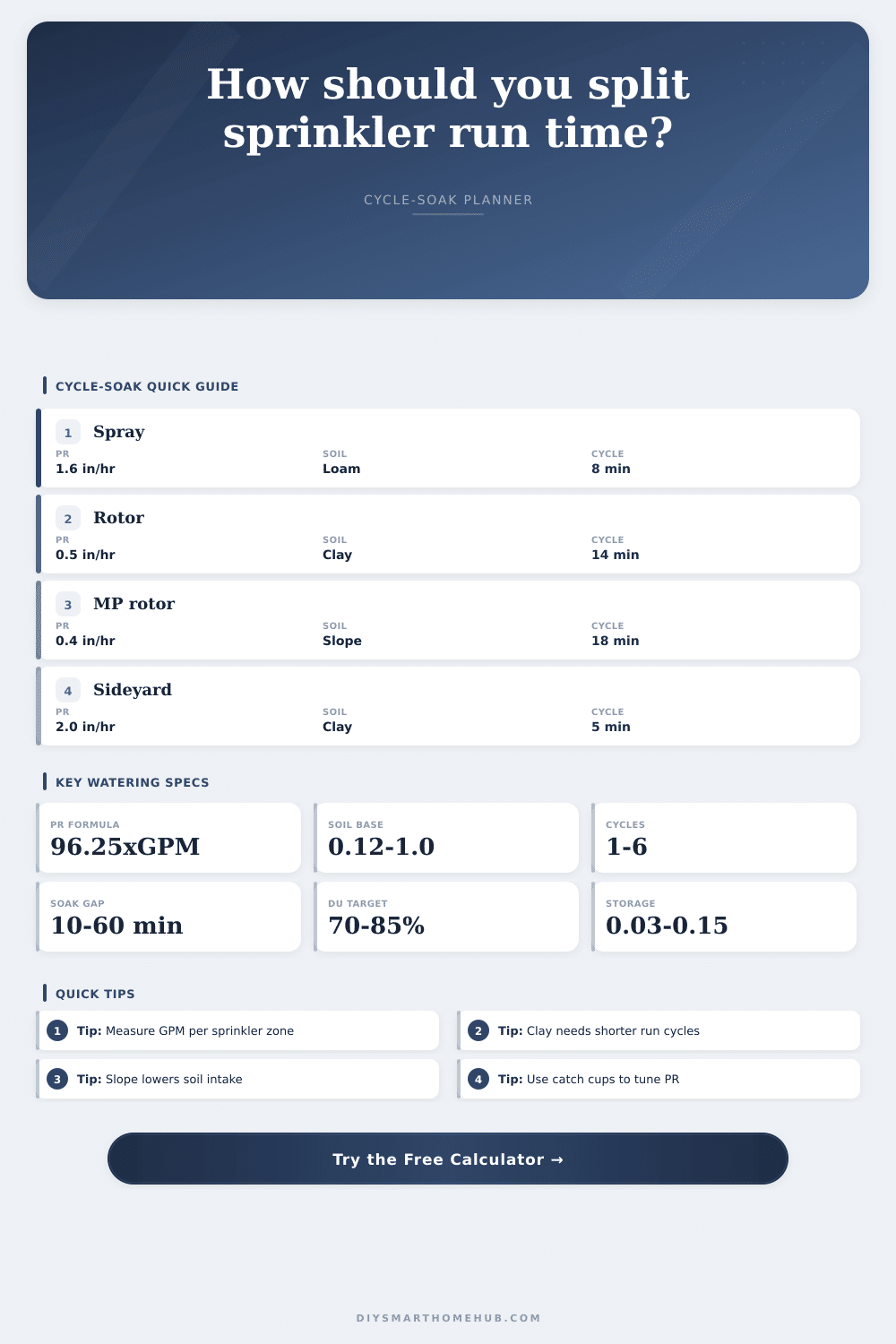
Smart Sprinkler Cycle-Soak Split Calculator
Split one sprinkler zone into cycle and soak blocks using precipitation rate, soil intake rate, slope reduction, surface storage, watering depth, and controller soak spacing.
Detailed cycle-soak breakdown
| Soil type | Base intake rate | Runoff tendency | Cycle-soak note |
|---|---|---|---|
| Sand or very sandy soil | 1.00 in/hr | Low surface runoff | Often limited more by root-zone storage than intake |
| Sandy loam | 0.60 in/hr | Low to moderate | Usually works with longer cycles on flat turf |
| Loam | 0.40 in/hr | Moderate | Spray heads may need two or three cycles |
| Silt loam | 0.30 in/hr | Moderate to high | Use moderate cycles and check low spots |
| Clay loam | 0.20 in/hr | High | Short cycle blocks protect against early runoff |
| Clay | 0.12 in/hr | Very high | Use repeated short cycles with longer soak gaps |
| Compacted clay | 0.08 in/hr | Severe | Needs the shortest cycles and longest soak recovery |
| Sprinkler pattern | Typical PR range | Best-fit soil | Cycle-soak behavior |
|---|---|---|---|
| Fixed spray heads | 1.30 to 2.00 in/hr | Sand to loam | Often needs short cycles on clay or slopes |
| Matched spray nozzles | 1.00 to 1.60 in/hr | Sandy loam to loam | Cycle split improves uniform wetting |
| Rotary stream nozzles | 0.35 to 0.75 in/hr | Loam to clay loam | Lower rate may allow fewer cycles |
| Gear rotors | 0.35 to 0.70 in/hr | Loam to clay | Longer cycles are common if spacing is matched |
| Impact rotors | 0.25 to 0.60 in/hr | Mixed turf | Good for large zones with slower intake |
| Side-strip nozzles | 1.50 to 2.40 in/hr | Sand to loam | High local rate can trigger edge runoff quickly |
| Zone example | Area | Likely cycle count | Common soak gap |
|---|---|---|---|
| Small front strip spray zone | 250 to 450 sq ft | 2 to 5 cycles | 15 to 35 minutes |
| Single-room sized lawn patch | 150 to 250 sq ft | 1 to 3 cycles | 10 to 25 minutes |
| Open-plan backyard turf | 600 to 1,000 sq ft | 2 to 4 cycles | 20 to 45 minutes |
| Garage-side slope zone | 300 to 700 sq ft | 3 to 6 cycles | 30 to 60 minutes |
| Whole-house rotor zone | 1,200 to 2,400 sq ft | 1 to 4 cycles | 20 to 50 minutes |
| Slope class | Intake factor | Storage expectation | Cycle adjustment |
|---|---|---|---|
| 0% to 3% nearly flat | 1.00x | Highest temporary storage | Use calculated cycle length as-is |
| 3% to 6% gentle slope | 0.85x | Moderate temporary storage | Shorten high-rate sprays if water moves |
| 6% to 10% moderate slope | 0.70x | Low temporary storage | Use extra cycles and longer soak gaps |
| Over 10% steep slope | 0.55x | Very low temporary storage | Use conservative cycle caps and inspect runoff |
In early summer, do you notice all that water going down the street and into gutter rather than onto your lawn? That’s because most of us live in homes where our irrigation zones does not match the underlying soil structure: High-output sprinkler heads dispensing water at speeds that exceed what the ground can absorbs, and you’re expecting the grass to drink from a firehose, on concrete!
This is where the smart sprinkler cycle-soak split calculator come in: it helps you deal with physics of runoff while there’s still time to do something about it. Rather than just being a way to set timers, it considers all three factors (precipitation rate, surface storage, and soil intake). The key factor is the precipitation rate, which is how fast your chosen nozzles apply a certain number of inches of water per hour over a specific area. Any more then the soil can soak up, the rest will form a pool and run off.
How to Use the Sprinkler Calculator for Better Watering
The calculator figures out how long you can go before a pool appears, and divides the total amount needed to be watered into several cycle of short bursts followed by soaking periods. The trouble with this is that people rely too much on default values instead of what’s actualy happening. Most people gets tripped up at this step, which is understanding the input.
What kind of soil do you have? Clay soils is slow to absorb water, holding it tightly but absorbing it slowly, which can lead to runoff; sand absorbs it fast and rarely runs off. So if you pick out clay for an area that’s really sandy loam, you’ll overwater. Pick out loam for compacted clay, and you’re going to see runoff.
Another variable is slope: Gravity wants all that water to go downhill, pulling it away from infiltration before it has a chance. That’s why the tool applies reduction factors to steeper slopes. This ensures length of cycle reflects how water behaves when it’s moving around on a hillside rather than when it’s standing still on level ground.
The one that’s not widely discussed is distribution uniformity, or DU. No sprinkler system waters evenly. Some zones are drier; some get too much. To make sure the dry zones gets their fair share, you have to run it longer…but then you raise the risk of runoff in the zones that got plenty already. The gross runtime goes up accordingly in calculator based off the uniformity you estimate. It’s an efficiency versus coverage tradeoff that can’t be avoided if you don’t waste water. And want a healthy lawn.
What you get as output is not one big watering, but a series of mini-drinks. Here’s an example: Four cycles of ten minutes each, separated by twenty-minute gaps. That way, it gives the soil time to catch up. Infiltration rates increases during this soak gap, because surface tension has been broken, and water has infiltrated into air pockets.
There are reference tables on page that can help put your numbers in context, typical intake rates for various kinds of soils, and how slope affects the rates. Your irrigation controller is not a set-it-and-forget-it appliance; it needs to be tuned. It’s worth taking time to measure how much water actualy flows through each of your zone using a stopwatch and bucket; manufacturer ratings are sometimes off-base depending on pressure differences.
What you find out about GPM means that your precipitation rate is adjusted accordingly, and therefore so is your maximum safe cycling time. Make sure your math fit your particular yard conditions. Bottom line: Successful irrigation require understanding your soil and how to work with it instead of against it. Splitting cycles means applying at the rate the ground can absorb.
Once you enter the physical limits; the ground’s infiltration capacity, the calculator does the math for you (no more guesswork and possible runoff violation). You’ll have to watch your yard when it runs to see if the water is soaking in like it was supposed of. Local terrain sometimes has a crusty patch or a depression somewhere; the numbers are correct but your ground doesn’t behaves as predicted. Adjusting the model to your particular landscape quirks takes some tweaking of the surface storage value.
It’s all about making sure we have a nice green carpet, but we don’t dump gallons of treated water down drain while doing it. If you know the capacity of your soil, you learn to work with it rather than against it. You are no longer battling hydrology, but learning to manage it. And that changes everything, because suddenly what was a pain-in-the-butt maintenance task becomes a manageable system that actualy works.
Your lawn grows roots deeper and more frequently; your water bill shows fewer wasted dollars. A tiny adjustment in timing brings big results in efficiency.