Container Plant Watering Interval Calculator
Estimate watering frequency from pot diameter, container taper, soil volume, potting mix water reserve, plant demand, sun exposure, temperature, and rain reaching the container.
Formula breakdown
| Plant profile | Crop coefficient | Depletion target | Typical container behavior |
|---|---|---|---|
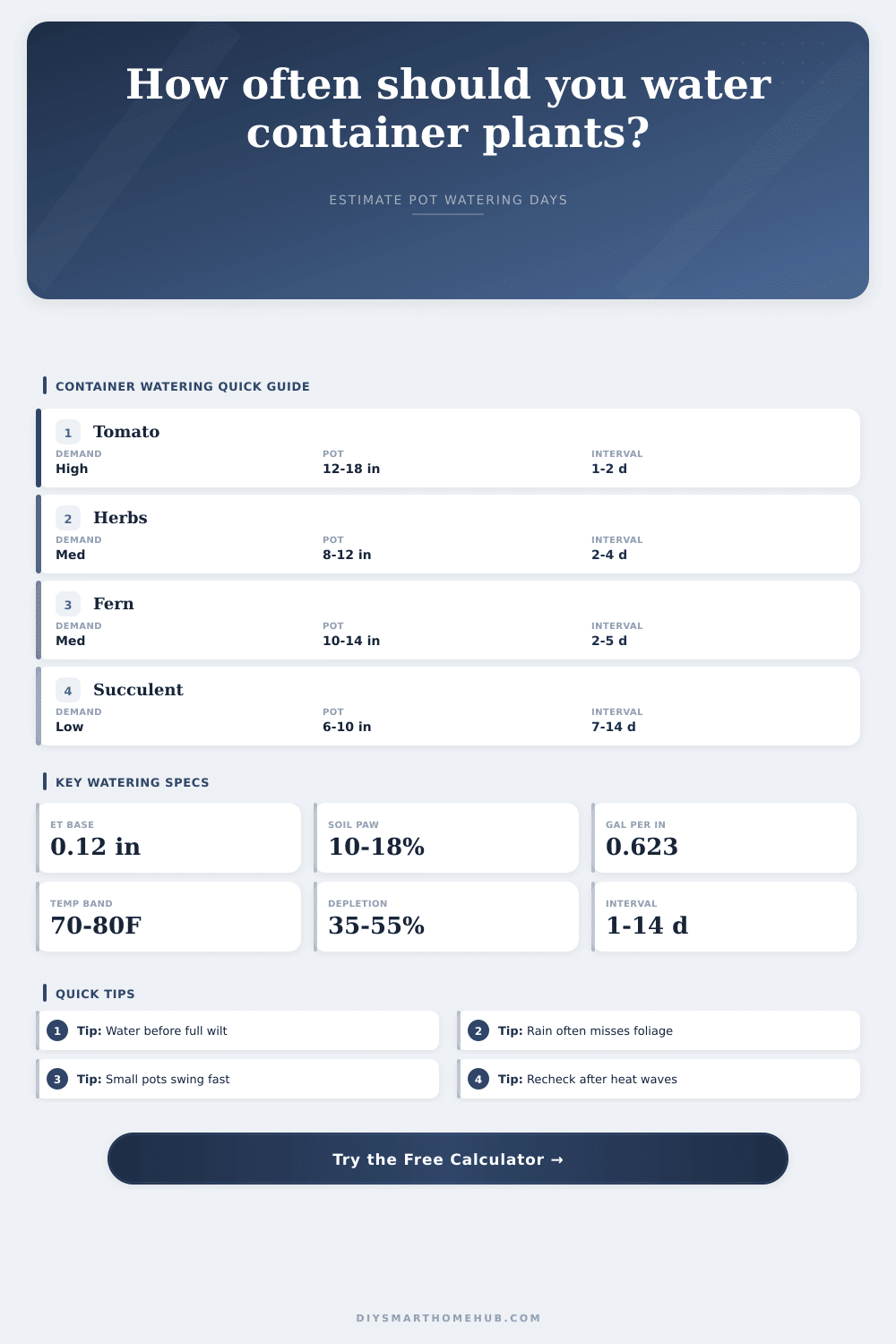
| Tomato, cucumber, squash | 1.05 to 1.15 | 35% to 45% | High transpiration and fruit load shorten intervals |
| Pepper, eggplant | 0.90 to 1.00 | 40% to 50% | Moderate demand with less leaf area than tomato |
| Basil, mint, leafy herbs | 0.80 to 0.95 | 35% to 45% | Shallow roots benefit from steady moisture |
| Flowering annual baskets | 0.95 to 1.10 | 35% to 45% | Small hanging volumes dry rapidly in sun and wind |
| Ferns and shade foliage | 0.60 to 0.75 | 30% to 40% | Lower light demand but poor wilt tolerance |
| Succulents and cactus | 0.25 to 0.40 | 55% to 70% | Low daily use, but gritty mixes store little water |
| Potting mix | Available water fraction | Drainage behavior | Best fit |
|---|---|---|---|
| Peat/coir standard mix | 0.14 gal per gal | Balanced water and air | Most herbs, flowers, and houseplants |
| Moisture-retentive mix | 0.18 gal per gal | Higher reserve after drainage | Thirsty patio plants and hot decks |
| Bark-heavy mix | 0.10 gal per gal | Fast air exchange | Citrus, woody shrubs, orchids in pots |
| Cactus gritty mix | 0.07 gal per gal | Very fast drainage | Succulents, cactus, dry-tolerant plants |
| Compost-rich vegetable mix | 0.16 gal per gal | Good reserve with steady roots | Tomatoes, peppers, lettuce, cucumbers |
| Self-watering wicking mix | 0.20 gal per gal | High capillary refill | Containers with a working reservoir |
| Condition | Multiplier or credit | Formula role | Watering effect |
|---|---|---|---|
| Bright indoor | 0.55x exposure | Reduces ETo for low air movement | Longer intervals unless pot is tiny |
| Outdoor shade | 0.75x exposure | Lower sun-driven evaporation | Moderate interval extension |
| Part sun | 1.00x exposure | Baseline container patio condition | Use calculator result as entered |
| Full sun | 1.25x exposure | Raises evapotranspiration depth | Shorter intervals |
| Windy balcony | 1.45x exposure | Adds sun plus wind drying | Small pots may need daily checks |
| Rain reaches pot | 0.08 to 0.15 in/day | Credits water landing inside top area | Only reduces demand when soil can hold it |
| Container type | Typical diameter | Soil volume | Water reserve clue |
|---|---|---|---|
| Small herb pot | 6 to 8 in | 0.5 to 1.5 gal | Fast drying, narrow buffer |
| Patio annual pot | 10 to 12 in | 2 to 4 gal | Often 1 to 3 days in summer |
| Tomato container | 14 to 18 in | 5 to 12 gal | Larger volume stabilizes fruiting plants |
| Dwarf citrus tub | 18 to 24 in | 12 to 25 gal | Woody roots use water steadily |
| Hanging basket | 10 to 14 in | 1.5 to 4 gal | Wind exposure can dominate interval |
Pot volume
Frustum volume uses top diameter, estimated bottom diameter, and usable soil depth.
Soil reserve
Available water equals pot volume times the mix water-holding fraction.
Plant use
Crop coefficient scales reference ETo for foliage density and growth stage.
Weather
Temperature and exposure multiply evapotranspiration before rain is credited.
Interval
Usable depletion reserve divided by net daily demand gives watering days.
It’s Tuesday afternoon, and suddenly your tomato plant isn’t looking so good: wilted, and you don’t know what’s up. You water it madly from the faucet until the water runs out the bottom. “I’ll never do this again!” you resolve, promising yourself to pay better attention. But by Thursday, your tomato are turning yellow from too much water.
That back-and-forth between neglect and then frantic catching-up, guessing about how much water something needs rather than figuring it out, is the single biggest cause for failure in container growing. No, it’s not because you’re a bad gardener. It’s because you guessed based off how it looks, rather than calculating actual amount. You input the size of your pots, the kind of thing growing inside them and the calculator do the rest.
How to Know How Much Water Your Pots Need
No more guesswork about whether a twelve-inch pot can survive three days without rain. I mean who goes by the drooping leaf anyway as their indicator of when to water? Wrong! It’s too late. The air spaces in the soil is already collapsed. Just like plants will drown in wet dirt, so do their roots suffocates in soaked soil. You want it wetted just before they begin to scream for help… But not after.
A container isn’t simply a hole in the ground filled with dirt. It has an evaporative lid and a leaky bottom containing a limited amount of water. To calculate how much actual soil there will be, it consider the shape and size of the container. The real-world volume of soil in a straight-sided nursery pot of a certain width is different than that of a tapered decorative one of the same width. It is two gallons’ worth.
Two gallons can make the difference between twice-a-day watering in the middle of summer versus once-every-two-days watering. The geometry makes a difference…and the calculator figure that into its calculations, instead of having you try to picture a truncated cone in your brain.
But that water needs somewhere to be stored, and the soil mix act as the battery. A typical peat-based mix holds up to fourteen percent by weight of available water. A moisture-retentive mix can push that closer to eighteen percent. Grow anything thirsty in a grittier bark mix? Guess what? It’s like having a small battery instead of the big one you’re thinking of. This is made plain enough in the reference table on the page. No amount of coercion can turn a fast-draining mix into a sponge. Switch to a moister mix, or plan to water more frequent. There’s no such thing as a free lunch in the world of container gardening.
That’s the battery; how quickly it empties depend on plant biology. Tomato plants with heavy loads of fruit has a high crop coefficient; they transpire like crazy, pulling lots of water upward to sustain their fruit-filled tops. Succulents in grit-filled mixes (low coefficients) holds moisture in their leaves. The calculator include those profiles in its daily-demand calculations. That’s what kills cacti when you try a schedule designed for ferns, and vice-versa. Get that wrong and something gets either overwatered (root rot) or under (dried out).
Weather exposure is another complication. A wind-blown full-sun balcony can be twice the drying force of a shady porch. The tool use multipliers to show these factors. You’ll see how it explains why your patio pots goes dry quicker than ones tucked under the overhang. It also doesn’t always help as much as we imagine when it rains, since very little water actualy penetrates the soil surface if it’s hitting the foliage first, or coming in at an angle. Only what lands right in the pot area is credited by the calculator; so when all your pots were sitting dry beneath some broad leaves, and it rained for ten minutes, don’t skip this watering session just because it rained!
The answer is an interval expressed in days. And that’s what you treat as a signal, rather than a hard-and-fast timer. “Three days,” it said? Feel around at day three. Is it still damp? Wait another half-day. Is it dry? Water deeply. Do it awhile, and it becomes intuitive. You begin to know the habits of your individual containers (and thus learn your particular local environment).
Container-watering isn’t something you memorize. It is something you respect. It is all about respecting the laws of physics regarding small volumes. When you use the numbers, instead of guessing, the panic subsides. No more wilted-looking things on Tuesday afternoons. Just happy ones. You should of used calculator sooner!