Drip Irrigation Flow Zone Calculator
Calculate drip-zone total GPH, watering runtime, pressure loss, remaining headroom, and smart-controller valve capacity from emitter count, emitter flow, gallons target, tubing, length, elevation, and available pressure.
📌Drip zone presetsLoad a realistic zone, then fine tune the inputs.
⚙Calculator inputsFlow is computed from emitter count times emitter GPH.
📋Current zone specsUpdated from your selected inputs.
Drip flow results
📊Drip zone comparison gridCommon layouts and what usually limits them.
📋Reference tablesEmitter flow, tubing limits, pressure planning, and preset benchmarks.
| Emitter flow | Formula check | 1 gal runtime | Best fit |
|---|---|---|---|
| 0.4 GPH | emitters x 0.4 | 150 min | Inline dripline and dense beds |
| 0.5 GPH | emitters x 0.5 | 120 min | Pots, herbs, raised beds |
| 1.0 GPH | emitters x 1.0 | 60 min | Shrubs and mixed plantings |
| 2.0 GPH | emitters x 2.0 | 30 min | Trees and thirsty plants |
| Adjustable | use measured GPH | varies | Small basins and bubblers |
| Tubing | Suggested flow | Loss behavior | Planning note |
|---|---|---|---|
| 1/4 in microtube | 0.1-0.5 GPM | High loss | Use short branches only |
| 1/2 in poly | 0.2-4 GPM | Moderate loss | Common residential laterals |
| 5/8 in poly | 0.3-6 GPM | Lower loss | Better for longer runs |
| 3/4 in header | 0.5-8 GPM | Low loss | Main feed or larger zone |
| 1 in header | 1-12 GPM | Very low loss | Large manifolds and headers |
| Pressure item | Typical range | Calculator use | Warning sign |
|---|---|---|---|
| Emitter pressure | 10-30 psi | Required pressure at outlet | Low pressure means uneven drip |
| Filter/regulator | 2-8 psi | Fixed loss before laterals | Dirty filter increases loss |
| Elevation | 0.433 psi/ft | Uphill subtracts pressure | Uphill beds use headroom fast |
| Tubing friction | flow based | Length and flow per lateral | Long high-flow runs lose psi |
| Headroom target | 3+ psi | Supply minus required and loss | Negative headroom needs redesign |
| Preset zone | Emitters | Flow | Main watch |
|---|---|---|---|
| Patio Herbs | 16 | 8 GPH | Very low valve flow |
| Vegetable Rows | 96 | 58 GPH | Runtime and DU |
| Hedge Line | 140 | 140 GPH | Long-run friction |
| Tree Rings | 36 | 72 GPH | Deep target gallons |
| Large Mixed Zone | 220 | 220 GPH | Valve capacity |
💡Drip flow tips
This calculator is for planning drip irrigation zone flow and controller settings. Confirm final values with emitter specifications, pressure-regulator limits, local water restrictions, and field pressure or flow measurements.
The hardware is humble, so easy to use: Black tubing, turn on the tap, plants drink without waste. Simple. Yet there’s a strict math behind it all. When pressure vanishes somewhere in line, whole zone at the end has run dry. Where did the pressure go? Knowing can save you both wasted water and brown patches.
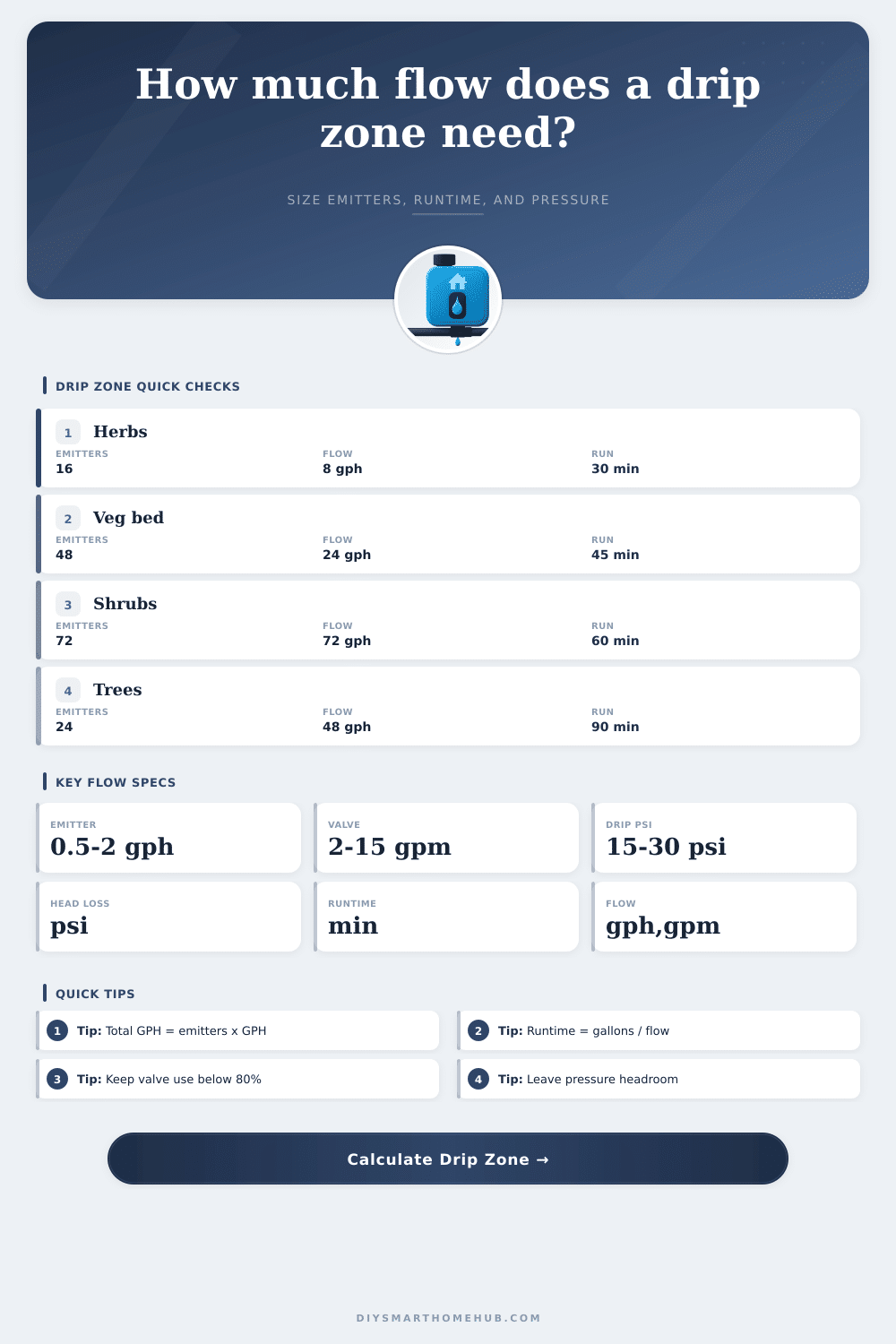
You enter your design into calculator above, and it do the math for you. But what does that mean? What do you plug in there? Total flow is emitter rate times emitter count. So say you have sixteen herbs, each of which are set on half a gallon an hour. Your system’s moving eight gallons an hour, which is only a fraction of capacity of your controller valve, which may be rated as high as five gallons a minute. So you’re not even tapping it by much. It is great for the herbs. It is also okay if you are running big shrub bed with this little valve, but double check the load before doing so.
How to Calculate Your Drip Irrigation Needs
Most designs fails under pressure. As water move through them, it pushes back. For each foot of uphill rise, there’s pressure loss (about 0.433 psi per foot). Tubing puts another brake on flow: Narrower tubes and longer runs eat up pressure headroom. The tool figures in all this pressure loss so you know whether your emitters is still getting that 15-30 psi range required to function properley.
At the other end, if your supply pressure fall short of what emitters demand, those drippers will starve. Plants closest to the valve gets drowned; those downstream get sprinkled on. Immediately, uniformity gets hurt. How long? That varies depending on whether your soil retains lots of water or little. It also depends on how deep your plants’ roots is. Deep-rooted things like trees and shrubs want a slow soak to reach down but don’t mind running off first. Shallow things such as pots need more frequent, shorter cycle. The calculator will adjust your calculated gallons up or down to reflect how evenly you think the water would spread itself across the system. Ideally it’s about 85 percent uniform, so that everyone, even the driest spot, gets their fill. Then you choose an interval between runs based off that recalculated total.
Elevation change is frequently neglected in people’s yards. Even if your garden look flat, there may be a two-foot drop from the valve down to the back border. Water will exert more pressure on lower emitters; they’re liable to blow gaskets or emit mist rather than drip. Conversely, going uphill will have just the opposite effect. It’s all spelled out clearly in reference table on page, which shows what size tubing can manage how much flow vs. How much loss. For most residential zone, half-inch poly tubing is the ticket. Microtube (quarter inch) is so restrictive it’s best used powering short branches to individual pot, not long laterals.
Inline vs. Pressure-Compensating: The right emitter choice alters your approach. Inline driplines run slower where there’s less pressure and faster where it’s higher. This means they’re not forgiving on long runs or over bumpy ground, though they’re simple to install and less expensive. Pressure-compensating (PC) emitters stays constant at any given pressure fluctuation. More costly initially, they’ll save you some troubleshooting time in the future. For this reason, PC emitters allows for greater control when you have limited headroom.
Flow is also limited by size of the zones a smart controller can handle and how many zone it can run at once. Flow may be limited even lower to avoid stressing the plumbing. Going over this threshold could of blow out a fuse or trip your breaker. A safety buffer for aging and surge is keeping the valves under 80 percent use. This is another little thing that make a difference if you want an automated system for watering while away on vacation.
How do you design drip? First: Pressure limits. Second: Flow limits. Third: Soil requirements. More water doesn’t go through small diameter tube if there’s not enough pressure. Don’t be afraid of elevation (or it won’t all go where you think). The objective is to apply water reliably. Not wasted.
Begin by creating your plant profiles. Calculate their gallonage requirement. Test whether your valve-to-dripper-pressure holds throughout. If the runtime matches the type of soil and the headroom remains positive, it’s a done deal and the drip system hums along quietly behind the scenes. Quiet reliability is why drip irrigation are worth this upfront exercise.