Watts to BTU per Hour Converter
Convert electrical watts into BTU/hr heat load, reverse BTU/hr back to watts, and estimate daily BTU, kWh, device-count totals, and HVAC cooling context for smart home equipment.
⚡Smart Home Power Presets
📊Converter Inputs
Watts and BTU/hr estimate
Full calculation breakdown
🔧Reference Spec Grid
📘Conversion And Equipment Tables
| Electrical watts | BTU/hr heat | kW | BTU/day at 24 hr |
|---|
| Smart home load | Typical watts | BTU/hr each | Reference basis |
|---|
| Comparison item | Input basis | Watts | BTU/hr | Daily energy | Planning note |
|---|
| HVAC reference | BTU/hr | W at EER 10 | W at EER 12 | Cooling tons |
|---|
💡Actionable Heat Load Tips
The temperature inside an electrical closet climb rapidly when you stack video cameras and network switches there. Almost all of the power flowing through these pieces of equipment gets converted to heat, and unless it’s taken out of the building, it won’t go anywhere. That’s a direct load on your air conditioning system. Knowing the watt-to-British Thermal Unit per hour conversion will help you control this load before it turn into higher cooling bills.
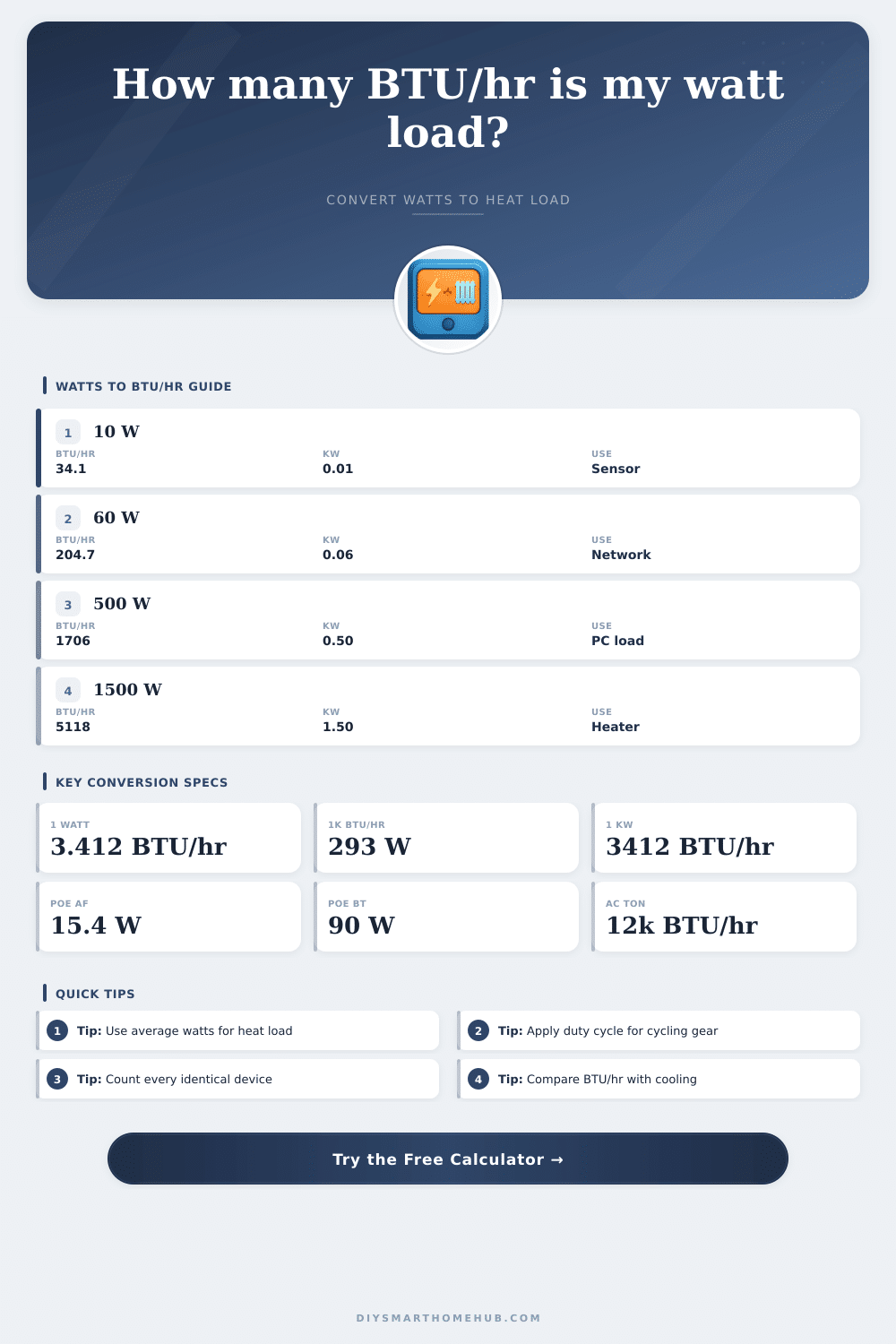
Physics are physics: The conversion factor stay constant. For every hour, one watt = roughly three point four twelve BTU. It doesn’t matter if you’re looking at little sensors or big heaters; the same number hold true for both.
How to Calculate Heat from Electrical Equipment
In reality, however, most gear do not operate at maximum capacity. Most of us figure out how much heat a piece of equipment puts out based off the highest number found on its power label, assuming that what it says is correct. However, labels report theoretical output, not how much power is actualy used during operation. A twenty-watt router may pull just five when idling, which makes necessary cooling too large. Don’t base it on peak capacity, but rather on average consumption. Measure this using a power meter during a few hours, then plug in the average watts into a converter. That tells you how many watts of heat your real-life usage create. For something like a NAS drive or computer which only kicks in sporadically, the gap between average and peak is significant. Going with average avoids purchasing cooling based on theoretical maxes that never happen.
How many are running? Running multiple devices at the same time will generate more heat. One camera might produce little heat, but ten cameras will adds up fast. It helps with network closets where there is so much equipment packed into a small space. Tight spaces don’t do well with dissipating heat because it collects and raises air temperature around them. Heat slows electronics down or causes them to fail early.
A second key parameter is duty cycle. Some devices aren’t running continuously; they’re turned on for some fraction of each day. If you have a space heater that turns itself on and off as needed to hold at a target temp, maybe it’s only on 30% of the time? And that means we should of adjust the duty cycle in the tool, because that’s how it relates back to its real-world environmental impact. In other words, the device doesn’t produce full-thermal output all the time; that’s why we use the duty cycle to bridge the gap between raw electrical specs and the actual environmental impact.
Heating and cooling are not the same thing. Air conditioners might be listed by the number of “tons” or the amount of BTUs per hour removed. However, that rating applies only to their cooling capacity. Twelve thousand BTU per hour is one ton of cooling capacity. That provides a reference point to compare your HVAC system’s capacity with your equipment’s heat load. A server rack might add five thousand BTU per hour, which is almost half a ton of cooling capacity. Knowing that will help you determine whether extra ventilation might be required.
These are quick reference tables. The tables is a fast lookup for commonly used situations. They are a quick benchmark that doesn’t force you to do the math all the time. At a glance, see how much a PoE switch draws compared to your standard desktop PC. The tables will be a sanity check against what you input. If your estimated load is way off from similar equipment in the table, recheck the wattage measurements.
Don’t underestimate heat, it’ll cause hot spots. Overestimate and you’re wasting money on oversizing. The trick to managing heat is balance: you want plenty of ventilation to cool your components but don’t waste electricity by chasing small changes in temp.
Watts are a measure of electrical consumption; BTU/hr are a way to convert those watts into terms we can grasp (namely), how much heat is produced. It’s no longer about abstract numbers, but about physical comfort and how long your equipment last. Electric bills are predictable, the closet remains cool, and the gear hums along.