Depth of Discharge Cycle Calculator
Estimate usable watt-hours, cycle life, lifetime energy throughput, and service years from battery chemistry, depth of discharge, load pattern, temperature, and end-of-life target.
⚡Smart Home Battery Presets
🔋Battery And Cycle Inputs
Depth of discharge cycle estimate
Calculation breakdown
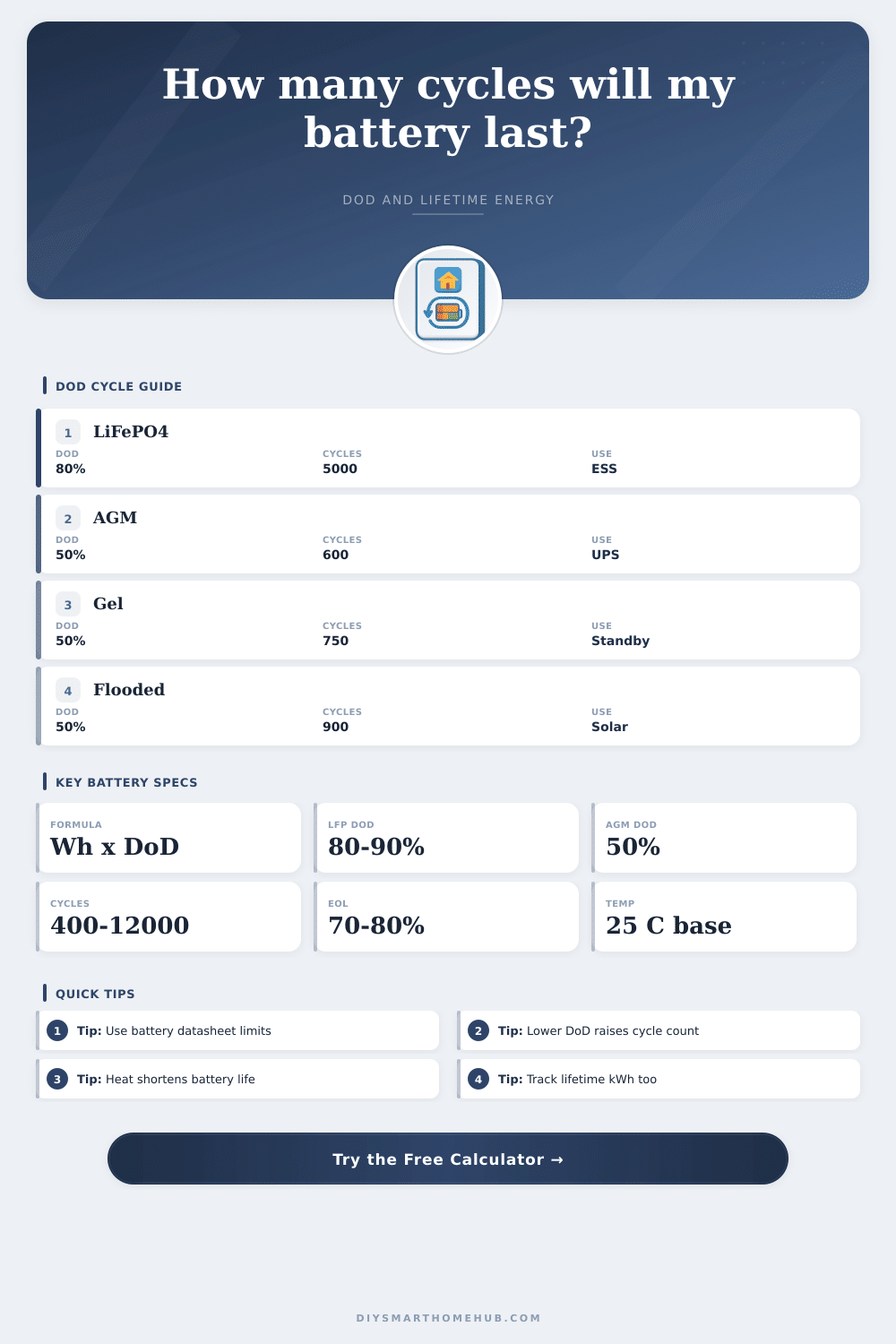
📊Battery Cycle Spec Grid
⚙DoD Comparison Grid
📘Reference Tables
| Chemistry | Shallow cycle | Common planning DoD | Deep cycle reference |
|---|
| Smart home use | Typical load | Cycle pattern | DoD planning note |
|---|---|---|---|
| Router and modem UPS | 15-45 W | Short outages or daily tests | Small loads often permit shallow DoD and long cycle life. |
| PoE camera recorder | 80-180 W | Moderate outage cycles | Use measured average watts because drive and PoE draw vary. |
| Alarm and sensor panel | 5-25 W | Standby float with rare cycles | AGM can fit this use when deep cycling is infrequent. |
| Home energy storage | 300-2000 W | Daily cycling | LiFePO4 is usually favored for high cycle counts. |
| Garage or shed battery | 40-250 W | Solar day/night cycles | Temperature and lead-acid DoD limits matter strongly. |
| Adjustment | Base assumption | Calculator effect | When it matters |
|---|---|---|---|
| Depth of discharge | Chemistry curve points | Interpolates estimated cycles by DoD | Any battery that cycles repeatedly |
| Temperature | 25°C / 77°F baseline | Applies chemistry-specific cycle factor | Garage, attic, cabinet, or outdoor batteries |
| Discharge rate | Low to moderate C-rate | Penalizes high load per battery size | Inverters, motors, heaters, and large PoE loads |
| EOL target | 80% remaining capacity | 70% target extends reported cycles conservatively | When a weaker battery is still acceptable |
| Example battery | Nominal energy | Usable at 50% DoD | Usable at 80% DoD |
|---|
🔧Depth Of Discharge Tips
So you’ve got one of those backup batteries? Maybe after a long weekend when there’s no electricity, you find that it doesn’t work so well. It lights up for awhile, an hour or two, but then loses its punch and you’re left sitting in the dark because the battery simply doesn’t have enough voltage to run your equipment.
Why would that be? It isn’t because your battery is bad; it’s because it follows rules of physics. There are no memories in a battery, but every time you use one, you change its status. Know this: Depth of discharge are always king with regard to battery life. Many users only look at the amp-hour rating. It’s not the complete picture.
How to Make Your Battery Last Longer
Eighty-percent depletion nightly for a few years sounds like plenty, but it doesn’t account for stress. Some chemistries fail sudden; others gradually decay due to the same stresses. Lead acid batteries will wear out fast during deep cycles while lithium iron phosphate handles them just fine. Enter the type of battery and usage into the calculator and it will estimate how long it should of lasted.
Take a router, for example, used in a garage. That draw maybe twenty watts and operates all day long. Backed by a sealed lead acid battery, it’ll draw only five or so percent of its charge in a power outage. That low rate of draw doesn’t stress the batteries. Running a space heater off the same battery do. A massive chunk gets drained out, much more than the 5% draw would imply.
Matching your load to the right chemistry is what makes the difference between an eighteen-month failure and a five-year lifespan. Use the right battery for the job, not just the biggest one you can find.
Battery health is bad news bears. Batteries are chemical reactions, and heat accelerates both that reaction and it’s degradation. An unshaded summer battery in your shed will degrade at double the rate of a winter battery in your climate-controlled basement, losing half its expected cycle life. This means the calculation factors in ambient temperature… But even if you’re careful about discharging the battery just so direct sun exposure or other warm surface contact can kill it nonetheless.
Typically, a manufacturer define end-of-life at eighty percent of initial capacity, or four out of five amp-hours left in the battery. This can be defined as “end” for some people who prefer to keep batteries fresh by replacing them regularly. For others, the “end” is when they squeeze as much as they can out of each one and don’t replace it until the capacity reaches seventy percent. You can change that value in the calculator to understand the trade-off between additional capacity and overall cycles.
The depth of discharge means that as you discharge more, the number of usable watt-hours drop dramatically. It’s not that the battery is less efficient; it’s simply due to voltage sag under load. Terminal voltage drops quickly at higher current levels compared to lower ones, which reduces available energy even sooner than math alone would suggest. Smaller loads will increase run time, whereas larger spikes will reduce it.
Designing with an awareness of this dynamic avoids the mistake of specifying a system based off highest possible use rather than what is needed steadily over time. On the page is a quick table to reference which batteries are right for your smart home use. As you’ll notice, an alarm panel has different needs compared to a camera recorder. The battery will be used differently; one runs during moderate outages while another is just sitting there waiting to be used when necessary. It also doesn’t need the same battery type or level of discharge as the other application.
Using the proper battery for the job not only extends life but also helps avoid premature death and unnecesary costs. The fact is that batteries aren’t free power; they’re consumable devices with a finite amount of usable charge. There are ways to maximize their lifetime, such as avoiding deep discharging, keeping them cool, and respecting the limits of your specific cell.
Ultimately, the trick is making sure your system lasts for years rather than just having maximum power for one day. Battery planning is part art and part science, how do you balance short term requirements with long term survivability?