HP to Watts Converter
Convert horsepower to watts or watts back to horsepower, then estimate electrical input watts, running amps, daily kWh, and starting surge for smart home motors and monitored circuits.
⚙Smart Home Motor Presets
🔌Power Conversion Inputs
Horsepower conversion estimate
Full calculation breakdown
📊Reference Specs
📐Horsepower And Motor Reference Tables
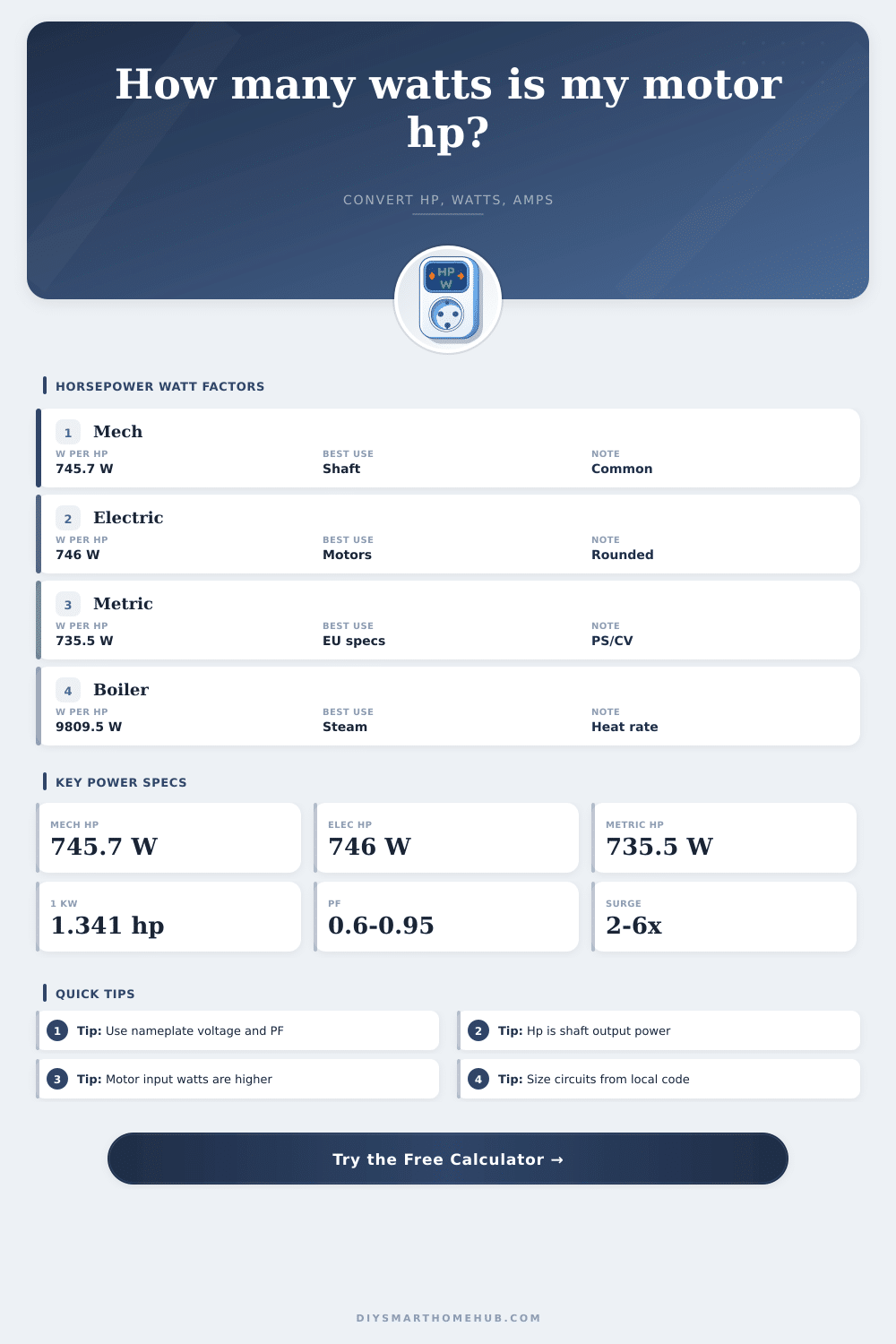
| Horsepower type | Watts per hp | Formula to watts | Formula from watts | Best match | Reference basis |
|---|
| Smart home load | Typical hp | Shaft watts | Efficiency planning | Common voltage | Automation note |
|---|---|---|---|---|---|
| Motorized blind tube motor | 1/20 hp | 37 W | 65-80% | 12-24 V DC or 120 V AC | Use duty hours from actual open and close events. |
| Smart HVAC damper actuator | 1/50 hp | 15 W | 60-75% | 24 V AC | Short run time means low daily kWh but visible inrush. |
| Bathroom exhaust fan motor | 1/25 hp | 30 W | 45-70% | 120 V AC | Use fan timer hours for energy estimates. |
| Garage door opener | 1/2 hp | 373 W | 65-80% | 120 V AC | Surge and short duty matter more than daily kWh. |
| Sump pump on smart relay | 1/3 hp | 249 W | 60-78% | 120 V AC | Cycle count changes daily energy quickly. |
| HVAC blower motor | 3/4 hp | 559 W | 60-85% | 120-240 V AC | ECM motors usually draw less at reduced airflow. |
| Well pump contactor | 1 hp | 746 W | 70-82% | 240 V AC | Use voltage and PF for current monitoring thresholds. |
| Motor profile | Efficiency | Power factor | Surge range | Best use | Calculator effect |
|---|
| Rated hp | Shaft watts | Input watts at 75% | 120 V 1-phase, PF 0.80 | 240 V 1-phase, PF 0.80 | 240 V 3-phase, PF 0.85 |
|---|
✅Actionable Sizing Tips
Look on nameplate of any electric motor and you will read something like half horsepower. Half? That doesn’t seem very much for a sump pump or garage door opener. But amperes and watts is how a circuit breaker measures power, not horses. And that is where so many home automation projects goes wrong.
You plug a smart switch into the wall rated for fifteen amps and think it can handle the load. Then what happens when the motor kicks in… The circuit trips. Plug those numbers into the calculator above (input your voltage and efficiency) and it do the math for you. You won’t have to guess about converting between mechanical output and real-world electrical reality.
How to Calculate Motor Power Correctly
Watts describe how much the grid provide in order to produce movement. Horsepower describes how much power the motor provide at the shaft. There will always be a gap between those two figures, that gap represents magnetic resistance and heat loss. In other words, you can’t simply equate watts and horsepower. Doing so means you may have an overloaded wiring system or you might undersize your monitoring systems. It’s not semantics, it’s physics.
Fortunately, the tool allows you to toggle between boiler horsepower, mechanical horsepower, electrical (which is exactly 746 watts) and metric horsepower. Depending on whether you are using a US standard for motor sizing, the conversion factor is slightly different than electrical horsepower, for example, which is exactly 746 watts. But that isn’t of any benefit if you forget about efficiency rating.
Where things get interesting is efficiency. An inefficient motor will draw more power off the wall then it puts out on the shaft. For example, a half-horsepower pump only outputs around 373 watts. But because of inefficiencies, its input may be almost 500 watts. That additional capacity becomes important when sizing uninterruptible power supplies. And it comes into play as well if you want to know if two pumps can share a circuit or run simultaneously without causing problems.
You’ll notice the calculator allows you to input efficiency of your specific motor as well as your load factor. It doesn’t make an assumption about perfect conditions which don’t often occur in reality.
Starting motors also cause a surge. It is not a gentle awakening. It is a push to get the motor going. Motors needs more than their regular operating amps to break free from inertia. That surge can last a fraction of a second but draw four to six times there normal power. Nameplates don’t show inrush. That’s why weak wiring and sensitive electronics can be wrecked by starting.
With this tool, you can set a surge multiplier to size up how much higher the electrical system will have to handle. A smart plug may say it takes 15 amps. If it isn’t rated for motor use, that first surge could blow immediately. You can avoid burnt out relays by using this knowledge.
Another issue is power factor (particularly with respect to induction motors). Power factor represents the efficiency by which current is being converted to useful work. If your power factor is low, it will take more current down your wiring to get the job done. That leads to greater strain and heat within the circuit. You can see that in reference table on this page. Different types of motors exhibit varying factors.
For instance, residential single-phase motor tend to have a factor of roughly 0.80. Three-phase larger industrial motors operates at a higher factor. Whether you have three-phase or single-phase service makes a whole difference in the current equation. Be sure to pick the right one when selecting the phase from the tool so you are getting an accurate reading.
Lastly, how much electricity does it consume? How many kilowatt-hours? That’s the final element of the equation: operating hours times input watts (you know both of these numbers now). The resulting number is an approximation of your daily electricity usage. And that reveals which devices is expensive to run. A pool filter is cheaper to operate than a well pump because a big motor uses less energy when it’s on briefly, compared to a little motor always humming along.
The way people misinterpret this is to look at maximum power; they fail to account for time. Logging your hours-per-day is far more useful then looking at theoretical maximums. Sizing circuits correctly is less about memorizing tables and more about understanding these relationships. You should of know some of the relationships between electrical input and shaft output, but understanding them is more important than just knowing them.
There’s starting surge and efficiency losses. You also need to take local voltage standards into consideration. All of those gets rolled up into one estimate with the calculator. It combines many variables. It is one number.
It is not instead of licensed electricians. And it is certainly not instead of code books. It provides enough information to ask smarter questions. It provides enough information to stop wondering if your motor will be big enough. It provides enough information to plan on reliability.
Translation is the name of the power game. Translation from your mechanical ability to an electrical need. Home automation flows nicely when you speak the same language. When you don’t, you run around after breakers that trip. It’s a simple matter of clear communication. Understand what motor needs before plugging it in.