Single Phase Amps Calculator
Calculate single-phase current from watts, kW, VA, horsepower, or BTU/hr using voltage, power factor, efficiency, quantity, continuous-load rules, and reserve margin.
🔌Real Load Presets
⚡Single Phase Load Inputs
Single phase amp estimate
Full calculation breakdown
📊Formula And Spec Grid
📋Reference Tables
| Formula case | Single-phase formula | Best input source | Important note |
|---|---|---|---|
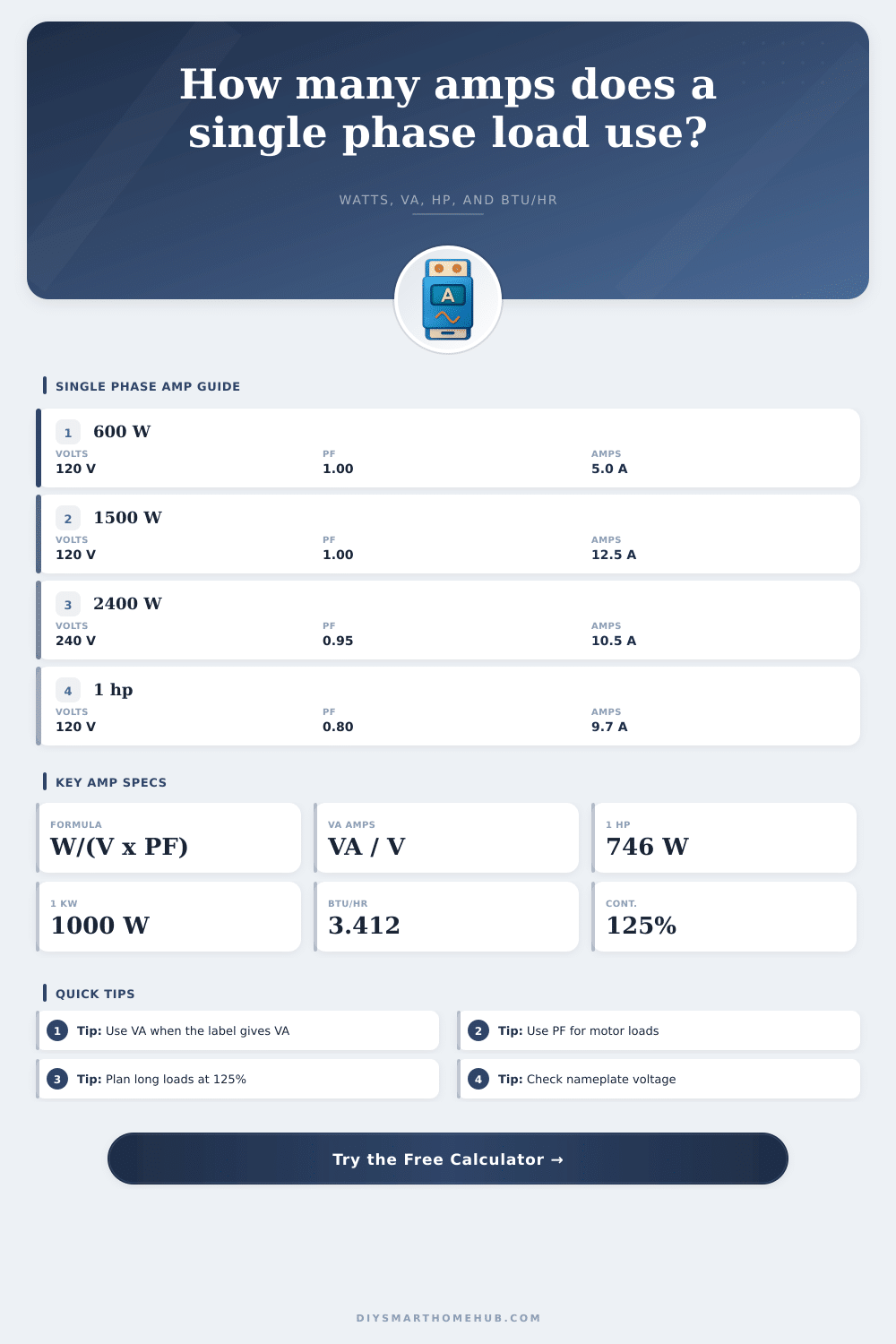
| Real power in watts | A = W / (V x PF) | Device watts or measured watts | Use PF 1.00 only for resistive loads. |
| Apparent power in VA | A = VA / V | UPS, transformer, adapter VA rating | VA already includes current and power factor relationship. |
| Motor horsepower | A = hp x 746 / (V x PF x efficiency) | Motor nameplate hp, PF, efficiency | Use nameplate FLA for final motor circuit work. |
| Thermal BTU/hr | W = BTU/hr / EER | Cooling label, heat pump data, or resistance heat | Use 3.412 for direct resistance heat conversion. |
| Circuit rating | Voltage | Noncontinuous VA | Continuous planning amps | Continuous planning VA |
|---|---|---|---|---|
| 15 A branch circuit | 120 V | 1800 VA | 12 A | 1440 VA |
| 20 A branch circuit | 120 V | 2400 VA | 16 A | 1920 VA |
| 20 A branch circuit | 240 V | 4800 VA | 16 A | 3840 VA |
| 30 A branch circuit | 240 V | 7200 VA | 24 A | 5760 VA |
| 40 A branch circuit | 240 V | 9600 VA | 32 A | 7680 VA |
| 50 A branch circuit | 240 V | 12000 VA | 40 A | 9600 VA |
| Smart home load | Typical input | Voltage | PF used | Running amps | Planning note |
|---|---|---|---|---|---|
| Network router stack | 60 W | 120 V | 0.90 | 0.56 A | Often continuous for circuit planning. |
| PoE camera switch | 240 W | 120 V | 0.92 | 2.17 A | Include switch overhead and PoE budget. |
| Server closet UPS load | 900 VA | 120 V | VA | 7.50 A | Use VA when UPS output is rated in VA. |
| 1500 W space heater | 1500 W | 120 V | 1.00 | 12.50 A | Resistive loads have PF near 1.00. |
| 12k BTU mini split | 12000 BTU/hr | 240 V | 0.95 | 4.39 A | Example uses EER 12; use MCA when available. |
| PoE standard | PSE max power | PD available power | 120 V input amps at 90% | Planning use |
|---|---|---|---|---|
| IEEE 802.3af Type 1 | 15.4 W | 12.95 W | 0.14 A per port | Doorbells, phones, small cameras |
| IEEE 802.3at Type 2 | 30 W | 25.5 W | 0.28 A per port | PTZ cameras and access points |
| IEEE 802.3bt Type 3 | 60 W | 51 W | 0.56 A per port | High-power APs and displays |
| IEEE 802.3bt Type 4 | 90 W | 71.3 W | 0.83 A per port | High-power PoE devices |
| Reference basis | Spec value used | Calculator use | Source |
|---|---|---|---|
| Continuous branch-circuit load | Noncontinuous load plus 125% of continuous load | Planning current multiplier | Schneider Electric NEC note |
| NEMA 5-15 receptacle class | 15 A, 125 V, 2-pole, 3-wire grounding | Common plug and receptacle reference | Eaton straight blade brochure |
| PoE power classes | 15.4 W, 30 W, 60 W, 90 W PSE levels | Smart camera and access-point amp planning | Eaton PoE overview |
| PoE PD power draw | Type 1 about 13 W, Type 2 25.5 W at PD | Device-side power comparison | HPE Aruba PoE docs |
For code compliance, use this calculator as an estimating aid and verify final conductor, breaker, receptacle, motor, and EV charging requirements against the applicable electrical code and equipment nameplate.
🔧Actionable Amp Planning Tips
Plug in that new space heater and suddenly the lights starts to flicker? Your electrical panel’s full! Until an appliance fails to work or your circuit trips, most of us don’t give amperage much thought. Use the calculator on this page; it will do math for you. Simply enter numbers off label of a device to learn how much current it actualy uses, before you buy or install any new equipment.
Labels for consumers are confusing. They throw around all sorts of units: watts, volt-amps, horsepower, or BTUs listed in different places. To make matters worse, they’re not using the same unit! The way something use energy determines how it’s labeled. For example, a heating element will list watts because it has a nearly-perfect power factor. In other words, the thing takes electricity and turns it directly into heat without waste.
How to Calculate Amperage for Your Home
Things like motors and electronics get more messy, pulling current in waves that don’t necessarily peak at the same time as voltage. This results in what seems like more power, called “apparent” power, expressed in volt-amps, then there really is; actual power is just watts. The calculator takes this into account by allowing you to enter your power factor, typically ranging from 0.75… 0.95 for a mixture of loads. Not accounting for this discrepancy can mean you end up running out of capacity where it hurts most. It’s a little detail but one that makes all the difference in the long run for circuit duribility.
Most DIYers make mistake on continuous load rule: For a load that’s used for three hours or longer, electrical code demands sizing it with an extra 25 percent beyond the true load. So that fifteen-amp breaker isn’t really rated for fifteen amps of continuous use. It’s rated for twelve. The extra twenty-five percent margin ensures the wire doesn’t get too hot over time and create a fire hazard. Selecting continuous duty cause the tool to apply this multiplier automatically (avoiding any error-prone manual math). Still gotta make the call between constant and intermittent loads, but after that, the math takes care of itself.
Then there’s the additional complication of horsepower ratings, especially on items like compressors and pumps. Electrically speaking, a one-half horsepower sump pump doesn’t pull half a horsepower. Because it has to start up with a surge, and be inefficient due to its motor design, it pulls much more. You can enter an efficiency percentage into the calculator to have it adjust. Otherwise you may under-estimate how big a breaker you’ll need. And that’s where people go wrong, they look at the output rating and think it’s the same as the input. But it’s hardly ever even remotly close.
Another factor is thermal load. Air conditioners for example. If it’s a mini split, you won’t find an amp rating on label easily. Instead, they list cooling capacity in BTU/hr. To convert that into electrical draw, we have to know the equipment’s efficiency ratio. The higher energy efficiency ratio, the lower the electrical draw for a given amount of cooling. The calculator does all that work for you so you can also get a sense of your daily energy consumption too. It will help you figure out whether the circuit can handle the load and how much it will cost you. It shows both safety and cost.
Reserve capacity is part of the planning process too. Very seldom do you run a circuit full bore. By reserving ten or fifteen percent, you know if at some point down the road, you add a little something else, it doesn’t trip your breaker. It’s future proofing your wiring without having to go overkill with it today. On the page there are reference tables that outline what typical branch circuits is and give you a baseline to work from (e.g., twelve volt, twenty-four volt, etc.). These aren’t recommendations because they are hard limits based off wire heating characteristics.
Understand Amperes: Amps aren’t something you should of learned a formula for; it’s more important to understand what they’re capable of, physically speaking. The amount of current your wire can handle has a hard cap, beyond which you’ll be looking at a potential fire situation. Knowing how much a device actualy draws helps when building a server closet or when checking if your microwave can share a circuit with the garage door opener. Better to plan twice then blow a breaker once.
You don’t think about amperes until your lights start flickering, and when that happens, it is already too late. Thinking ahead makes that moment of potential panic nothing more than another line item on the spreadsheet.