Three Phase Power Calculator
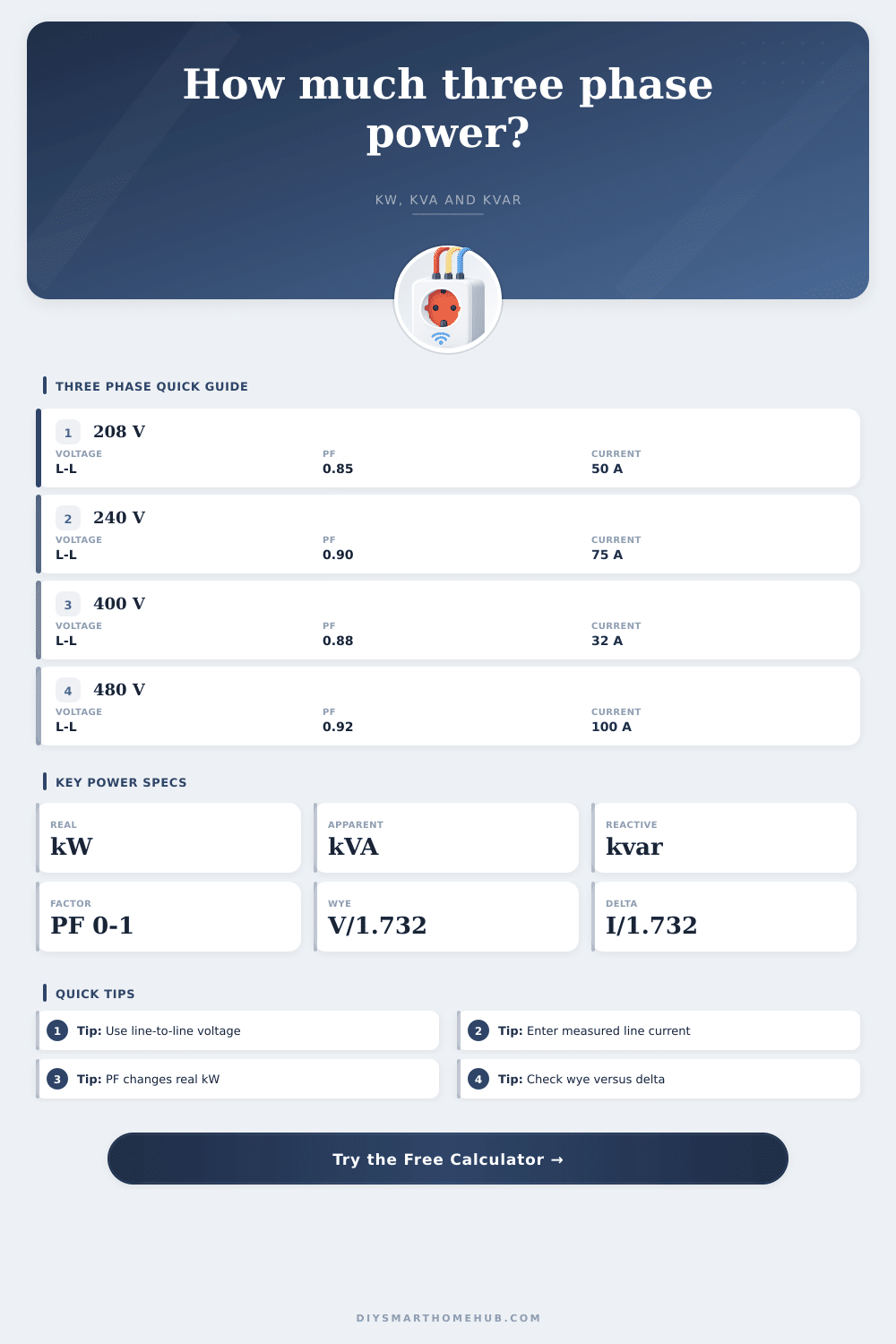
Calculate real power, apparent power, reactive power, phase voltage, phase current, and correction targets from line-to-line voltage, line current, power factor, and wye or delta connection.
⚡Three Phase Presets
🔧Electrical Inputs
Three phase power estimate
Calculation breakdown
📊Power Formula Grid
📋Three Phase Reference Tables
| Voltage system | Common use | At 50 A, PF 0.90 | Phase note |
|---|
| Connection | Phase voltage | Phase current | Best calculation use |
|---|---|---|---|
| Wye / star | Vphase = VLL / √3 | Iphase = IL | Four-wire systems, line-neutral loads, many distribution panels. |
| Delta | Vphase = VLL | Iphase = IL / √3 | Three-wire motor loads and delta-connected equipment windings. |
| Balanced load | Equal phase voltages | Equal line currents | Use √3 x VLL x IL for total three phase power. |
| Unbalanced load | Measure each phase | Measure each line | Use per-phase measurement when currents differ significantly. |
| Power factor | Angle estimate | kW from 100 kVA | Planning meaning |
|---|
| Scenario | Voltage and current | Calculated power | Secondary result |
|---|
⚙Connection Comparison Grid
| Comparison point | Wye / star | Delta | Calculator impact |
|---|---|---|---|
| Voltage relationship | Phase voltage is VLL / √3 | Phase voltage equals VLL | Changes displayed phase voltage, not total kVA formula. |
| Current relationship | Phase current equals line current | Phase current is IL / √3 | Changes winding current shown in the phase values card. |
| Neutral availability | Often supports line-neutral loads | Usually three-wire without neutral | Use wye for phase-to-neutral review and delta for winding review. |
| Power formula | √3 x VLL x IL x PF | √3 x VLL x IL x PF | Total balanced three phase kW uses the same line values. |
💡Calculation Tips
If all you want to do is determine whether your new HVAC unit trips a breaker, three phase power can be a bit of a mystery. There are amps in panel. And there are numbers on the nameplate. Between those numbers are measurements like kilowatts and kilovolt-amps that seem to exist just to make everything confusing. But they’re not complicated at all.
When you stop thinking about current and voltage as separate things, and instead start seeing them as a single vector triangle, you get it. This switch of perspective change what you read in an electrical bill. It’s also one that changes how you size a conductor. Plug your current (A) and line-to-line voltage into the calculator above, and it will do all math for you. No more trying to track down decimal places and square roots.
Understanding Three Phase Power
What the calculator spits out? It is a map of what happens with your electricity. KW measures real power. Real power spin motor shafts, warms compressor coils, powers LEDs. It does actual work. KVA measures apparent power. It’s the total amount of electricity that flows through your wires, regardless of whether or not it actualy does any work. The gap between those two is reactive power.
Reactive power is the invisible weight that inductors and magnets drag behind themself. It doesn’t register on your meter as electricity consumption, but it do warm your cables and eat up transformer capacity. That’s why utility companies care about it. So what’s this business of power factor? Power factor is a measure of efficiency of using apparent power. The higher the better (ideally 1.0). That means every joule counts.
For most industrial applications, it ranges from 0.80, 0.95. This is pretty good, but there is room for improvement. If the PF gets down under 0.80, utilities can assess penalties. Why? Because you are making them do more than they need to by running an inefficient load.
You will be able to plug in different correction scenarios into the calculator. See how adding capacitors to boost that factor frees up capacity in your existing panel. No magic, just cleaning out inefficiency and getting more bang per ampere.
And there’s this: what kind? What type of connection are you using? Is it a delta or a wye configuration? If the latter, then your line-to-line voltage will be higher than your phase voltage (divided by the square root of three). That’s frequently the case for four-wire systems, which include those neutral lines.
Motor loads tend toward delta systems. There is no neutral leg; instead, phase and line voltages matches. Getting them confused isn’t just a theoretical mistake; it can mean really messing up your winding ratings calculations. And it affects whether a piece of equipment will fit inside the thermal envelope of its wiring. The tool accounts for all this automatically. There’s no need to calculate unit conversions each time you change context.
Demand factors and efficiency ratings are practical considerations as well. They’re sometimes overlooked by pure theory. The nameplate numbers reflect ideal conditions that don’t always occur on a given Tuesday afternoon in July. Motors aren’t perfectly efficient. Transformers lose some juice as they hum along. Cables gets hot when loaded. A realistic efficiency percentage brings theoretical ideas down to earth where they lives in real life.
Running at 92 percent efficiency means your drive system wastes an additional 8 percent of its potential energy creating heat. Ignoring it might save you money on paper but costs you dearly in cooling loads later. It could of cost you dearly in cooling loads later.
The other problem with a three phase system is load balance. Capacity is wasted because one leg carries much heavier loads than the other legs. In wye systems, this overheats the neutral conductor. The calculator will flag imbalance so that you can see it coming and take action before an outage occurs. Phases should be carrying their fair share of the load.
Voltage is over-emphasized by most folks. People overlook how much current their service entrance can carry. When it’s time to run that production line, knowing how close your calculation gets to your breaker limit helps prevent tripping the main disconnect. These reference tables help put those numbers into context so you can do a quick sanity check to see if the numbers seem normal for your typical 480 volt industrial feed or 208 volt subpanel system.
At the end of the day, learning about three phase power is less a matter of formula memorization than it is an understanding of the relationship between current, voltage, and what sort of load exists in play. You will save money and increase equipment life expectancy. Know precisely what’s happening behind the meter and sleep easy.
This is why we circle back to the triangle. When you understand the interaction between real and reactive power, well, the confusion dissapears.