Solar Battery Autonomy Calculator
Estimate how many backup days your battery bank can support after depth-of-discharge, inverter efficiency, temperature derate, battery health, reserve margin, and solar recharge hours are applied.
| Chemistry | Planning DoD | Cold behavior | Best autonomy use |
|---|---|---|---|
| LiFePO4 | 80-90% | Good discharge, charging limited below freezing | Daily cycling, cabins, home backup, mobile systems |
| AGM lead-acid | 45-55% | Capacity drops sharply in cold conditions | Occasional backup where simple maintenance matters |
| Flooded lead-acid | 40-50% | Needs stronger cold reserve and ventilation planning | Stationary banks with routine checks |
| Gel lead-acid | 45-55% | Moderate cold derate with strict charge limits | Lower-current standby loads |
| NMC lithium | 70-85% | Good energy density, depends on pack BMS limits | Compact packs with monitored electronics |
| Load group | Typical daily energy | Autonomy note | Planning check |
|---|---|---|---|
| Router, modem, small hub | 0.25-0.60 kWh/day | Long runtime from compact banks | Verify standby watts over 24 hours |
| Fridge and LED lights | 1.2-2.8 kWh/day | Compressor cycles need a reserve | Use measured plug meter data when possible |
| Work shed or office | 2.0-5.0 kWh/day | Daytime loads may overlap solar input | Separate critical and optional loads |
| Tiny home essentials | 4.0-8.0 kWh/day | Winter autonomy often drives bank size | Use seasonal sun hours and cold derate |
| Storm essentials panel | 6.0-12.0 kWh/day | Large loads shorten backup quickly | Exclude heat, large motors, and resistive loads unless measured |
| Battery location | Approx temp | Derate factor | When to use it |
|---|---|---|---|
| Conditioned utility room | 60-80°F | 95-100% | Indoor banks with stable room temperature |
| Cool basement or garage | 40-60°F | 85-95% | Mild cold exposure during standby |
| Unheated shed | 20-40°F | 70-85% | Winter cabin, gate, and shed systems |
| Below freezing enclosure | 0-20°F | 55-70% | Only with BMS and charge protections confirmed |
| Bank voltage | Example capacity | Nominal energy | Why it matters |
|---|---|---|---|
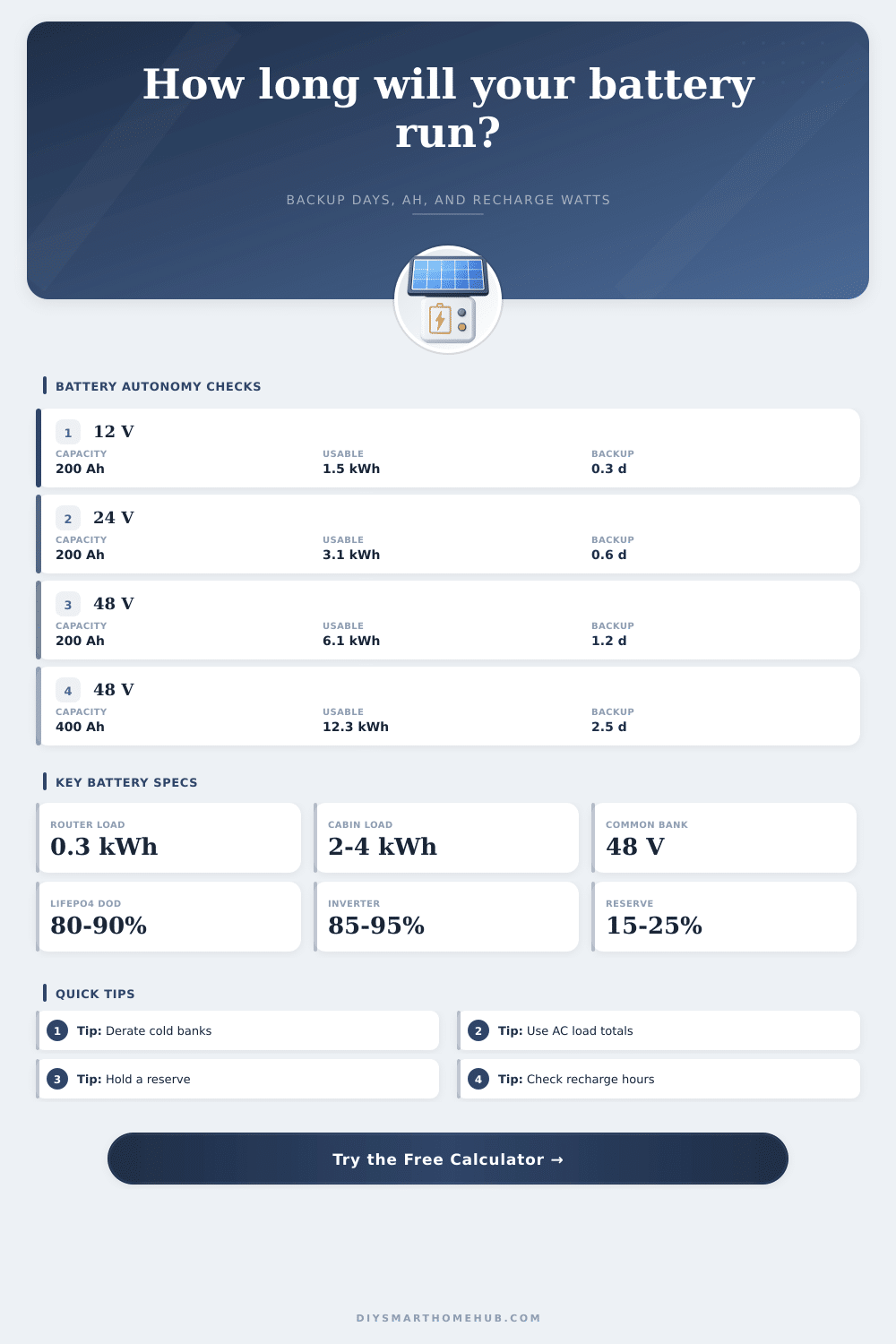
| 12 V | 200 Ah | 2.4 kWh | Fine for small DC systems and light inverter loads |
| 24 V | 200 Ah | 4.8 kWh | Reduces current for medium off-grid circuits |
| 48 V | 200 Ah | 9.6 kWh | Common for whole-cabin and home backup inverters |
| 48 V | 400 Ah | 19.2 kWh | Supports multi-day essential-load planning |
| 72 V | 200 Ah | 14.4 kWh | Used when compatible high-voltage equipment is specified |
| Solar window | Recharge meaning | Array sizing effect | Planning use |
|---|---|---|---|
| 1.5-2.5 peak sun hrs | Cloudy or winter planning day | Requires much larger array for recovery | Use for conservative storm and winter reserve |
| 3.0-4.5 peak sun hrs | Moderate annual daily average | Balanced array size for routine backup refill | Use for many home and cabin estimates |
| 5.0-6.5 peak sun hrs | Strong sunny-season production | Faster recovery with fewer array watts | Use for summer cabins and open exposure |
| Variable shade | Output changes by hour | Needs measured or modeled production | Use lower sun hours until shade is quantified |
A lot of people think that 200 amp hours lasts through a night of storms, but they’re typically wrong. Yes, it says so on the label. But remember: the inverter use some of those amps. Cold air make them less efficient. Also, older cells aren’t as strong as when they were new. Do yourself a favor: do the math; don’t guess.
That’s where the page’s calculator comes into play. Choose your battery type/chemistry and the weather you expect to encounter. The calculator will then crunch numbers to give you actualy autonomy. Don’t make guesses about how much juice is available once you reach your appliances from storage.
How To Know How Long Your Battery Will Last
Before thinking about capacity, think about voltage. If your system use 12 volts instead of four banks of eight, it will move electrons along without resistance. When you pull hundreds of watts through skinny wires, that resistance matter. That’s one reason why high voltage platforms is used in larger systems (see table below). While you’ll pay more at first to be compatible with hardware, you’ll get improved efficiency under load. This trade-off between upfront expense and longevity only makes sense when you look at the whole system.
The one that factor into everything else is depth of discharge. For example with lithium iron phosphate batteries you can dig deep, often down to eighty five percent or more, without punishing the lifespan. If you want your lead acid batteries to last through another winter season, you should of try to stay above half capacity. Forget about that and you’ll end up having to buy double the number of batterys you currently need eventually.
Luckily this calculator accounts for that and you just pick which battery type you are using or intend to use and it knows how to adjust from there. So you won’t have to memorize the performance curve of each battery but rather just tell it what you have and it’ll tell you how much juice you has left before your fridge stops running.
But all this is subject to temperature. If your battery is in a heated room, it will act different than if it were sitting in 30 degree F temperatures. It is in an unheated shed. Available capacity will be less as will output. Internal resistance rises, chemical reaction slows. At extreme temperatures (especially cold) you may even find yourself limited to just three fifths of rated power, i.e., a derate factor of seventy percent. That’ll have you hoping for sunshine during a January blackout; not gonna happen.
Instead, use conservative estimates in winter time if you expect to actualy see results when an emergency happens. When a storm blows through it’s sunny again. Time to recharge. How much power can you get back during daylight hours? That’s your panel wattage requirement. If you’re on a cloudy day with less peak sun hours, you’ll need more panels to hit 100 percent by sunset. To keep your solar estimate realistic (not optimistic), the calculator takes into account both inverter losses and controller efficiency. If you’d like to have the bank topped up by tomorrow evening just enter those parameters and see how many panels you’ll need.
Real life has surprises, hence the reserve margin. You forget about the space heater plugged in behind the sofa. Your appliances all decided to kick on at once. Or maybe you just went into another room and left your cell phone charging on the counter. To keep from discharging down to zero (which would be bad for the batteries), the battery management system shut off discharge. A 20 percent reserve means you’re never caught with a dead battery and no way to charge your phone. It’s insurance against surprise loads and human error, not wasted capacity.
But there’s no substitute for knowing how much you actually use (not what your appliances claim they might use), at least not when it comes to batteries. Your computer monitor is always on but only sucks a few watts; a refrigerator does not run its compressor continuously; those load will add up over weeks. Plug meters reveal the truth about duty cycles and phantom loads. Put those real figures into the tool along with your desired number of autonomy days, and it’ll tell you whether your current bank size is enough, or whether you need more. It crunches the complicated math for you while you decide whether you feel comfortabley staying off-line given the answer.
When we’re buying batteries, there’s more at stake than storage space. There is also how much usable energy reaches your devices after subtracting all the losses along the way. Each adds up, spreading itself across many months of use. You can’t find them on a spec sheet, but you can figure them out beforehand, before the grid goes down. This helps turn anxiety into a plan, one with clear expectations of what your system will provide when it needs to do its job most.