Solar Tilt for Latitude Calculator
Set a practical solar panel tilt from latitude, hemisphere, season, roof pitch, azimuth, adjustment goal, panel row spacing, and low-sun altitude for a roof or ground mount layout.
Tilt results
| Season | Tilt rule | Best use |
|---|
| Azimuth offset | Factor | Planning note |
|---|
| Sun altitude | Spacing effect | Use case |
|---|
| Roof pitch | Angle | Solar note |
|---|
Everyone thinks installing solar panels is as simple as slapping some glass across your roof until you’ve hit desired output. Grab some panels, tie ’em down, cross your fingers and pray. But here’s the deal: Angle make all the difference in the world. Tilt a panel five degrees too flat or too steep and over the course of the year, you’ll lose energy without even noticing. What appears to be a flawless setup becomes a system that waste energy and loses money.
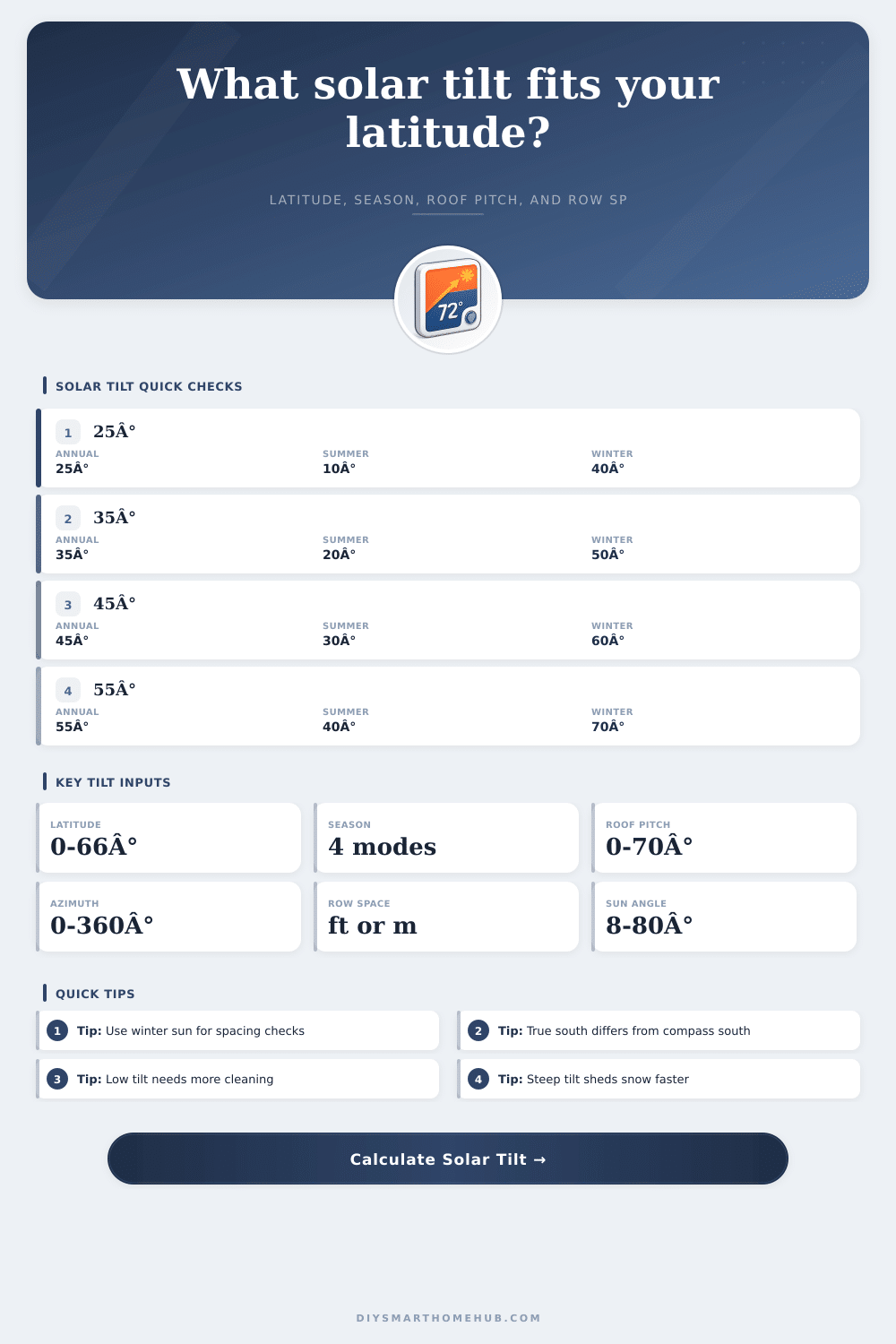
Calculating the correct tilt isn’t rocket science… but it will ask you to look beyond your weather app to your exact location. Latitude is your starting point for nearly all installations. It’s the distance north or south from the earth’s equator, and it determine where in the sky the sun tracks on average throughout the day. As a rule of thumb, tilting your panels at your exact latitude provide a good starting point for producing energy all year long. Plug that number into the calculator above, and it’ll do the math for you. No need to grab a textbook (or even a protractor) and do any tricky trigonometry here. It’ll translate that raw geography information into something you can use for your roof.
Why Solar Panel Angle Matters
But life isn’t always so simple. To get the most power in cold winters, for example, you’d have to make that steeper. In winter, sun’s lower in the sky, producing longer shadows and striking flat surfaces at shallow angles. Tilted-upward panels captures more of these weak, low-angled rays.
In summer, when most concerned with output, you can get away with a shallower angle, since the sun’s higher up in the sky and beats down on things overhead. That’s the kind of tradeoff that depends as much on personal habit as engineering theory: Do you run electric heat in January? Air conditioning in July? Make that choice and you’ll know whether to chase the winter trough or summer peak.
It’s also got something to do with where in the world you are (but really it’s primarily about which way). For those of us up North, true south is your sweet spot for pointing your panels. That’s flipped down south, to true north. No worries, the tool will account for that automatically. Your azimuth inputs will line up with how the sun actualy moves, not what your compass needle says. Your compass might mislead you based off magnetic declination. You’ll have wasted all that careful calculation of your panel tilt if you gets the direction wrong.
And then there’s the matter of roof pitch. The perfect solar angle rarely aligns exactly with most home roofs. If your roof’s pitch is almost the same as your latitude, you can just install them flush to the roof. That will save some cash on racking hardware. However, an unusually steep or flat roof will require tilt-adjusting racks. This introduces wind load concerns and structural considerations that aren’t captured in pure energy math.
Also consider debris. Low-tilt panels gets covered up by leaves, dust, and bird poop, blocking out sunlight and lowering their efficiency. A steeper angle sheds these impurities more easily with rainfall, allowing for clearer glass with less maintenance.
Spacing matters immensely for flat-roof arrays or ground mounts where rows of panel sit behind one another. Even a slight change in tilt can cause the front row to shade the back row at high noon when the winter sun is so low. You can enter your desired spacing into the calculator and it will show you whether those panels will shade themselves, so you don’t have to search for a perfect angle only to end up casting shadows on yourself.
In the end, putting up solar is about finding a balance between practical factors like physical restrictions and seasonal/location considerations. No one angle fits all; there’s simply the optimal tradeoff for each situation. If you want summer lushness most, go for higher tilt. Winter hardiness? Go higher. Go lower. Make sure the tilt is dialed-in so that each watt that strikes your roof helps pay the bill.
You’ll have a well-tuned instrument instead of a pile of solar cells just waiting to see if the sun will please show up someday. It’s something you should of considered earlier.