Solar Production Loss By Angle Calculator
Estimate how much energy your panels lose from tilt and azimuth, then layer in season, peak sun hours, shading, soiling, and inverter loss to see practical daily and monthly production.
Presets 9 common installs
System And Site Inputs edit any value
Angle Loss Specification Grid live site details
Step-By-Step Breakdown production formula
Reference Tables angle, season, loss, presets
| Tilt / Azimuth Situation | Typical Angle Loss | Planning Note |
|---|
| Season | Target Tilt Rule | Sun-Hour Multiplier | Use When |
|---|
| Loss Type | Common Range | How To Improve It |
|---|
| Preset | Array | Angle | Loss Inputs | Best Fit |
|---|
Solar Angle Tips practical checks
Why do you get solar installed? You want to capture the sun and watch your electricity bill vanish. You gets it installed and then wait for bills to shrink. Maybe they don’t shrink as much as expected. Why? It’s never really because the equipment has failed. Usually its because of some geometry problem: perhaps your house faces east rather than south; or maybe the tilt angle match the shingles but not the most efficient angle for capturing winter sunlight. All these little misalignments adds up to huge amounts of wasted energy over time. This calculator aim to measure that hidden waste.
Orientation vs System Size: People tend to get hung up on total system size when they’re planning solar. North-facing ten-kilowatt systems generates less electricity than south-facing four-kilowatt ones in the Northern Hemisphere. The calculator breaks this out for you, allowing you to understand how much you’ll be giving up if you try to use existing roof slope rather than mounting your own custom arrays. It also models angle loss as a different factor. Apart from dirt and shading. That’s important because you can wash your panels every day; you can’t alter home’s latitude.
How Solar Angles Change Your Energy
So start with your season and your latitude. Your latitude tells the tool where the sun appears in the sky at midday. For flat mounting, that’s OK if you’re close to the equator. Up north, the low winter sun require steeper angles. Based off that information, it figures out what tilt you should of be aiming for.
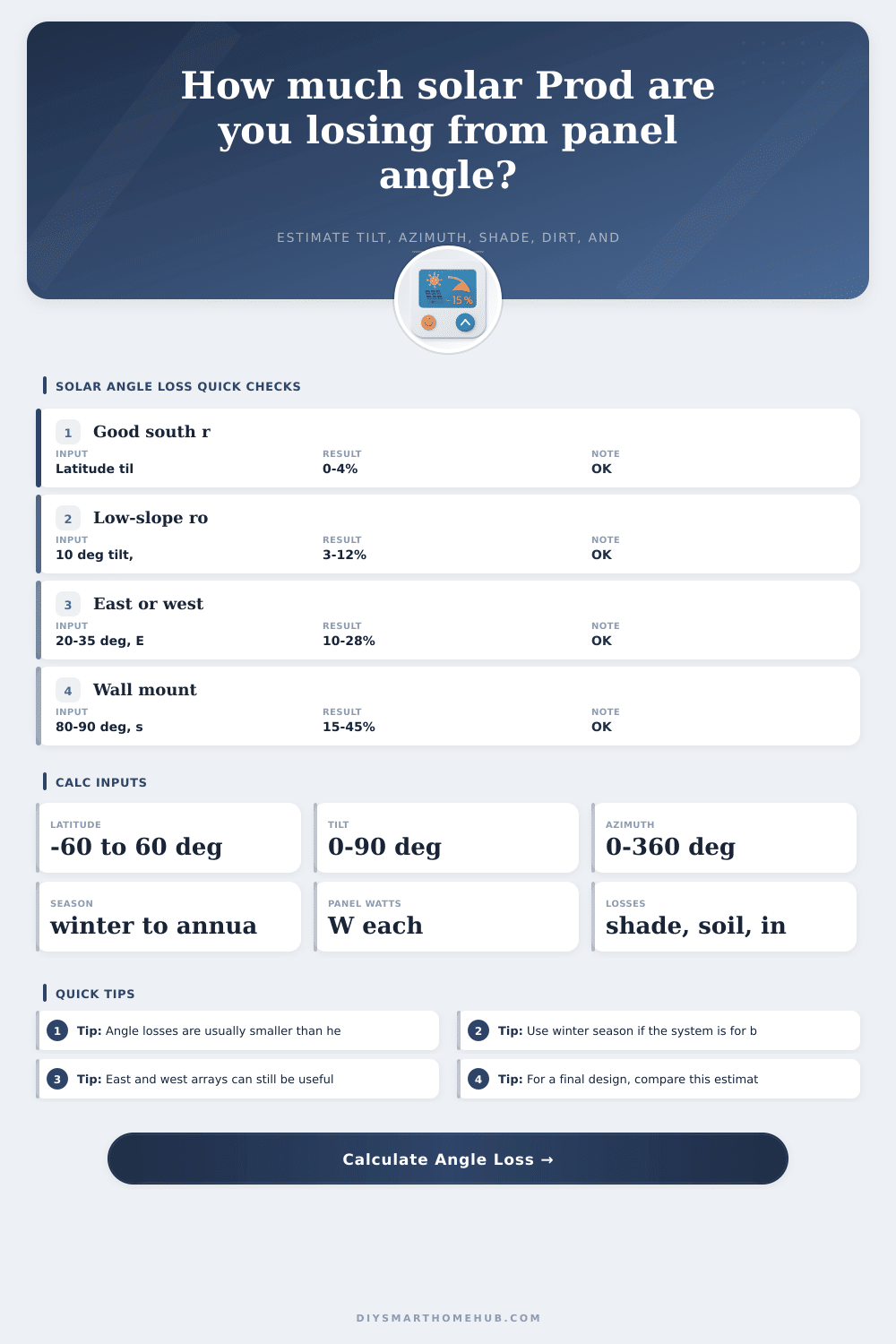
Next you put in the actual azimuth and tilt of your panel. Azimuth is the compass direction. True south (zero loss) are in the northern hemisphere. Each degree deviation from true south represent a penalty. Panels facing east or west captures much less total energy. However, they shift production into morning or evening hours. This might make sense for someone trying to use time-of-use billing.
For example, it will add in real world losses such as soiling, shading (chimneys can cast a shadow at 2 PM!), inverter efficiency and more. It is tempting to say “it’s all about the angle,” but in reality, bird poop on the glass or a chimney casting shade at 2 PM are the actual problem. Isolating out the angle loss percentage give you an apples-to-apples comparison of just how much energy is lost to physics.
Maybe your east system has twenty percent loss because of wrong azimuth but only three percent because of the wrong tilt. If this is a system you’re planning to expand, then that helps tell you where you need to focus your redesign. The page also includes reference tables so people can get ballpark comparisons for typical situations (like wall mounted vs. Flat roof) quickly.
Oftentimes, wall mounting lead to very high loss values due to pointing in vertical directions that rarely match the direction of the sun except at extreme latitudes. A lot of folks underestimate impact of having an existing roof slope instead of a perfect angle for their home installs… but it’s typically just a couple of percentage points. And the math reveal that staying within 10 degrees of ideal tilt usually results in losing only a couple percent per year compared to a perfectly aligned install. Unless you’re really tight on space, adjustable racks don’t normaly pay for themselves by recovering a couple percentage points.
Before purchasing a used panel set for an rv or cabin run this on it first. You will know if you need to purchase additional batteries to handle the load or just settle for less than expected results. The purpose isn’t perfection it’s awareness. When you know you’ve lost something and angles determine potential then you don’t guess anymore, you plan.
Maybe you won’t have the perfect roof but at least you’ll know what you’re losing and thus what you’ll be getting yourself into.