Solar String Voltage Calculator
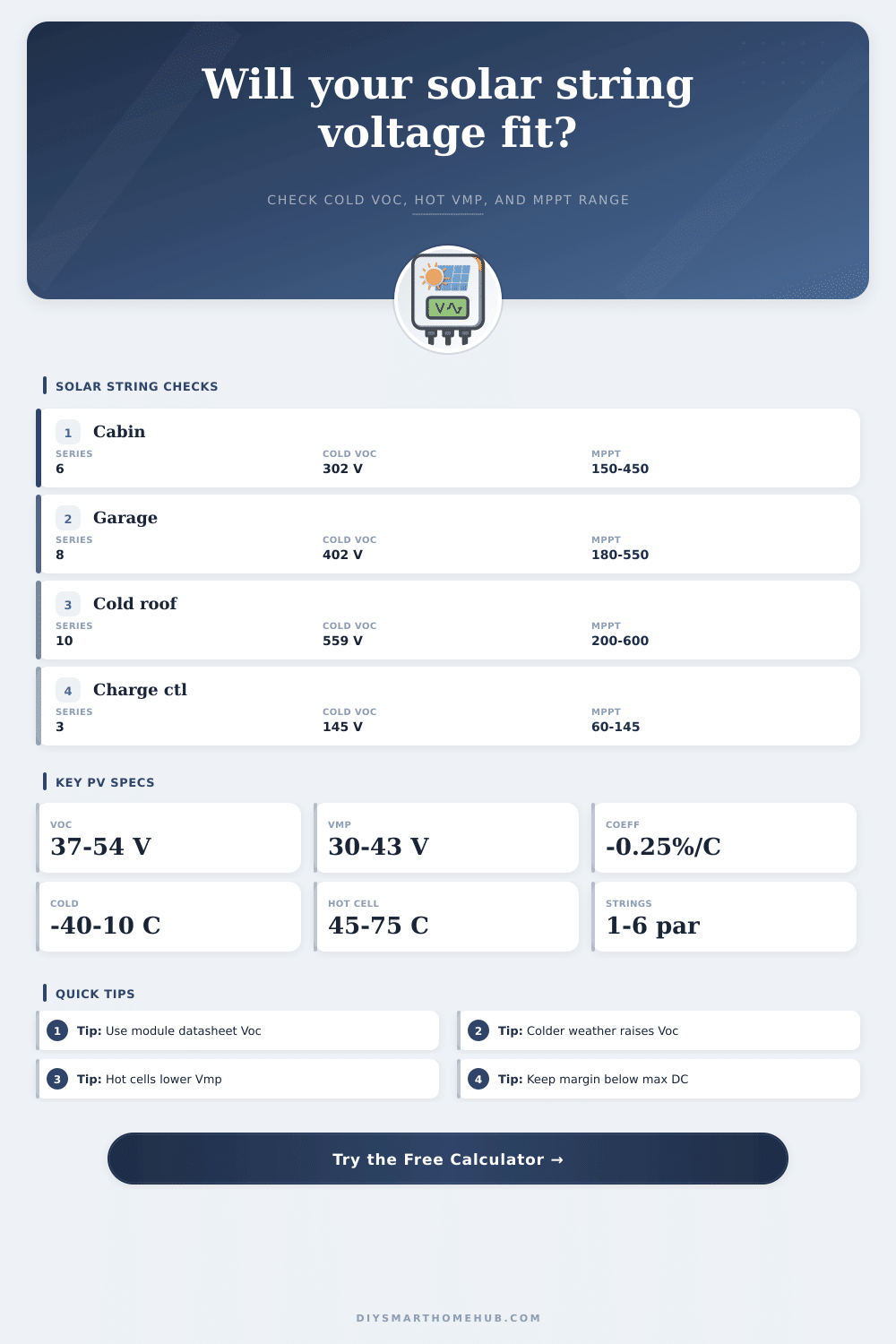
Check whether a PV string stays below the inverter maximum DC voltage on the coldest morning and remains inside the MPPT operating window when modules are hot.
Formula breakdown
Cold panel Voc = Voc_STC × [1 + abs(Voc coeff) × (25 - cold temp) / 100]Cold string Voc = cold panel Voc × modules in seriesHot panel Vmp = Vmp_STC × [1 + Vmp coeff × (hot cell temp - 25) / 100]Hot string Vmp = hot panel Vmp × modules in seriesArray Isc = panel Isc × parallel strings and array watts = Vmp_STC × Imp × modules × stringsPV voltage terms
| Term | Where it appears | Used for | String effect |
|---|---|---|---|
| Voc | Module label and datasheet | Cold maximum voltage limit | Adds in series |
| Vmp | Rated power condition | MPPT operating voltage | Adds in series |
| Isc | Short-circuit current rating | Input current and protection checks | Adds in parallel |
| Imp | Rated operating current | Approximate array power at STC | Adds in parallel |
Typical crystalline module temperature behavior
| Parameter | Common coefficient | Cold effect | Hot effect |
|---|---|---|---|
| Voc | -0.24% to -0.32%/°C | Voltage rises | Voltage falls |
| Vmp | -0.30% to -0.40%/°C | Voltage rises slightly | Voltage falls more |
| Isc | +0.03% to +0.06%/°C | Current falls slightly | Current rises slightly |
| Power | -0.29% to -0.45%/°C | Higher voltage helps | Output declines |
Controller and inverter spec comparison grid
| Equipment class | Max DC input | Typical MPPT window | String sizing focus |
|---|---|---|---|
| Small charge controller | 100 V to 150 V | Battery voltage plus overhead | Very few modules in series |
| Hybrid inverter low-voltage PV | 145 V to 250 V | 60 V to 200 V | Cold Voc margin is tight |
| Residential string inverter | 500 V to 600 V | 120 V to 550 V | Balance cold Voc and hot Vmp |
| High-voltage inverter | 1000 V to 1100 V | 180 V to 950 V | Long strings, wide MPPT range |
Example module counts by cold corrected Voc
| Cold panel Voc | 150 V limit | 600 V limit | 1000 V limit |
|---|---|---|---|
| 42 V | 3 modules | 14 modules | 23 modules |
| 50 V | 3 modules | 12 modules | 20 modules |
| 58 V | 2 modules | 10 modules | 17 modules |
| 66 V | 2 modules | 9 modules | 15 modules |
Real-world design checkpoints
| Checkpoint | Pass condition | Warning sign | What changes it |
|---|---|---|---|
| Cold string Voc | Below max DC input | Within margin band | Fewer series modules |
| Hot string Vmp | Above MPPT minimum | Near lower window edge | More series modules |
| Normal Vmp | Inside MPPT window | Above MPPT maximum | Fewer series modules |
| Array current | Within MPPT input rating | Many parallel strings | Fewer parallel strings |
Never begin by trying to use a panel count. The math rarely align like this, and here’s why: You may look at a roof and say, “Well, there are ten module there, so I’ll just go with ten.” But that’s not how solar strings gets designed.
A little voltage balance goes a long way. Your task is to make sure your array doesn’t blow up on a cold winter morning, yet remain viable through summer heat. Solar cells are harsh creatures of silicon physics; they don’t like swinging from blistering hot to sub-zero, never disrespect their boundaries. What’s realy bad news about cold is that it pushes harder on your stuff.
Why Panel Counts Are Wrong and Voltage Matters
Voltage increase with decreasing temperature. Weird, I know. But think of it this way: when it gets colder, everything slows down…except electricity. So you better not wire too many modules in series or that open circuit voltage can go far beyond what your inverter can handle at its DC input (this is especially true first thing in the morning on Jan 1).
Plug in your module’s temp coefficient and your site’s lowest anticipated temperature into the calculator, and it’ll do the math and let you know if your string will blow past your inverter’s over-voltage protection before the sun clears the trees. Most installers adds some wiggle room here just in case. Nobody should of want to have to describe a fried inverter to an insurance adjuster.
And that’s when we get to the summer afternoon, and this is where the voltage fails. A hot cell doesn’t put out anywhere near as much voltage than a cold one. When your operating voltage fall beneath the inverter’s minimum for maximum power tracking, you lose efficiency or the whole system shut down. So you size up the array exactly right for winter but then it falls silent on a ninety-five degree day because the voltage sagged outside the tracking window. It’s a tightrope walk between the cold max and the hot min.
But the point is that the inputs are far more important than you think. You can’t get away with using the nominal rating from the datasheet… Nominal is for marketing purposes, while open circuit is what actualy happens physically. Second, it’s also important to know the temperature coefficient: How sensitive are your panels to heat? Some new ones have been designed to fare better under heat than some old ones; you’ll notice that reflected in the rate at which they lose voltage. Unless you pay attention to those details, you’re not designing to your own roof… Just to an average.
The other wrinkle is in the case of parallel strings. Adding panels adds current, not voltage. I know it’s tempting to think adding them always adds power linearly, but there are hard limits on how much amperage can enter an inverter and combiner. Stack too many parallel runs together and you’ll exceed the continuous current rating of both your MPPT and potentially also your breakers.
This is done by taking your short circuit current and multiplying it by the number of parallel strings. It is a simple multiplication, but it will save you hours of rewiring later. Reference tables fill the gap between theory and practice by reminding you that current coefficients is slightly positive and voltage ones are negative.
Cold helps less than heat hurts, and both are significant effects on power output from crystalline module. Realizing this asymmetry changes your design considerations, and leads you to sometimes give up some of that gain in winter in exchange for greater reliablity in summer. Standard test conditions don’t reflect real world condition. Dirt, age, and shade impact performance, but voltage limits are rigid. The weather doesn’t negotiate with an inverter. It won’t start if voltage is too high; shut down if it’s too low. Hardware protection circuits has no gray area.
Getting the series count correct before buying connectors and wires is vital. Make it so the system plays to the season’s strength instead of fighting it. It can stretch in the cold without tearing apart and shrink in the heat without drowning itself. If you get the give-and-take, there’s no need to remember all the math.
Technology changes and those numbers will change with it, but the physics of silicon don’t. Pay attention to the extremes, honor your equipment’s limitations, and use the tools for the grueling math. When the bills come due, your roof will be glad you did.